Turkey says ready to help Iraq to oust Kurdish fighters

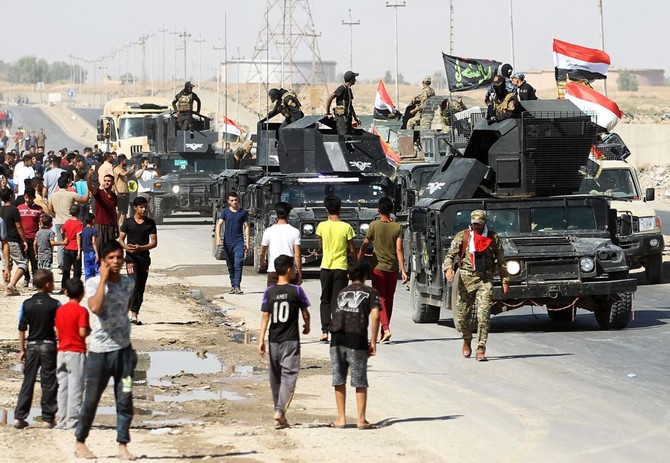
Iraqis gather as Iraqi forces arrive in the first neighborhood on the southern outskirts of Kirkuk on October 16, 2017. (AFP)
Updated 16 October 2017
Follow

Turkey says ready to help Iraq to oust Kurdish fighters

ANKARA: Turkey on Monday said it was ready to help the Iraqi government oust Kurdish fighters from the disputed city of Kirkuk.
Ankara fears independence moves by the Iraqi Kurdistan Regional Government (KRG) could spark similar moves by its own Kurdish minority.
“We are ready for any form of cooperation with the Iraqi government in order to end the PKK presence in Iraqi territory,” the Turkish foreign ministry said, referring to the Kurdistan Workers’ Party (PKK), which Ankara has outlawed.
Iraq’s National Security Council on Sunday said it viewed as a “declaration of war” the presence of “fighters not belonging to the regular security forces in Kirkuk,” including fighters from the PKK.
On Monday, Iraqi forces took control of a military airport near Kirkuk from Kurdish fighters.
Tensions have mounted since a controversial September 25 independence referendum, which irked Baghdad as well as neighboring Turkey and Iran.
Turkish authorities said Ankara would now talk to the central government in Baghdad rather than Iraqi Kurdish leaders, with whom they had forged close ties in the past.
The PKK, which has waged an insurgency inside Turkey since 1984, is listed as a terror group by Turkey and much of the international community including the United States.
The referendum was held in the three provinces of the autonomous Kurdish region and also in adjacent Kurdish-held areas, including Kirkuk, which are claimed by both Baghdad and Iraqi Kurdistan.
Turkey has fiercely opposed the referendum and slammed it as null and void.
“We are warning the (Kurdistan regional government) not to add to the grave mistakes it has made in recent times,” the foreign ministry said.
“Those who help the PKK terror group ... find safe haven in this region will be held responsible also by us.”


2025: The most successful year in Syrian history since 1970

Updated 6 sec ago
Follow

2025: The most successful year in Syrian history since 1970

  • First year without Bashar Assad brought sweeping diplomatic gains and sanctions relief
  • War-torn nation re-entered global forums, saw sanctions lifted even as scars persisted

LONDON: One year after the fall of Bashar Assad, Syrians are holding fast to hope as 2025 emerges as the country’s most diplomatically successful year in about five decades, marked by renewed international engagement and regional reintegration, even as the legacy of repression and war remains deeply etched into daily life.

The scale of that change is best understood against the longevity of the rule that preceded it. Modern Syria was shaped by more than five decades of Assad family dominance, beginning when Hafez Assad, then defense minister, seized power in a military coup on Nov. 16, 1970.

He formally became president in March 1971, inaugurating an era of centralized authority and political repression that would persist through his son’s presidency.

Over the following decades, Syria drifted deeper into rigid Cold War alignments, recurrent confrontations with its neighbors and, eventually, entrenched international isolation. That trajectory hardened under both Hafez and Bashar Assad, leaving little room for political reform and laying the groundwork for the uprising that erupted in 2011.

But today, post-Assad optimism was on display earlier this month, when thousands gathered in cities including Damascus, Homs, and Aleppo to mark the anniversary of Assad’s downfall.

In Damascus’s Umayyad Square, crowds danced to an Arabic song repeating the chorus, “Raise your head up high, you’re a free Syrian,” reflecting aspirations shaped by nearly 14 years of civil war.

Behind the public celebrations, analysts say Assad’s removal opened a rare historical window.

“Syria has opened a new chapter that many once thought impossible,” Nanar Hawach, a senior Syria analyst at the International Crisis Group, told Arab News. “Diplomatic ties are rebuilding, investment is returning, and the country is beginning to shake off years of isolation.”

Even so, he added, the country’s future hinges on developments at home. “To maintain this momentum, the government needs to focus internally: prioritizing day-to-day security and building trust with all communities.

“External support remains vital, but lasting peace will depend on Syrians feeling safe, included, and represented in the new order they are working to build.”

That view is shared by Comfort Ero, the ICG’s president and CEO. “Syria has made incredible strides forward on the international stage in the past year — forging partnerships, attracting funding and securing the easing of some of its most crippling sanctions,” she told Arab News. “But its future now depends on what happens at home.”

Indeed, the past year brought a wave of diplomatic normalization. Syria restored regional and international ties, saw US and European sanctions lifted or suspended, and rejoined major global forums.

The war-weary country reappeared at high-profile gatherings including the Arab League Summit in Baghdad, the Russian-Arab Summit, the World Economic Forum in Davos, and the Doha Forum.

That momentum culminated in November with interim President Ahmad Al-Sharaa’s visit to the White House, the first such visit by a Syrian leader since independence from France in 1946.

During the trip, Syria formally joined the US-led Global Coalition Against Daesh, days after the US Treasury removed Al-Sharaa, a former Al-Qaeda supporter who once had a $10 million bounty for his capture, from its Specially Designated Global Terrorist sanctions list.

Similarly, the UN Security Council adopted on Nov. 6 a US-backed resolution delisting Al-Sharaa and Interior Minister Anas Hasan Khattab, a move widely seen as a powerful signal of international recognition of Syria’s political transition.

These diplomatic gains followed the dramatic moment on Dec. 8, 2024, when Assad fled to Moscow as a coalition of rebel groups, led by Al-Sharaa, then-commander of the armed group Hayat Tahrir Al-Sham, seized Damascus in a lightning offensive.

Within two months, the new military command named Al-Sharaa transitional president, repealed the 2012 constitution, and dissolved the regime’s parliament, army, and security agencies.

In March, he signed a draft constitutional declaration establishing a five-year transitional period and announced a transitional cabinet.

Economic relief soon followed. The EU suspended major sanctions; the UK lifted asset freezes and most sanctions; and the US ended its comprehensive sanctions program and twice suspended the Caesar Act before permanently repealing it on Dec. 17 — a move many believe will facilitate foreign investment and speed reconstruction.

The Caesar Act had long blocked Syrian banks from accessing the global financial system, restricting external transfers and limiting correspondent banking relationships. Its repeal marked the culmination of a sustained diplomatic push led by Riyadh.

In May, during a high-level visit to Saudi Arabia, US President Donald Trump announced from Riyadh the lifting of sanctions on Syria and met the following day with Al-Sharaa. Around the same time, Saudi Arabia and Qatar paid off Syria’s $15.5 million World Bank debt.

Investment activity soon accelerated. In July and August, Syria had signed 47 investment agreements worth more than $6.4 billion with Saudi companies and secured $14 billion in deals with companies from Qatar, the UAE, Italy, and Turkiye, targeting transport, infrastructure, and real estate.

Opinion

This section contains relevant reference points, placed in (Opinion field)

Diplomatic engagement continued into the fall. In September, Al-Sharaa addressed the UN General Assembly — the first Syrian head of state to do so since 1967. He pledged accountability and national rebuilding.

While in New York, he held meetings across diplomatic and policy circles, including a highly symbolic discussion with former CIA director David Petraeus.

Assad’s fall and early signs of recovery have also encouraged many displaced people to return to their original towns and villages.

According to the UN Refugee Agency, more than 1.2 million Syrians have voluntarily returned from neighboring countries since December 2024, alongside nearly 1.9 million internally displaced people who have gone back to their home areas.

At the same time, Syrians with the means to do so are reopening small businesses and rebuilding homes, even without reliable public services and amid widespread destruction.

Marking the anniversary of Assad’s fall on Dec. 7, UN Secretary-General Antonio Guterres urged the international community to “stand firmly behind this Syrian-led, Syrian-owned transition,” stressing the need for sustained humanitarian support, fewer barriers to reconstruction, and backing for economic recovery.

“On this anniversary,” he said, “we stand united in purpose — to build a foundation of peace and prosperity and renew our pledge to a free, sovereign, united, and inclusive Syria.”