PARIS: Britain, Turkey and the African Union (AU) on Sunday strongly condemned the weekend suicide bombing in Somalia, the worst attack to date with at least 231 deaths.
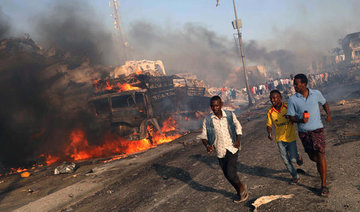
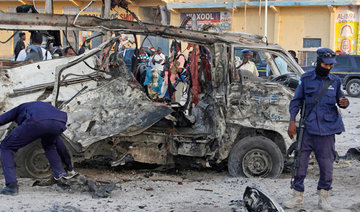
Saturday’s massive truck blast occurred at a junction in Hodan, a bustling commercial district of the capital Mogadishu, which has many shops, hotels and businesses.
British Foreign Secretary Boris Johnson said his country “condemns in the strongest terms the cowardly attacks in Mogadishu, which have claimed so many innocent lives.”
Moussa Faki Mahamat, the chairman of the African Union Commission asked the government “to show renewed unity at this critical time and overcome divisions, to rebuild cohesion at all levels of the federal institutions.”
It said the pan-African body, which has deployed a peacekeeping mission in the east African country, would “continue its support to the Somali government and people in their efforts to achieve sustainable peace and security.”
Turkish President Recep Tayyip Erdogan’s spokesman Ibrahim Kalin said Ankara was sending planes “with medical supplies,” adding that the wounded would be flown to Turkey and treated there.
Somalia’s government blamed the Al-Qaeda-linked Al-Shabab group for what it called a “national disaster.”
President Mohamed Abdullahi Mohamed declared three days of mourning and joined thousands of people who responded to a desperate plea by hospitals to donate blood.


![]()


Outrage over Somalia blast horror
Outrage over Somalia blast horror

Taiwan to send team to assess US rare earth deposits
TAIPEI: Taiwan plans to send officials to assess US rare earths deposits with a goal to have such minerals refined on the island, Economy Minister Kung Ming-hsin said on Wednesday.
President Donald Trump’s administration has stepped up efforts to secure US supplies of critical minerals after China rattled senior officials and global markets last year by withholding rare earths required by American automakers and other industrial manufacturers.
Trump last week launched a US strategic stockpile of critical minerals, called Project Vault, backed by $10 billion in seed funding from the US Export-Import Bank and $2 billion in private funding.
While semiconductor powerhouse Taiwan is not formally part of that scheme, it has previously held talks with the United States on how it can help, given Taipei’s concerns about over-reliance on a China-centric supply chain.
China views Taiwan as its own territory and has stepped up its military threats.
Speaking to reporters in Taipei, Kung said the ministry’s Geological Survey and Mining Management Agency would go to the United States to assess rare earths deposits there.
“Specifically, what rare-earth elements they contain and whether they are suitable. In other words, whether those are the rare earths we actually need. So we still need to investigate,” he said.
Given Taiwan does not mine such elements itself, it can instead play a role in refining the materials from other countries, Kung added.
“The technology is not an issue; the next step is scaling up,” he said.
Taiwan consumes 1,500 metric tons of rare earth annually, a figure projected to rise to 2,000 metric tons given economic growth, Kung added.
“Our goal is to expand production capacity to meet half of our demand by then, strengthening the supply chain.
President Donald Trump’s administration has stepped up efforts to secure US supplies of critical minerals after China rattled senior officials and global markets last year by withholding rare earths required by American automakers and other industrial manufacturers.
Trump last week launched a US strategic stockpile of critical minerals, called Project Vault, backed by $10 billion in seed funding from the US Export-Import Bank and $2 billion in private funding.
While semiconductor powerhouse Taiwan is not formally part of that scheme, it has previously held talks with the United States on how it can help, given Taipei’s concerns about over-reliance on a China-centric supply chain.
China views Taiwan as its own territory and has stepped up its military threats.
Speaking to reporters in Taipei, Kung said the ministry’s Geological Survey and Mining Management Agency would go to the United States to assess rare earths deposits there.
“Specifically, what rare-earth elements they contain and whether they are suitable. In other words, whether those are the rare earths we actually need. So we still need to investigate,” he said.
Given Taiwan does not mine such elements itself, it can instead play a role in refining the materials from other countries, Kung added.
“The technology is not an issue; the next step is scaling up,” he said.
Taiwan consumes 1,500 metric tons of rare earth annually, a figure projected to rise to 2,000 metric tons given economic growth, Kung added.
“Our goal is to expand production capacity to meet half of our demand by then, strengthening the supply chain.
Latest updates


Recommended


© 2026 SAUDI RESEARCH & PUBLISHING COMPANY, All Rights Reserved And subject to Terms of Use Agreement.