

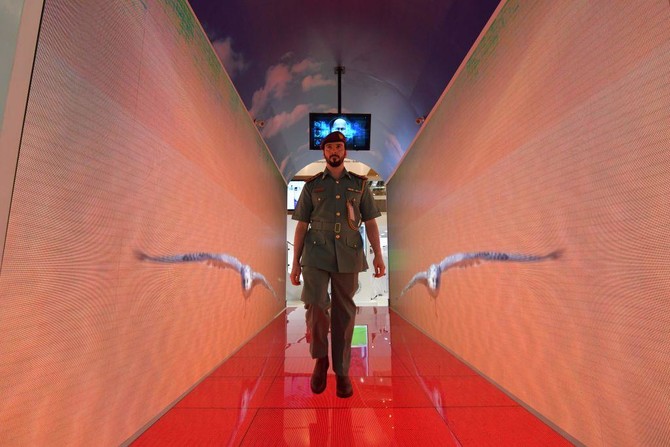
Dubai’s futuristic border and security control would be a virtual aquarium

A policeman walks through a security tunnel at the Gitex 2017 exhibition. (AFP)
Updated 15 October 2017
Follow

Dubai’s futuristic border and security control would be a virtual aquarium

DUBAI: Paperless government transactions. Smart pedestrians. Self-driving police patrols. Autonomous taxis.
These are just some of the objectives Sheikh Mohammed bin Rashid Al-Maktoum, the Ruler of Dubai, has envisioned under the Smart Dubai initiative for residents and visitors to have an impactful experience during their stay in the emirate.
And Dubai wants residents and visitors to experience this futuristic vision starting right at the airport, as it unveiled concepts for a contactless security and border control at Gitex Technology Week.

Dubai Airport, no stranger to early adoption of new and innovative technologies such as e-gates, wants to set the bar higher with the introduction of walk-through “biometric borders” in lieu of security controls and passport controls.
The virtual aquarium tunnel, teeming with digital aquatic sea life, will have 80 in-built, non-intrusive cameras to scan the faces of residents and visitors for security clearances. The tunnels will operational by late 2018 at Dubai International Airport’s Terminal 3, with other terminals being fitted with them by 2020.
The smart lanes would allow passenger to check-in less in that 10 seconds, the Dubai Media Office said in a Twitter post.


Apple to update EU browser options, make more apps deletable

Updated 22 August 2024
Follow

Apple to update EU browser options, make more apps deletable

  • iPhone maker came under pressure from regulators to make changes after the EU’s sweeping Digital Markets Act took effect on March 7
  • Apple users will be able to select a default browser directly from the choice screen after going through a mandatory list of options

STOCKHOLM: Apple will change how users choose browser options in the European Union, add a dedicated section for changing default apps, and make more apps deletable, the company said on Thursday.
The iPhone maker came under pressure from regulators to make changes after the EU’s sweeping Digital Markets Act took effect on March 7, forcing big tech companies to offer mobile users the ability to select from a list of available web browsers on a “choice screen.”
The new rules require mobile software makers to show the choice screen where users can select a browser, search engine and virtual assistant as they set up their phones, which earlier came with preferred options from Apple and Google.
In an update later this year, Apple users will be able to select a default browser directly from the choice screen after going through a mandatory list of options.
A randomly ordered list of 12 browsers per EU country will be shown to the user with short descriptions, and the chosen one will be automatically downloaded, Apple said. The choice screen will also be available on iPads through an update later this year.
Apple released a previous update in response to the new rules in March, but browser companies criticized the design of its choice screen, and the Commission opened an investigation on March 25 saying it suspected that the measures fell short of effective compliance.
The company said it has been in dialogue with the European Commission and believes the new changes will address regulators’ concerns.
It also plans to introduce a dedicated area for default apps where a user will be able to set defaults for messaging, phone calls, spam filters, password managers and keyboards.
Users will also be able to delete certain Apple-made apps such as App Store, Messages, Camera, Photos and Safari. Only Settings and Phone apps would not be deletable.