LOS ANGELES: One evening filmmaker Theo Anthony noticed an unnervingly large brown rat trapped in his trash can, trying repeatedly but in vain to escape a receptacle specifically designed to contain it.
“I came home, heard this sound and went to my iPhone and started filming,” the Baltimore-based director says of the incident, the basis for “Rat Film,” his essay on the city’s war with its rodent population — and its problematic history of racial segregation.
“I had this piece of footage and I had no idea what it was going to be... It was just this really haunting image.”
Brown rats — otherwise known as Norway, wharf or sewer rats — are thought to have spread across the world from China in the Middle Ages and can grow to the size of a domestic cat.
They have thrived in America’s garbage-strewn east coast cities but their relationship with humans is hardly symbiotic: they get food and shelter while we get chewed cables, parasites and the Black Death.
US television channel Animal Planet named Baltimore the third most rat-plagued city on Earth in 2014, behind two other US destinations, Boston and New York.
A post-industrial Rust Belt town built for one million people, Baltimore is actually underpopulated, with large swaths of its housing boarded up and abandoned — making it a paradise for rats.
The rodent population swelled from fewer than 10 rats per 1,000 residents in 2002 to 60 in 2009, according to local government figures uncovered by Karen Houppert writing for The Washington Post.
A Baltimore City Health Department report that year noted “the rodent infestation rate in Baltimore is six times the national average,” Houppert wrote in her 2013 article.
“Rat Film” — which gets its theatrical release this weekend in Los Angeles, having toured the worldwide festival circuit — is much more than a film about rats.
The feature-length debut for 27-year-old Anthony, it invites audiences to see Baltimore’s infestation as a corollary of the urban neglect caused by racist housing policies.
Anthony grew up in nearby Annapolis but lived in Baltimore for years before a recent move to upstate New York, and still keeps a room in the city.
It was the first city in early 20th century America to pass a residential segregation law — later scrapped by the Supreme Court — restricting blacks and whites to certain parts of the city.
“Ain’t never been a rat problem in Baltimore; it’s always been a people problem,” says one of his subjects, a wise and wizened rat exterminator who notes that the critters thrive in poor housing areas.
Fusing old photographs, poetry, 3D simulations and interviews with an eccentric assortment of rodent lovers and rat killers, the filmmaker charts Baltimore’s efforts to confront its pest problem since the 1930s.
His insight is that population control and rat control appeared to be enmeshed in the city’s development, with poor, rat-infested areas “redlined” by insurers as forever undesirable.
The filmmaker highlights the historical city government practice of denying home and business loans to people living in majority-black neighborhoods.
City officials, he demonstrates, were using the same language in the 1930s to talk about the “infiltration” of black populations as they do now to talk about rats.
To underline his point, Anthony lays statistical maps of present-day Baltimore’s unemployment and mortality rates over a racial segregation map from 80 years ago, showing how accurately they dovetail.
He discovered that medical research being carried out in some of the most impoverished sectors led to Curt Richter, a biologist at Johns Hopkins University, inventing the first-ever effective rat poison.
Back in the present day, we meet a pair of “rat fishermen,” who use meat and peanut butter on the end of a fishing line to catch rats in alleyways.
Elsewhere, a rat hunter proudly shows off his armament of pellet guns, and we are introduced to a homeless duo freestyling a poem about hating rats, as well as a snake handler who uses baby rats for food.
“I’m not like a pro-rat advocate or against them. I think there’s a lot of violence toward rats in my film that I have a lot of mixed feelings about in hindsight,” Anthony tells AFP.
“But I have a lot of respect for them and I think they are really adorable and cute. If I was in one place for more than a week at a time I’d probably have a pet rat.”


‘Rat Film’ highlights Baltimore’s rodents, racism
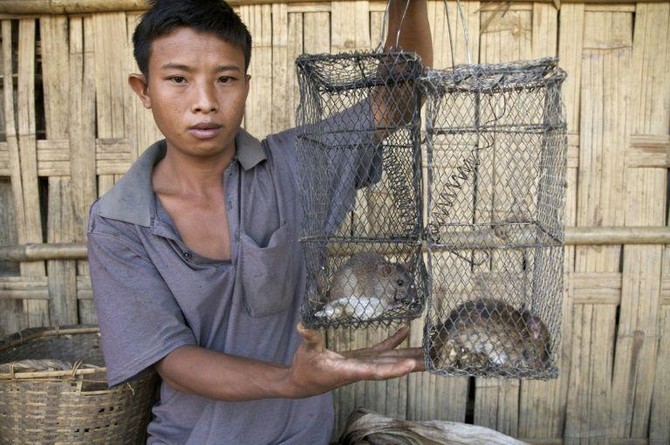
‘Rat Film’ highlights Baltimore’s rodents, racism

These shy, scaly anteaters are the most trafficked mammals in the world
CAPE TOWN, South Africa: They are hunted for their unique scales, and the demand makes them the most trafficked mammal in the world.
Wildlife conservationists are again raising the plight of pangolins, the shy, scaly anteaters found in parts of Africa and Asia, on World Pangolin Day on Saturday.
Pangolins or pangolin products outstrip any other mammal when it comes to wildlife smuggling, with more than half a million pangolins seized in anti-trafficking operations between 2016 and 2024, according to a report last year by CITES, the global authority on the trading of endangered plant and animal species.
The World Wildlife Fund estimates that over a million pangolins were taken from the wild over the last decade, including those that were never intercepted.
Pangolins meat is a delicacy in places, but the driving force behind the illegal trade is their scales, which are made of keratin, the protein also found in human hair and fingernails. The scales are in high demand in China and other parts of Asia due to the unproven belief that they cure a range of ailments when made into traditional medicine.
There are eight pangolin species, four in Africa and four in Asia. All of them face a high, very high or extremely high risk of extinction.
While they’re sometimes known as scaly anteaters, pangolins are not related in any way to anteaters or armadillos.
They are unique in that they are the only mammals covered completely in keratin scales, which overlap and have sharp edges. They are the perfect defense mechanism, allowing a pangolin to roll up into an armored ball that even lions struggle to get to grip with, leaving the nocturnal ant and termite eaters with few natural predators.
But they have no real defense against human hunters. And in conservation terms, they don’t resonate in the way that elephants, rhinos or tigers do despite their fascinating intricacies — like their sticky insect-nabbing tongues being almost as long as their bodies.
While some reports indicate a downward trend in pangolin trafficking since the COVID-19 pandemic, they are still being poached at an alarming rate across parts of Africa, according to conservationists.
Nigeria is one of the global hot spots. There, Dr. Mark Ofua, a wildlife veterinarian and the West Africa representative for the Wild Africa conservation group, has rescued pangolins for more than a decade, which started with him scouring bushmeat markets for animals he could buy and save. He runs an animal rescue center and a pangolin orphanage in Lagos.
His mission is to raise awareness of pangolins in Nigeria through a wildlife show for kids and a tactic of convincing entertainers, musicians and other celebrities with millions of social media followers to be involved in conservation campaigns — or just be seen with a pangolin.
Nigeria is home to three of the four African pangolin species, but they are not well known among the country’s 240 million people.
Ofua’s drive for pangolin publicity stems from an encounter with a group of well-dressed young men while he was once transporting pangolins he had rescued in a cage. The men pointed at them and asked him what they were, Ofua said.
“Oh, those are baby dragons,” he joked. But it got him thinking.
“There is a dark side to that admission,” Ofua said. “If people do not even know what a pangolin looks like, how do you protect them?”


