WASHINGTON: President Donald Trump has kicked the fate of the landmark Iran nuclear deal to the US Congress, ignoring the advice of worried allies as he vowed to confront the “fanatical regime” in Tehran.
Trump defended his decision to “decertify” Iran’s compliance with the 2015 agreement in a speech Friday that evoked US grievances dating back to the 1979 Islamic Revolution.
He railed against the “Iranian dictatorship, its sponsorship of terrorism, and its continuing aggression in the Middle East and all around the world.”
And he warned he could rip up the 2015 agreement curbing Iran’s nuclear program “at any time,” saying it had failed to address Iranian subversion in its region and its illegal missile program.
Reaction to the US move came fast and furious, with Iranian President Hassan Rouhani declaring the United States was “more than ever against the Iranian people.”
Former US secretary of state John Kerry, who negotiated the nuclear deal, accused Trump of “creating an international crisis” and called on the US Congress to stand in the president’s way.
“It endangers America’s national security interests and those of our closest allies,” Kerry said.
In a cautious but unmistakable rebuke, the leaders of Britain, France and Germany said the deal remained in “our shared national security interest.”
“We encourage the US administration and Congress to consider the implications to the security of the US and its allies before taking any steps that might undermine” the deal.
French President Emmanuel Macron later said he was considering visiting Iran after speaking by phone with his Iranian counterpart.
The International Campaign to Abolish Nuclear Weapons, which was awarded this year’s Nobel Peace Prize, also denounced the move, saying it makes proliferation more likely.
Trump stopped short of scrapping the deal outright, however, leaving Congress and US allies some room for maneuver.
The Republican-controlled Congress now has 60 days to decide whether to reimpose sanctions on Iran — a step that if taken would almost certainly doom the accord.
The US president said he supports efforts in Congress to work on new measures to address the broader threats posed by Iran without immediately torpedoing the nuclear deal.
“However, in the event we are not able to reach a solution working with Congress and our allies, then the agreement will be terminated,” Trump said, in a televised address from the Diplomatic Room of the White House.
Proposals by Republican Senators Tom Cotton and Bob Corker to introduce “trigger points” for new sanctions and extend sanctions beyond a pre-agreed deadline have spooked allies, who believe it could breach the accord.
But it remains unclear if their proposals can garner the 60 votes need to pass the Senate.
Trump also backed away from designating Iran’s powerful Revolutionary Guards Corps as a terror group, a move that would have triggered sanctions and almost certain Iranian retribution.
Apart from running swaths of Iran’s economy and Iran’s ballistic missile program, the Revolutionary Guards are accused of guiding proxy forces across the region, from Hezbollah in Lebanon, to the Houthis in Yemen and Shiite militias in Iraq and Syria.
“We have considered that there are particular risks and complexities to designating an entire army, so to speak, of a country,” Secretary of State Rex Tillerson said.
Instead, the US Treasury said it had taken action against the Islamic Revolutionary Guards under a 2001 executive order to hit sources of terror funding and added four companies that allegedly support the group to its sanctions list.
Trump has repeatedly pledged to overturn one of his predecessor Barack Obama’s crowning foreign policy achievements, deriding it as “the worst deal” and one agreed to out of “weakness.”
The agreement stalled Iran’s nuclear program and marginally thawed relations between Iran and what Tehran dubs the “Great Satan,” but opponents, and even some supporters, say it also prevented efforts to challenge Iranian influence across the Middle East.
Since coming to office, Trump has faced intense lobbying from international allies and much of his own national security team, who argue the nuclear deal should remain in place.
Both the US government and UN nuclear inspectors say Iran is meeting the technical requirements of its side of the bargain, dramatically curtailing its nuclear program in exchange for sanctions relief.
Trump claimed support for his move in a tweet late Friday, while suggesting that his critics among US allies were placing trade profits ahead of security.
“Many people talking, with much agreement, on my Iran speech today. Participants in the deal are making lots of money on trade with Iran!” he wrote on Twitter.


Trump kicks fate of Iran nuclear deal to Congress
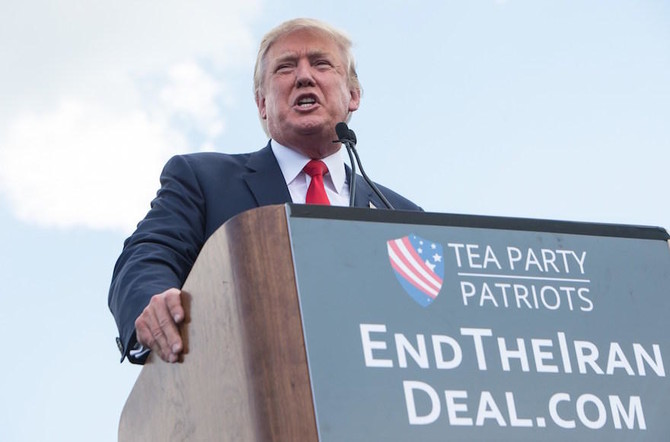
Trump kicks fate of Iran nuclear deal to Congress

Trump pivots to new 10 percent global tariff, new probes after Supreme Court setback
WASHINGTON: US President Donald Trump moved swiftly on Friday to replace tariffs struck down by the Supreme Court with a temporary 10 percent global import duty for 150 days while opening investigations under other laws that could allow him to re-impose the tariffs.
Trump told a briefing he was ordering new tariffs under Section 122 of the Trade Act of 1974, duties that would go on top of surviving tariffs. These would partly replace tariffs of 10 percent to 50 percent under the 1977 International Emergency Economic Powers Act that the top court declared illegal.
Trump said later on Truth Social that he had signed an order for the tariffs on all countries “which will be effective almost immediately.”
A spokesperson for the US Customs and Border Protection agency declined comment when asked when collections of the illegal IEEPA tariffs would halt at ports of entry.
Trump’s Treasury Secretary, Scott Bessent, said the new 10 percent duties and potentially enhanced tariffs under the Section 301 unfair practices statute and the Section 232 national security statute would result in virtually unchanged tariff revenue in 2026.
“We will get back to the same tariff level for the countries. It will just be in a less direct and slightly more convoluted manner,” Bessent told Fox News, adding that the Supreme Court decision had reduced Trump’s negotiating leverage with trading partners.
The never-used Section 122 authority allows the president to impose duties of up to 15 percent for up to 150 days on any and all countries to address “large and serious” balance of payments issues. It does not require investigations or impose other procedural limits. After 150 days, Congress would need to approve their extension.
“We have alternatives, great alternatives,” Trump said. “Could be more money. We’ll take in more money and we’ll be a lot stronger for it,” Trump said of the alternative tools.
While the administration will likely face legal challenges, the Section 122 tariffs would lapse before any final ruling could be made, said Josh Lipsky, international economics chair at the Atlantic Council, a think tank in Washington.
Trump said his administration also was initiating several new country-specific investigations under Section 301 of the Trade Act of 1974 “to protect our country from unfair trading practices of other countries and companies.”
Trump’s shift to other statutes, including Section 122, while initiating new investigations under Section 301 had been widely anticipated, but these have often taken a year to complete.
The 10 percent tariffs only last five months, but Trump said that would allow his administration to complete investigations to enhance tariffs.
Asked if rates would ultimately end up being higher after more probes, Trump said: “Potentially higher. It depends. Whatever we want them to be.”
He said some countries “that have treated us really badly for years” could see higher tariffs, whereas for others, “it’s going to be very reasonable for them.”
The fate of dozens of trade deals to cut IEEPA-based duties and negotiations with major US trading partners remained unclear in the wake of the ruling, though Trump said he expected many of them to continue. He said deals that are abandoned “will be replaced with the other tariffs.”
“This is unlikely to affect reciprocal trade negotiations with our trading partners,” said Tim Brightbill, trade partner with the law firm Wiley Rein in Washington. “Most countries would prefer the certainty of a trade deal to the chaos of last year.”
US Trade Representative Jamieson Greer said details on new Section 301 investigations would be revealed in coming days, adding these are “incredibly legally durable.” Trump relied on Section 301 to impose broad tariffs on Chinese imports during his first term.
The Supreme Court’s ruling puts about $175 billion in tariff revenue collected over the past year subject to potential refunds, according to estimates provided to Reuters by Penn-Wharton Budget Model economists.
Asked if he would refund the IEEPA duties, Trump said, “I guess it has to get litigated for the next two years,” a response indicating that a quick, automatic refund process was unlikely.
Speaking in Dallas, Bessent told business leaders that since the Supreme Court did not provide any instructions on refunds, those were “in dispute,” adding: “My sense is that could be dragged out for weeks, months, years.”
Part of the reason why Trump opted for IEEPA to impose tariffs last year was because the 1977 sanctions statute allowed fast and broad action with almost no constraints. Until Friday, he had also used it as a cudgel to swiftly punish countries over non-trade disputes, such as Brazil’s prosecution of former president and Trump ally Jair Bolsonaro.
While Trump’s new investigations will prolong tariff uncertainty, they could inject more order into his tariff policy by forcing him to rely on trade laws that have well-understood procedures, research and public comment requirements, and longer timelines, said Janet Whittaker, senior counsel with Clifford Chance in Washington.
“The administration will need to follow these set processes, conduct the investigations, and so for businesses, that means more visibility into the process,” Whittaker said.
Robert Lighthizer, Trump’s trade chief during his first term, said on Fox News that he hoped Congress would revise decades-old trade laws to give Trump new tariff tools.
“I think there’s consensus in this Congress that we have to change the old system, and I hope that they will take this as an opportunity to do that,” Lighthizer said.


