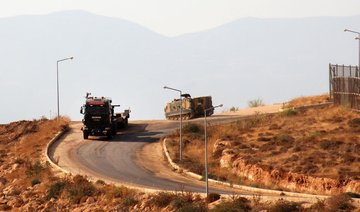
ANKARA: Following days of reconnaissance activities in Idlib, some 100 Turkish soldiers — including commandoes — set foot in the Syrian province Thursday night with armored vehicles, tanks and artillery as part of Ankara’s attempts to establish a “de-escalation zone” there.
As a first step, the Turkish military will begin establishing observation posts to implement the de-escalation zone, as per the Astana agreement brokered on Sept. 16 between Turkey, Russia and Iran.
Turkish President Recep Tayyip Erdogan said Friday: “Turkey shares a border with Idlib, so we should take our own measures. It is us who are under constant abuse and threat.” Idlib is dominated by Hayat Tahrir Al-Sham (HTS), which rejects the Astana process.
The Turkish military said its mission is to establish, monitor and maintain a cease-fire, deliver humanitarian aid to civilians and help the displaced return home.
The military is set to establish 14 observation posts in Idlib, and will provide security for NGOs to deliver humanitarian aid.
During this open-ended operation, Turkish troops are not expected to launch a ground offensive. They will only support the Free Syrian Army (FSA) in case the Astana deal is violated.
Turkey, Iran and Russia will send 500 observers each to Idlib to monitor the de-escalation agreement.
Turkey’s previous Operation Euphrates Shield in northern Syria targeted Daesh, but this time the target is HTS.
Another aim is to stop the Syrian-Kurdish People’s Protection Units (YPG), which Ankara considers an extension of the outlawed Kurdistan Workers’ Party (PKK), from gaining access to the Mediterranean and expanding their sphere of influence.
Murat Yesiltas, a Middle East expert at the Ankara-based think tank SETA, said the deployment phase has not experienced any logistical or military problems so far, and the mission seems to be going smoothly.
“The presence and military dominance of HTS in Idlib is the most likely local parameter to challenge the mission,” he told Arab News.
“Especially after the splinter group Ansar Al-Furqan’s announcement that it will fight any ‘invader force,’ there’s considerable risk of a fight in the medium term.”
Yesiltas said since the emergence of a Daesh pocket in southeast Idlib in recent days, there is a risk of the group sabotaging the de-escalation zone and targeting Turkish troops via cells.
Nursin Atesoglu Guney, dean of the faculty of economics, administrative and social sciences at Bahcesehir Cyprus University, told Arab News: “Turkey entered Idlib not as a warring party but as a peacekeeping actor. The aim is to consolidate our presence there and sit at the negotiation table along with opposition groups at the political resolution stage.”
Yesiltas agrees: “Turkey’s exit strategy consists of maintaining the de-escalation zone and thus stability in Idlib first. The elimination of the YPG threat from Afrin via military force should follow if necessary. The last phase would be negotiations with the Assad regime for an ultimate solution to the Syrian conflict.”
Guney said: “The stance of the US, which is active east of the Euphrates River via the YPG, will determine activity on the ground. Turkey’s experience acquired during Euphrates Shield will help it coordinate its military efforts with local realities and diplomatic contacts.”


![]()


What challenges for Turkish forces in Idlib?
What challenges for Turkish forces in Idlib?


Sudanese trek through mountains to escape Kordofan fighting
- For eight days, Sudanese farmer Ibrahim Hussein led his family through treacherous terrain to flee the fighting in southern Kordofan — the latest and most volatile front in the country’s 31-month-old
PORT SUDAN: For eight days, Sudanese farmer Ibrahim Hussein led his family through treacherous terrain to flee the fighting in southern Kordofan — the latest and most volatile front in the country’s 31-month-old conflict.
“We left everything behind,” said the 47-year-old, who escaped with his family of seven from Keiklek, near the South Sudanese border.
“Our animals and our unharvested crops — all of it.”
Hussein spoke to AFP from Kosti, an army-controlled city in White Nile state, around 300 kilometers (186 miles) south of Khartoum.
The city has become a refuge for hundreds of families fleeing violence in oil-rich Kordofan, where the Sudanese army and the Rapid Support Forces (RSF) — locked in a brutal war since April 2023 — are vying for control.
Emboldened by their October capture of the army’s last stronghold in Darfur, the RSF and their allies have in recent weeks descended in full force on Kordofan, forcing nearly 53,000 people to flee, according to the United Nations.
“For most of the war, we lived in peace and looked after our animals,” Hussein said.
“But when the RSF came close, we were afraid fighting would break out. So we left, most of the way on foot.”
He took his family through the rocky spine of the Nuba Mountains and the surrounding valley, passing through both paramilitary and army checkpoints.
This month, the RSF consolidated its grip on West Kordofan — one of three regional states — and seized Heglig, which lies on Sudan’s largest oil field.
With their local allies, they have also tightened their siege on the army-held cities of Kadugli and Dilling, where hundreds of thousands face mass starvation.
- Running for their lives -
In just two days this week, nearly 4,000 people arrived in Kosti, hungry and terrified, said Mohamed Refaat, Sudan chief of mission for the UN’s International Organization for Migration.
“Most of those arriving are women and children. Very few adult men are with them,” he told AFP, adding that many men stay behind “out of fear of being killed or abducted.”
The main roads are unsafe, so families are taking “long and uncertain journeys and sleeping wherever they can,” according to Mercy Corps, one of the few aid agencies operating in Kordofan.
“Journeys that once took four hours now force people to walk for 15 to 30 days through isolated areas and mine-littered terrain,” said Miji Park, interim country director for Sudan.
This month, drones hit a kindergarten and a hospital in Kalogi in South Kordofan, killing 114 people, including 63 children, according to the World Health Organization.
Adam Eissa, a 53-year-old farmer, knew it was time to run. He took his wife, four daughters and elderly mother — all crammed into a pickup truck with 30 others — and drove for three days through “backroads to avoid RSF checkpoints,” he told AFP from Kosti.
They are now sheltering in a school-turned-shelter housing around 500 displaced people.
“We receive some help, but it is not enough,” said Eissa, who is trying to find work in the market.
According to the IOM’s Refaat, Kosti — a relatively small city — is already under strain. It hosts thousands of South Sudanese refugees, themselves fleeing violence across the border.
It cost Eissa $400 to get his family to safety. Anyone who does not have that kind of money — most Sudanese, after close to three years of war — has to walk, or stay behind.
Those left behind
According to Refaat, transport prices from El-Obeid in North Kordofan have increased more than tenfold in two months, severely “limiting who can flee.”
In besieged Kadugli, 56-year-old market trader Hamdan is desperate for a way out, “terrified” that the RSF will seize the city.
“I sent my family away a while ago with my eldest son,” he told AFP via satellite Internet connection, asking to be identified only by his first name. “Now I am looking for a way to leave.”
Every day brings “the sound of shelling and sometimes gunfire,” said Kassem Eissa, a civil servant and head of a family of eight.
“I have three daughters, the youngest is 14,” he told AFP, laying out an impossible choice: “Getting out is expensive and the road is unsafe” but “we’re struggling to get enough food and medicine.”
The UN has issued repeated warnings of the violence in Kordofan, raising fears of atrocities similar to those reported in the last captured city in Darfur, including summary executions, abductions and rape.
“If a ceasefire is not reached around Kadugli,” Refaat said, “the scale of violence we saw in El-Fasher could be repeated.”
“We left everything behind,” said the 47-year-old, who escaped with his family of seven from Keiklek, near the South Sudanese border.
“Our animals and our unharvested crops — all of it.”
Hussein spoke to AFP from Kosti, an army-controlled city in White Nile state, around 300 kilometers (186 miles) south of Khartoum.
The city has become a refuge for hundreds of families fleeing violence in oil-rich Kordofan, where the Sudanese army and the Rapid Support Forces (RSF) — locked in a brutal war since April 2023 — are vying for control.
Emboldened by their October capture of the army’s last stronghold in Darfur, the RSF and their allies have in recent weeks descended in full force on Kordofan, forcing nearly 53,000 people to flee, according to the United Nations.
“For most of the war, we lived in peace and looked after our animals,” Hussein said.
“But when the RSF came close, we were afraid fighting would break out. So we left, most of the way on foot.”
He took his family through the rocky spine of the Nuba Mountains and the surrounding valley, passing through both paramilitary and army checkpoints.
This month, the RSF consolidated its grip on West Kordofan — one of three regional states — and seized Heglig, which lies on Sudan’s largest oil field.
With their local allies, they have also tightened their siege on the army-held cities of Kadugli and Dilling, where hundreds of thousands face mass starvation.
- Running for their lives -
In just two days this week, nearly 4,000 people arrived in Kosti, hungry and terrified, said Mohamed Refaat, Sudan chief of mission for the UN’s International Organization for Migration.
“Most of those arriving are women and children. Very few adult men are with them,” he told AFP, adding that many men stay behind “out of fear of being killed or abducted.”
The main roads are unsafe, so families are taking “long and uncertain journeys and sleeping wherever they can,” according to Mercy Corps, one of the few aid agencies operating in Kordofan.
“Journeys that once took four hours now force people to walk for 15 to 30 days through isolated areas and mine-littered terrain,” said Miji Park, interim country director for Sudan.
This month, drones hit a kindergarten and a hospital in Kalogi in South Kordofan, killing 114 people, including 63 children, according to the World Health Organization.
Adam Eissa, a 53-year-old farmer, knew it was time to run. He took his wife, four daughters and elderly mother — all crammed into a pickup truck with 30 others — and drove for three days through “backroads to avoid RSF checkpoints,” he told AFP from Kosti.
They are now sheltering in a school-turned-shelter housing around 500 displaced people.
“We receive some help, but it is not enough,” said Eissa, who is trying to find work in the market.
According to the IOM’s Refaat, Kosti — a relatively small city — is already under strain. It hosts thousands of South Sudanese refugees, themselves fleeing violence across the border.
It cost Eissa $400 to get his family to safety. Anyone who does not have that kind of money — most Sudanese, after close to three years of war — has to walk, or stay behind.
Those left behind
According to Refaat, transport prices from El-Obeid in North Kordofan have increased more than tenfold in two months, severely “limiting who can flee.”
In besieged Kadugli, 56-year-old market trader Hamdan is desperate for a way out, “terrified” that the RSF will seize the city.
“I sent my family away a while ago with my eldest son,” he told AFP via satellite Internet connection, asking to be identified only by his first name. “Now I am looking for a way to leave.”
Every day brings “the sound of shelling and sometimes gunfire,” said Kassem Eissa, a civil servant and head of a family of eight.
“I have three daughters, the youngest is 14,” he told AFP, laying out an impossible choice: “Getting out is expensive and the road is unsafe” but “we’re struggling to get enough food and medicine.”
The UN has issued repeated warnings of the violence in Kordofan, raising fears of atrocities similar to those reported in the last captured city in Darfur, including summary executions, abductions and rape.
“If a ceasefire is not reached around Kadugli,” Refaat said, “the scale of violence we saw in El-Fasher could be repeated.”
Latest updates


© 2025 SAUDI RESEARCH & PUBLISHING COMPANY, All Rights Reserved And subject to Terms of Use Agreement.