Baghdad launches Kirkuk operation as Kurd fighters mobilize

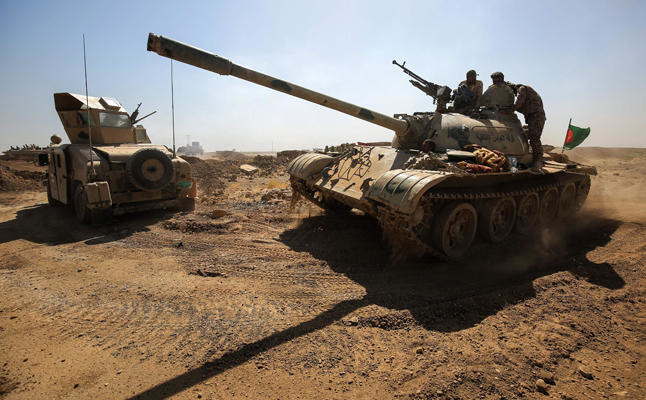
Tanks and vehicles of the combined Iraqi forces and Hashed al-Shaabi (Popular Mobilization) paramilitaries are seen on the advance towards villages between the northern Iraqi cities of Hawija and Kirkuk on October 6, 2017, after retaking Hawija from Daesh fighters a day before. (AFP / AHMAD AL-RUBAYE)
Updated 13 October 2017
Follow

Baghdad launches Kirkuk operation as Kurd fighters mobilize

KIRKUK, Iraq: The Iraqi army launched an operation to retake Kurdish-held positions around the disputed oil city of Kirkuk on Friday amid a bitter row with the Kurds over a vote for independence last month.
A senior Kurdish official said thousands of heavily armed fighters had been deployed to resist the offensive “at any cost” and called for international intervention with the federal government in Baghdad to prevent the confrontation worsening.
The Iraqi army and the Kurdish peshmerga have been key allies of the US-led coalition in its fight against the Daesh group and the threat of armed clashes between them poses a major challenge for Western governments.
Ethnically divided but historically Kurdish-majority Kirkuk is one of several regions that peshmerga fighters took over from the Iraqi army in 2014 when the jihadists swept through much of northern and western Iraq.
Baghdad is bitterly opposed to Kurdish ambitions to incorporate the oil-rich province in its autonomous region in the north and has voiced determination to take it back.
“The Iraqi armed forces are advancing to retake their military positions that were taken over during the events of June 2014,” an army general told AFP by telephone, asking not to be identified.
He said federal troops had already taken one base west of Kirkuk on Friday morning after peshmerga fighters withdrew during the night without a fight.
The peshmerga’s Kirkuk commander, Sheikh Jaafar Mustafa, said his forces had withdrawn from areas they had recently entered during fighting against Daesh in the west of the province.
“We withdrew to our lines in the area around Kirkuk and we will defend the city in the event of an attack,” he told a news conference.
“If the Iraqi army advances, we will fight.”
Kurdish media reported that the peshmerga had withdrawn from around 72 square kilometers (28 square miles) of territory.
Sheikh Mustafa said there had been an attempt to negotiate an agreed disengagement of forces through Iraqi Prime Minister Haider Al-Abadi but it had been overruled by field commanders.
“We informed the military commanders on the ground that we were in touch (with Abadi) and that he said our problems would be settled by dialogue within 48 hours,” he said.
“But the military commanders retorted that they had orders to advance in these areas and that they were not worried about statements from Mr. Abadi.”
Spokesmen for the prime minister declined to comment when contacted by AFP.
A top aide to Iraqi Kurdish leader Masoud Barzani vowed that peshmerga forces would defend their positions “at any cost.”
“Thousands of heavily armed peshmerga units are now completely in their positions around Kirkuk,” Hemin Hawrami said.
“Their order is to defend at any cost.”
The Kurdish authorities accused the Popular Mobilization Forces (PMF) — paramilitary units dominated by Iran-trained Shiite militia — of massing fighters in two mainly Shiite Turkmen areas south of Kirkuk in readiness for an attack.
Hawrami urged the international community to intervene and call on the Iraqi prime minister to “order PMF to pull back if he can or if they listen to him.”
The PMF published photographs of one its fighters making a victory sign in front of a Kurdish flag.
In Kirkuk, long queues formed at petrol stations Friday as motorists rushed to fill up, an AFP correspondent reported.
In Kurdish neighborhoods of the city, witnesses said there were armed civilians on the streets.
The surge in tensions comes two weeks after Kurdish voters overwhelmingly backed independence in a non-binding referendum that the federal government condemned as illegal.
Polling was held in the three provinces that have long formed an autonomous Kurdish region as well as several other Kurdish-held areas, including Kirkuk.
Baghdad continues to reject decades-old Kurdish ambitions to incorporate the city and other historically Kurdish-majority areas in their autonomous region.
The Kurdistan Regional Security Council said its intelligence reports suggested that Iraqi troops and armor were preparing an operation to taker over Kurdish-held oil fields.
The Kurds export an average of 600,000 barrels of oil per day under their own auspices, of which 250,000 bpd come from the three fields they control in Kirkuk province.
Abadi has repeatedly denied any intention of ordering an assault on his own people but tensions have been high on the front line for days.
On Thursday, Kurdish forces briefly blocked two roads into the autonomous region from second city Mosul for fear of an attack.
The federal government severed ties between Iraqi Kurdistan and the outside world after the independence referendum by cutting international air links.
It said there could be no negotiations on wider autonomy until Kurdish leaders annul the vote and commit to remaining part of Iraq.


A son of Iran’s late supreme leader is a possible candidate to replace his father as war rages

Updated 8 sec ago
Follow

A son of Iran’s late supreme leader is a possible candidate to replace his father as war rages

DUBAI, United Arab Emirates: Mojtaba Khamenei, a son of Iran’s late Supreme Leader Ayatollah Ali Khamenei has long been considered a contender to the post of the country’s next paramount ruler — even before an Israeli strike killed his father at the start of the war last week and despite the fact he’s has never been elected or appointed to a government position.
A secretive figure within the Islamic Republic, Mojtaba Khamenei has not been seen publicly since Saturday, when the Israeli airstrike targeting the supreme leader’s offices killed his 86-year-old father. Also killed were the younger Khamenei’s wife, Zahra Haddad Adel, who came from a family long associated with the country’s theocracy.
Khamenei is believed to still be alive and has likely has gone into hiding as American and Israeli airstrikes continue to pound Iran, though state-run Iranian media have not reported on his whereabouts.
Profile of Khamenei’s son rises after airstrike
Mojtaba Khamenei’s name continues to circulate as a possible candidate to replace his father, something that had been criticized in the past as potentially creating a theocratic version of Iran’s former hereditary monarchy.
But now with his father and wife considered by hard-liners as martyrs in the war against America and Israel, Khamenei’s stock likely has risen with the aging clerics of the 88-seat Assembly of Experts who will select the country’s next supreme leader.
Whoever becomes the leader will gain control of an Iranian military now at war and a stockpile of highly enriched uranium that could be used to build a nuclear weapon — should he choose to decree it.
Khamenei had occupied a similar role to that of Ahmad Khomeini, a son of Iran’s first Supreme Leader Ruhollah Khomeini — “a combination of aide-de-camp, confidant, gatekeeper and power broker,” according to United Against Nuclear Iran, a US-based pressure group.
Born into dissent
Born in 1969 in the city of Mashhad, some 10 years before the 1979 Islamic Revolution that would sweep Iran, Khamenei grew up as his father agitated against Shah Mohammad Reza Pahlavi of Iran.
An official biography on Ali Khamenei’s life recounts one moment when the shah’s secret police, the SAVAK, broke into their home and beat the cleric. Woken up after, Mojtaba and the rest of Khamenei’s children were told their father was going on vacation.
“But I told them, ‘There is no need to lie.’ I told them the truth,” the elder Khamenei was quoted as saying.
After the fall of the shah, Khamenei’s family moved to Tehran, Iran’s capital. Khamenei would go on to fight in the Iran-Iraq war with the Habib ibn Mazahir Battalion, a division of Iran’s paramilitary Revolutionary Guard that would see several of its members ascend to powerful intelligence positions within the force — likely with the backing of the Khamenei family.
His father became supreme leader in 1989 — and soon Mojtaba Khamenei and his family had access to the billions of dollars and business assets spread across Iran’s many bonyads, or foundations founded from state industries and other wealth once held by the shah.
Power rises with his father’s
His own power rose alongside his father’s, working within his offices in downtown Tehran. US diplomatic cables published by WikiLeaks in the late 2000s began referring to the younger Khamenei as “the power behind the robes.” One recounted an allegation that Khamenei actually tapped his own father’s phone, served as his “principal gatekeeper” and had been forming his own power base within the country.
Khamenei “is widely viewed within the regime as a capable and forceful leader and manager who may someday succeed to at least a share of national leadership; his father may also see him in that light,” a 2008 cable read, also noting his lack of theological qualifications and age.
“Mojtaba is, however, due to his skills, wealth, and unmatched alliances, reportedly seen by a number of regime insiders as a plausible candidate for shared leadership of Iran upon his father’s demise, whether that demise is soon or years in the future,” it said.
Khamenei has worked closely with Iran’s paramilitary Revolutionary Guard, both with commanders of its expeditionary Quds Force and its all-volunteer Basij that violently suppressed nationwide protests in January, the US Treasury has said.
The United States sanctioned him in 2019 during the first term of USPresident Donald Trump over working to “advance his father’s destabilizing regional ambitions and oppressive domestic objectives.”
That includes allegations that Khamenei from behind the scenes supported the election of hard-line President Mahmoud Ahmadinejad in 2005 and his disputed re-election in 2009 that sparked the Green Movement protests.
Mahdi Karroubi, who was a presidential candidate in 2005 and 2009, denounced Khamenei as “a master’s son” and alleged he interfered in both votes. His father reportedly at the time said Khamenei was “a master himself, not a master’s son.”
Powers of supreme leader at stake
There has been only one other transfer of power in the office of supreme leader of Iran, the paramount decision-maker since the country’s 1979 Islamic Revolution. Ayatollah Ruhollah Khomeini died at age 86 after being the figurehead of the revolution and leading Iran through its eight-year war with Iraq.
Now the new leader will come on board after the 12-day war with Israel and as a US-Israeli war with Iran is seeking to eliminate Iran’s nuclear threat and military power, hoping also the Iranian people will rise up against the Iranian theocracy.
The supreme leader is at the heart of Iran’s complex power-sharing Shiite theocracy and has final say over all matters of state. He also serves as the commander-in-chief of the country’s military and the Guard, a paramilitary force that the United States designated a terrorist organization in 2019, and which his father empowered during his rule.
The Guard, which has led the self-described “Axis of Resistance,” a series of militant groups and allies across the Middle East meant to counter the US and Israel, also has extensive wealth and holdings in Iran. It also controls the country’s ballistic missile arsenal.