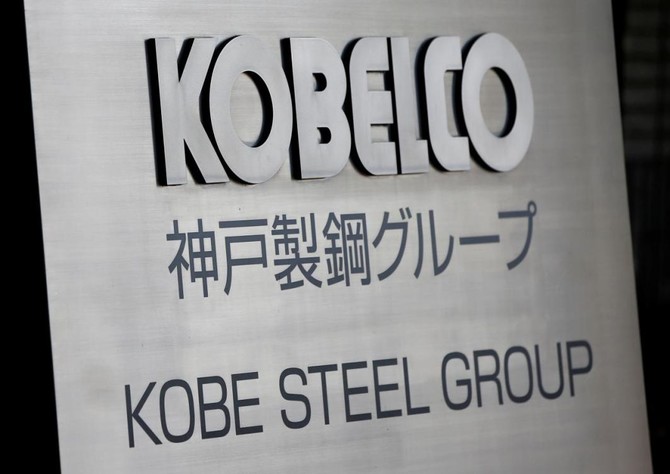
TOKYO: Crisis-hit Kobe Steel said on Friday its steel division has also falsely labelled products, the latest in a string of revelations confirming widespread cheating at the firm that has engulfed its global customers.
The bombshell admissions by Japan’s third-largest steel maker sent its shares plummeting again, with the scale of the misconduct dealing a body blow to the nation’s reputation as a high-quality manufacturing destination.
Investors, worried about the financial impact and legal fallout, have wiped out about $1.8 billion (SR6.75 billion) off Kobe Steel’s market value this week after the firm said about 200 companies were affected by its cheating.
On Friday, the company said it found data tampering in its steel wire products. Customers have said there are no problems with the safety or function of the products, the spokesman said.
Chief Executive Hiroya Kawasaki will brief media as the crisis ripples through supply chains across the world after the firm admitted at the weekend it had falsified data about the quality of aluminum and copper products used in cars, aircraft, space rockets and defense equipment.
Boeing has some of the falsely certified products, a source with knowledge of the matter told Reuters, but stressed that the world’s biggest maker of passenger jets does not as yet consider the issue a safety problem.
More than 30 non-Japanese customers including Daimler and Airbus had been affected by the firm’s data fabrication, the Nikkei newspaper reported on Friday.
A Kobe Steel spokesman said the companies received its products but would not confirm they had any of the falsely certified components.
Nuclear power plant parts are the latest to join the list of affected equipment as Fukushima nuclear operator Tokyo Electric Power (Tepco) said on Friday it had taken delivery of pipes from Kobe Steel that were not checked properly.
The pipes were delivered to its Fukushima Daini station, located near the destroyed Fukushima Daiichi plant, but have not been used, Tepco said, adding it was checking all its facilities.
Faulty parts have also been found in Japan’s famous bullet trains that run at speeds as high as around 300 kilometers per hour and a space rocket that was launched in Japan earlier this week. One bullet train operator has already said it will seek compensation from Kobe Steel.
The government has ordered Kobe Steel to address safety concerns within about two weeks and report on how the misconduct occurred in a month.
No safety issues have yet been identified in the unfolding imbroglio.
Kobe Steel shares fell nearly 9 percent on Friday and have fallen more than 40 percent since the scandal broke.
The steel maker faces a range of legal risks, including compensation sought by clients or their customers, penalties for violating unfair competition laws for false representation, shareholder lawsuits for the fall in the company’s stock price and class lawsuits from overseas customers seeking punitive damages, a lawyer said.
“It is hard to predict the extent of legal costs,” said Motokazu Endo, a lawyer at Tokyo Kasumigaseki law office.
“We cannot rule out the possibility that this will shake Kobe Steel to its foundation.”


Japan’s Kobe Steel cheating scandal widens
Japan’s Kobe Steel cheating scandal widens


Qatar property transactions reach $177m in late December
JEDDAH: Qatar’s real estate transactions exceeded 657 million Qatari riyals ($177.4 million) in the week ended Dec. 25, underscoring steady property market activity.
Data from Qatar’s Ministry of Justice showed that trading across Doha and other municipalities remained elevated, with residential unit sales recorded at 49.4 million riyals during the period, according to the Real Estate Registration Department.
The figure marks a sharp increase from the previous week, when total real estate transactions reached about 463 million riyals. That earlier period included sales contracts worth 354.26 million riyals and residential unit transactions totaling 108.76 million riyals, the Qatar News Agency reported.
Qatar’s weekly trading mirrors broader activity across the Gulf region, where major markets such as Dubai and Abu Dhabi have reported strong sales and stable prices, supported by robust residential and commercial demand.
The weekly activity highlighted sustained investor confidence, reflecting the broader Gulf-wide trend in real estate heading into 2026.
“The weekly bulletin issued by the department stated that the properties traded included vacant land, houses, residential buildings, residential complexes, commercial shops, commercial and residential buildings, a commercial and administrative building, and residential units,” the QNA report stated.
Qatar property sales were concentrated in the municipalities of Al-Rayyan, Doha, Al-Wakrah, and Umm Slal, in addition to Al-Daayen, Al Khor, as well as Al Thakhira, and Al-Shamal. They also included key areas including The Pearl Island, and Al-Kharayej, along with Lusail 69, Al-Wukair, Ghar Thuaileb, and Al-Sakhama municipalities.
The figures highlight sustained activity in Qatar’s real estate market, with a notable week-on-week increase in trading volumes as the year draws to a close.
The weekly data align with a stronger performance earlier in the year. Qatar’s real estate sector showed resilience in the first half of 2025, supported by rising residential activity, steady office demand and growth in hospitality and retail, according to a September report by Knight Frank.
Residential transaction values reached 9.23 billion riyals in the second quarter, up 114 percent year on year, led by Doha, Al Daayen and Al Wakrah. Apartment prices rose 3.5 percent to an average of 13,270 riyals per square meter, while villa prices edged lower. Land sales jumped 85 percent, and prime office rents in Lusail held steady at about 115 riyals per square meter.
Qatar added 718 hotel rooms during the period, while retail assets maintained high occupancy levels, pointing to continued confidence among investors and consumers.