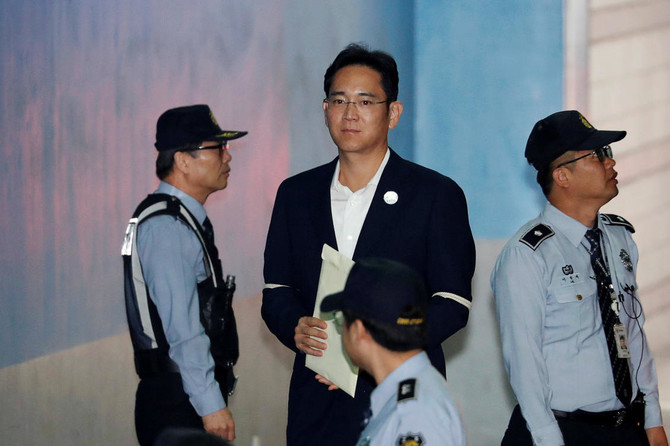
SEOUL: The heir to South Korea’s Samsung Group appeared in a packed court on Thursday for the first day of arguments in the appeal of his five-year jail term for corruption.
The 49-year-old Jay Y. Lee was convicted by a lower court in August of bribing former president Park Geun-hye to help strengthen his control of the crown jewel in the conglomerate, Samsung Electronics, one of the world’s biggest technology companies.
The appellate court hearing the appeal is likely to try to rule on the case by next February, legal experts said. Whichever side loses could take the case to the Supreme Court, the final court of appeal in South Korea.
Lee’s presence marked his first public appearance since the August ruling. He did not speak during the early proceedings other than giving his birth date and address.
The lower court in August had ruled that while Lee never asked for Park’s help directly, the fact that a 2015 merger of two Samsung affiliates did help cement Lee’s control over Samsung Electronics “implied” he was asking for the president’s help to strengthen his control of the firm.
The defense strongly challenged the lower court’s logic that Lee’s actions “implied” solicitation for help from Park by providing financial support for the former president’s close friend and confidante Choi Soon-sil.
The prosecution, which has lodged a cross-appeal against the lower court ruling that found Lee innocent on some charges, said the court’s decision to not acknowledge explicit solicitation for Park’s help from Samsung despite the evidence found “did not make sense.”
The defense, which spent much of its time during the initial trial refuting the prosecution’s individual charges, is expected to focus on a few key arguments in the appeal — including whether there was in fact an “ordinary type of bribery” as defined under South Korean law, which says only civil servants come under the statute.
Park’s friend Choi was not a civil servant.
The lower court found that Samsung’s financial support of 7.2 billion won ($6.27 million) to sponsor the equestrian career of Choi’s daughter constituted an ordinary type of bribery, as “it can be considered the same as she (Park) herself receiving it.”
The defense is expected to strongly challenge this by saying that the prosecution, on whom the burden of proof lies, has not proved collusion between Park and Choi.


Samsung scion’s defense fights back as legal appeal begins
Samsung scion’s defense fights back as legal appeal begins



Industry leaders highlight Riyadh’s Metro, infrastructure as investment catalysts
RIYADH: Saudi Arabia’s capital, Riyadh, is experiencing a transformative phase in its real estate sector, with the construction market projected to reach approximately $100 billion in 2025, accompanied by an anticipated annual growth rate of 5.4 percent through 2029.
The Kingdom is simultaneously advancing its data center capacity at an accelerated pace, with an impressive 2.7 GW currently in the pipeline. This expansion underscores the critical role of strategic land and power planning in establishing national infrastructure as a cornerstone of economic growth.
These insights were shared by leading industry experts during JLL’s recent client event in Riyadh, which focused on the city’s macroeconomic landscape and emerging trends across office, residential, retail, hospitality, and pioneering sectors, including AI infrastructure and Transit-Oriented Development.
Saud Al-Sulaimani, Country Lead and Head of Capital Markets at JLL Saudi Arabia, commented: “Riyadh is positioned at the forefront of Saudi Arabia’s Vision 2030, offering unparalleled opportunities for both investors and developers. National priorities are continuously recalibrated to ensure strategic alignment of projects and foster deeper collaboration with the private sector.”
He added: “Recent regulatory developments, including the introduction of the White Land Tax and the rent freeze, are designed to stabilize the market and are expected to drive renewed focus on delivering premium-quality assets. This dynamic environment, coupled with evolving construction cost considerations in select segments, is fundamentally reshaping the market landscape while accelerating progress toward our national objectives.”
The event further underscored the transformative impact of infrastructure initiatives. Mireille Azzam Vidjen, Head of Consulting for the Middle East and Africa at JLL, highlighted Riyadh’s transit revolution. She detailed the Riyadh Metro, a $22.5 billion investment encompassing 176 kilometers, six lines, and 84 stations, providing extensive geographic coverage, with a depth of 9.8 km per 100 sq. km. This strategic development generates significant TOD opportunities, with properties in proximity potentially commanding a 20-30 percent premium. JLL emphasized the importance of implementing climate-responsive last-mile solutions to enhance mobility and accessibility, particularly given Riyadh’s extreme temperatures.
Gaurav Mathur, Head of Data Centers at JLL, emphasized the rapid expansion of the Kingdom’s AI infrastructure, signaling a critical area for technological investment and innovation.
Focusing on the construction sector, Maroun Deeb, Head of Projects and Development Services, KSA at JLL, explained that the industry is actively navigating complexities such as skilled labor availability, material costs, and supply chain dynamics.
He highlighted the adoption of Building Information Modeling as a key driver for enhancing operational efficiency and project delivery.


