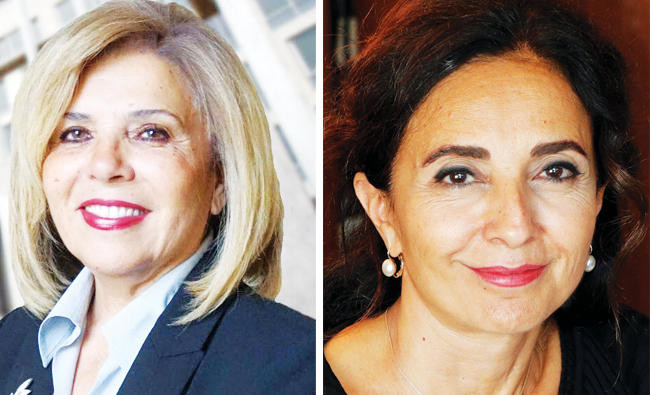
JEDDAH: An Egyptian diplomat is among the favorites to be the next head of UNESCO, the UN’s cultural agency.
Moushira Khattab, 73, a former minister of family and population and a leading activist for women’s and children’s rights, is one of four Arab candidates. The others are Vera El-Khoury from Lebanon, Saleh Mahdi Al-Hasnawi from Iraq and former Qatari Culture Minister Hamad bin Abdul Aziz Al-Kawari.
If Khattab wins, she would be the first person from Africa to lead UNESCO in its 72-year history.
She is a former assistant minister of foreign affairs and ambassador to South Africa, the Czech Republic and Slovakia.
“Ambassador Moushira Khattab has long diplomatic experience, and she knows how to deal with many files related to many humanitarian issues and therefore can very much meet the requirements of the new position,” Malek Awny, managing editor of Al-Ahram Foundation’s International Politics Journal, told Arab News.
“I think that the changes that have taken place in the Arab scene during the last few months may witness an Arab stance that strongly supports Ambassador Khattab.”
African support from neighboring countries also increased the likelihood of Khattab’s winning the post, said Awny. “Egypt’s evolving position on the Arab and African arena may be an important voting bloc that supports the ambassador’s candidacy.
“I think she is the best and most capable to perform such task.”
Al-Kawari, the cultural adviser to the emir of Qatar and former ambassador to France, the US and the UN, was his country’s first culture minister from 2008 to 2016.
His chances may be damaged by the dispute between Qatar and the Anti-Terror Quartet of Saudi Arabia, the UAE, Egypt and Bahrain over Doha’s support and funding for terrorism.
Voting by secret ballot of UNESCO’s 58-member executive board begins in Paris on Monday. If no candidate wins a majority, voting will continue daily until Oct. 13, when there will be a final choice between the two remaining candidates with most votes.
If the result is a tie, the winner will be chosen by drawing lots. The new director-general will be confirmed at the UNESCO General Conference in November.

Egyptian diplomat leads race to be UNESCO head
Syria sends thousands of troops to Lebanon border, sources say
- The Syrian officers said the Syrian reinforcement operation began in February but sped up in recent days
- The reinforcements include infantry units, armored vehicles and short-range Grad and Katyusha rocket launchers
DAMASCUS/BEIRUT: Syria has reinforced its border with Lebanon with rocket units and thousands of troops, eight Syrian and Lebanese sources said on Tuesday, as conflict spread in the region including between Israel and Hezbollah in Lebanon.
The sources included five Syrian military officers, a Syrian security official and two Lebanese security officials who spoke on condition of anonymity.
The Syrian officers said the Syrian reinforcement operation began in February but sped up in recent days. The Syrian and Lebanese armed forces did not immediately respond to requests for comment.
The Syrian officers, including a senior member of the military, said the move was aimed at preventing arms and drugs smuggling as well blocking Iran-backed Lebanese Hezbollah or other militants from infiltrating Syria.
A Syrian officer told Reuters that military formations from several Syrian army divisions, including the 52nd and 84th Divisions, have expanded their presence along the border in western Homs countryside and south of Tartus.
The reinforcements include infantry units, armored vehicles and short-range Grad and Katyusha rocket launchers, the official said.
The Syrian security official said Damascus had no plans for military action against any neighboring country. “But Syria is prepared to deal with any security threat to itself or its partners,” he said.
Still, the move has fueled concern among some European and Lebanese officials over a possible incursion.
The Syrian military officers vehemently denied any such plans, saying Syria wants balanced relations with its neighbor after decades of strained ties linked to Syria’s outsized influence in Lebanon and Hezbollah’s support for the former government of Syrian President Bashar Assad during a 14-year civil war.
Syria had troops stationed in Lebanon from 1976 until 2005 including during Lebanon’s civil war that ended in 1990.
Hezbollah resumed firing at Israel on Monday more than a year after reaching a ceasefire to a months-long war in 2024. Since that ceasefire, Israel continued near-daily strikes.
Israel this week ordered much of Lebanon’s south evacuated, with tens of thousands of people displaced. Israeli airstrikes across Lebanon’s South and southern Beirut have killed dozens and prompted thousands of people to flee toward Syria.
A senior Lebanese security official said Syrian authorities told Beirut that Syria’s deployment of rocket launchers along the mountains that form Lebanon’s eastern border with Syria was a “defensive measure against any action or attack that Hezbollah might launch against Syria.”