Police detain man after 11 injured in car incident near London museum, terrorism ruled out

Updated 07 October 2017
Follow

Police detain man after 11 injured in car incident near London museum, terrorism ruled out

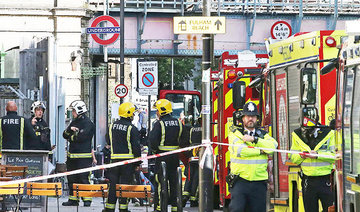
LONDON: A man was detained after 11 people were injured on Saturday in a collision with a car near London’s Natural History Museum, in one of the capital’s busiest tourist areas, but police ruled out terrorism.
Police said it was believed a car mounted the pavement and collided with a number of pedestrians.
“The incident is a road traffic investigation and not a terrorist-related incident,” the statement said.
The museum, one of the most popular visitor attractions in the country, said in a statement: “A vehicle has collided with pedestrians near the Natural History Museum entrance at Exhibition Road.”
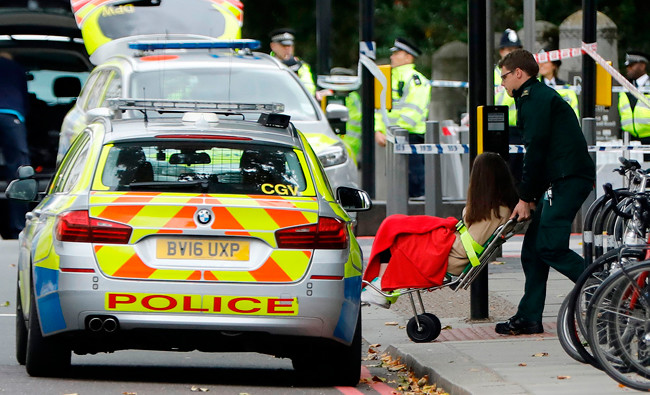
London’s ambulance service said they had treated 11 people, mostly for head and leg injuries, with nine taken to hospital.
Unverified footage from the scene in South Kensington, west London, showed a man being pinned to the ground by what appeared to be four security guards or police officers.
Prime Minister Theresa May was being updated, a spokesman said, adding it was usual practice in such circumstances, and London Mayor Sadiq Khan said he was in close contact with the police’s most senior counter-terrorism officer.
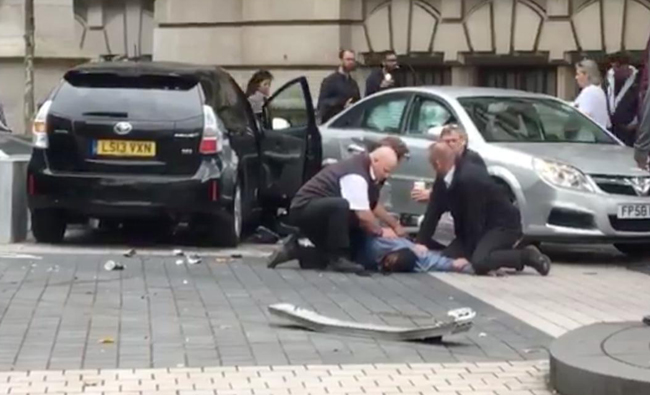


Footage of man being arrested after car hits pedestrians outside Natural History Museum in London. (Photo courtesy: social media)

Packed with tourists
Exhibition Road, in one of London’s most upmarket districts, is home to a host of museums, restaurants as well as university buildings with the streets packed with tourists at the weekend.
“We heard a horrible thudding noise and a car engine. Everyone started running and screaming inside,” Connor Honeyman, who was in the queue for the museum, told the BBC.
A Reuters witness said large numbers of paramedics and police, including armed officers, were at the scene although the atmosphere appeared calm.
The car believed to have been involved in the incident was lying diagonally across the road, jammed between two other vehicles. A BBC reporter said she had seen one or two people on the ground and police had told her the injuries sustained were minor.
Britain is on its second highest security alert level, meaning an attack by militants is considered highly likely. There have been five attacks described by the authorities as terrorism this year, three involving vehicles.
In March, a man drove a car into pedestrians on London’s Westminster Bridge killing four before stabbing a police officer to death in the grounds of parliament.
Three Islamist militants drove into people on London Bridge in June before stabbing people at nearby restaurants and bars, killing eight. The same month, a van was driven into worshippers near a mosque in north London which left one man dead.
The Natural History Museum is the fourth most popular tourist attraction in the United Kingdom, with 4.6 million visits during 2016, according to the Association of Leading Visitor Attractions.
A spokesman for the museum told Reuters that no one was being allowed into the building and people were being let out through a different exit. 


UN’s top court opens Myanmar Rohingya genocide case

Updated 14 min 8 sec ago
Follow

UN’s top court opens Myanmar Rohingya genocide case

  • The Gambia filed a case against Myanmar at the UN’s top court in 2019
  • Verdict expected to impact Israel’s genocide case over war on Gaza

DHAKA: The International Court of Justice on Monday opened a landmark case accusing Myanmar of genocide against its mostly Muslim Rohingya minority.

The Gambia filed a case against Myanmar at the UN’s top court in 2019, two years after a military offensive forced hundreds of thousands of Rohingya from their homes into neighboring Bangladesh.

The hearings will last three weeks and conclude on Jan. 29.

“The ICJ must secure justice for the persecuted Rohingya. This process should not take much longer, as we all know that justice delayed is justice denied,” said Asma Begum, who has been living in the Kutupalong refugee camp in Bangladesh’s Cox’s Bazar district since 2017.

A mostly Muslim ethnic minority, the Rohingya have lived for centuries in Myanmar’s western Rakhine state but were stripped of their citizenship in the 1980s and have faced systemic persecution ever since.

In 2017 alone, some 750,000 of them fled military atrocities and crossed to Bangladesh, in what the UN has called a textbook case of ethnic cleansing by Myanmar.

Today, about 1.3 million Rohingya shelter in 33 camps in Cox’s Bazar, turning the coastal district into the world’s largest refugee settlement.

“We experienced horrific acts such as arson, killings and rape in 2017, and fled to Bangladesh,” Begum told Arab News.

“I believe the ICJ verdict will pave the way for our repatriation to our homeland. The world should not forget us.”

A UN fact-finding mission has concluded that the Myanmar 2017 offensive included “genocidal acts” — an accusation rejected by Myanmar, which said it was a “clearance operation” against militants.

Now, there is hope for justice and a new future for those who have been displaced for years.

“We also have the right to live with dignity. I want to return to my homeland and live the rest of my life in my ancestral land. My children will reconnect with their roots and be able to build their own future,” said Syed Ahmed, who fled Myanmar in 2017 and has since been raising his four children in the Kutupalong camp.

“Despite the delay, I am optimistic that the perpetrators will be held accountable through the ICJ verdict. It will set a strong precedent for the world.”

The Myanmar trial is the first genocide case in more than a decade to be taken up by the ICJ. The outcome will also impact the genocide case that Israel is facing over its war on Gaza.

“The momentum of this case at the ICJ will send a strong message to all those (places) around the world where crimes against humanity have been committed,” Nur Khan, a Bangladeshi lawyer and human rights activist, told Arab News.

“The ICJ will play a significant role in ensuring justice regarding accusations of genocide in other parts of the world, such as the genocide and crimes against humanity committed by Israel against the people of Gaza.”