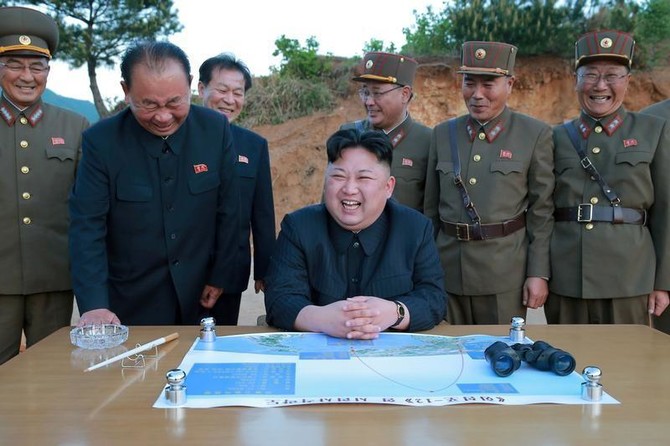
MOSCOW: North Korea is preparing to test a long-range missile which it believes can reach the west coast of the United States, a Russian lawmaker just returned from a visit to Pyongyang was quoted as saying on Friday.
Anton Morozov, a member of the Russian lower house of parliament’s international affairs committee, and two other Russian lawmakers visited Pyongyang on October 2-6, Russia’s RIA news agency reported.
“They are preparing for new tests of a long-range missile. They even gave us mathematical calculations that they believe prove that their missile can hit the west coast of the United States,” RIA quoted Morozov as saying.
“As far as we understand, they intend to launch one more long-range missile in the near future. And in general, their mood is rather belligerent.”
Tensions have risen in recent weeks over North Korea’s nuclear weapons and missile programs as Pyongyang has test-fired several missiles and conducted what it said was a test explosion of a hydrogen bomb as it advances toward its goal of developing a nuclear-tipped missile capable of hitting the US mainland.
Reuters was not able to independently verify Morozov’s account, and he did not specify which North Korean officials had given him the information about the planned test.
In Washington, a US official said that there had been indications that North Korea could be preparing for a missile test on or around October 10, the anniversary of the founding of the ruling Korean Workers Party and a day after the Columbus Day holiday in the US.
The official, speaking on condition of anonymity, did not disclose the type of missile that could be tested and cautioned that North Korea in the past has not staged launches despite indications that it would.
A senior CIA analyst, speaking at a conference in Washington this week, said the North Korean government likely would stage some kind of provocation on October 10 but did not elaborate on what form it might take.
“There is a clarity of purpose in what (North Korean leader) Kim Jong Un is doing. I don’t think he’s done,” said Yong Suk Lee, the deputy assistant director of the CIA’s Korea Mission Center, which was set up this year. “In fact, I told my own staff (that) October 10th is the Korean Workers Party founding day. That’s Tuesday in North Korea, but Monday – the Columbus Day holiday — in the United States. So stand by your phones.”
Morozov’s delegation had “high-level” meetings in Pyongyang, RIA news agency said, citing the Russian embassy in the North Korean capital.
Tensions over North Korea’s nuclear program have been running high in recent weeks since Pyongyang staged a series of missile tests, and conducted a text explosion on Sept. 3 of what it said was a hydrogen bomb.
There has also been an exchange of tough rhetoric between Pyongyang and Washington.
US President Donald Trump threatened to “totally destroy” North Korea if it threatens the United States. North Korean leader Kim Jong Un responded by calling Trump deranged and saying he would pay dearly for his threat.
China, North Korea’s main ally, has backed sanctions against Pyongyang and on Saturday in response to the Nobel Peace Prize being awarded to the International Campaign to Abolish Nuclear Weapons, said it backed a worldwide ban on nuclear weapons.
“China has always supported a complete and total ban on nuclear weapons, but also believes that the goal of achieving nuclear disarmament cannot be achieved overnight and must advance gradually within the existing disarmament mechanism. China is willing to work with all parties to achieve a nuclear-weapon-free world,” said China’s foreign ministry.
Morozov is a member of the LDPR, a right-wing populist party. It casts itself as an opposition party, but hews close to the Kremlin line on matters of international affairs.
Describing meetings with North Korean officials, Morozov said they “displayed serious determination and bellicose rhetoric,” RIA reported.
“The situation, of course, demands the swiftest intervention of all interested states, particularly those represented in the region, in order to prevent wide-scale military action,” the agency quoted him as saying.
Russia has closer relations with Pyongyang than many other world powers, linked in part to Kim Il Sung, the founder of North Korea and the current leader’s grand-father, having lived for a time in the Soviet Union.
Russian President Vladimir Putin has joined other world powers in condemning North Korea’s weapons program, but has taken a softer line than Western governments.
Putin has said that Pyongyang will not be cowed into giving up its weapons program. He has accused Washington of trying to effect regime change in North Korea, and predicted that would unleash chaos.

North Korea preparing long-range missile test, report cites Russian lawmaker
Voting passes peacefully in Nepal’s first election since September youth-led protests
KARMANDU: Voting was peaceful in Nepal’s first nationwide election Thursday since a violent, youth-led uprising forced the government from power in September.
Turnout was about 60 percent and only a few minor incidents were reported, according to Nepal’s acting Chief Election Commissioner Ram Prasad Bhandari.
Vote counting would begin immediately after the ballot boxes are collected and transported to counting centers across the Himalayan nation, which could be as early as Thursday night. Results were expected by the weekend. Helicopters will be used to ferry the boxes from polling stations in remote mountain villages in the northern region by Friday morning, Bhandari said.
The next administration is expected to inherit daunting challenges. It must deliver on changes demanded by last year’s protests, tackle entrenched corruption and carefully manage ties with its powerful neighbors, India and China.
“I came to vote mainly because of the protest and so many people gave their lives in the hope of a change, in hope of seeing better Nepal,” said Luniva, a first-time voter. “Hopefully, I want to see my country become better by all the sacrifices that have been made.”
Others shared similar hopes that the election could usher in positive change after months of political unrest.
Voters are directly electing 165 members to the House of Representatives, the lower chamber of Parliament. The remaining 110 seats in the 275-member body will be allocated through a proportional representation system, under which political parties nominate lawmakers based on their share of the vote.
The election is widely seen as a three-way contest, shaped by voter frustration over widespread corruption and demands for greater government accountability.
The National Independent Party, founded in 2022, is considered the front-runner, posing a strong challenge to two long-dominant parties: the Nepali Congress and the Communist Party of Nepal (Unified Marxist–Leninist).
The new party’s prime ministerial candidate is rapper-turned-politician Balendra Shah, who won the 2022 Katmandu mayoral race and emerged as a leading figure in the 2025 uprising that ousted former Prime Minister Khadga Prasad Oli.
Shah, 35, has rode a wave of public anger toward traditional political parties. He highlighted health and education for poor Nepalis as a key focus of his campaign.
The protests against corruption and poor governance were triggered by a social media ban before snowballing into a popular revolt against the government. Dozens were killed and hundreds injured when protesters attacked government buildings and police opened fire on them.
While the Congress and the Communists retain loyal voter bases, Shah’s party has drawn larger crowds on the campaign trail, highlighting its growing appeal among younger voters seeking an alternative.
There are about 19 million registered voters among the country’s nearly 30 million people, according to the Election Commission of Nepal.
Millions of Nepalis living overseas are unable to take part in the vote. An estimated 3 million citizens work abroad — largely in the Middle East, Southeast Asia and neighboring India — and cannot cast ballots because the country does not yet have a system allowing voting from abroad.
Turnout was about 60 percent and only a few minor incidents were reported, according to Nepal’s acting Chief Election Commissioner Ram Prasad Bhandari.
Vote counting would begin immediately after the ballot boxes are collected and transported to counting centers across the Himalayan nation, which could be as early as Thursday night. Results were expected by the weekend. Helicopters will be used to ferry the boxes from polling stations in remote mountain villages in the northern region by Friday morning, Bhandari said.
The next administration is expected to inherit daunting challenges. It must deliver on changes demanded by last year’s protests, tackle entrenched corruption and carefully manage ties with its powerful neighbors, India and China.
“I came to vote mainly because of the protest and so many people gave their lives in the hope of a change, in hope of seeing better Nepal,” said Luniva, a first-time voter. “Hopefully, I want to see my country become better by all the sacrifices that have been made.”
Others shared similar hopes that the election could usher in positive change after months of political unrest.
Voters are directly electing 165 members to the House of Representatives, the lower chamber of Parliament. The remaining 110 seats in the 275-member body will be allocated through a proportional representation system, under which political parties nominate lawmakers based on their share of the vote.
The election is widely seen as a three-way contest, shaped by voter frustration over widespread corruption and demands for greater government accountability.
The National Independent Party, founded in 2022, is considered the front-runner, posing a strong challenge to two long-dominant parties: the Nepali Congress and the Communist Party of Nepal (Unified Marxist–Leninist).
The new party’s prime ministerial candidate is rapper-turned-politician Balendra Shah, who won the 2022 Katmandu mayoral race and emerged as a leading figure in the 2025 uprising that ousted former Prime Minister Khadga Prasad Oli.
Shah, 35, has rode a wave of public anger toward traditional political parties. He highlighted health and education for poor Nepalis as a key focus of his campaign.
The protests against corruption and poor governance were triggered by a social media ban before snowballing into a popular revolt against the government. Dozens were killed and hundreds injured when protesters attacked government buildings and police opened fire on them.
While the Congress and the Communists retain loyal voter bases, Shah’s party has drawn larger crowds on the campaign trail, highlighting its growing appeal among younger voters seeking an alternative.
There are about 19 million registered voters among the country’s nearly 30 million people, according to the Election Commission of Nepal.
Millions of Nepalis living overseas are unable to take part in the vote. An estimated 3 million citizens work abroad — largely in the Middle East, Southeast Asia and neighboring India — and cannot cast ballots because the country does not yet have a system allowing voting from abroad.
© 2026 SAUDI RESEARCH & PUBLISHING COMPANY, All Rights Reserved And subject to Terms of Use Agreement.