DUBAI: Everyone should be concerned about Iran’s continued development of its missile program, Saudi Arabia’s Prince Turki Al-Faisal said in an interview with the Persian TV program “Voice of America.”
Speaking to presenter Setareh Derakhshesh, Al-Faisal said there needed to be more clarity on the restrictions that were agreed on the Iranian nuclear deal.
“I think everybody should be concerned, not just Saudi Arabia and the United States,” he said.
He said he understood that under the agreement the development of Iran’s missile program was restricted. But he said this was something Iranian officials had denied.
“And I think that this is part of the problem Iran has with the nuclear deal,” Al-Faisal added.
“That there seems to be issues with the deal that have not been brought out and put on the table.”
“So is the missile program restricted? Or is it not? The present American administration says ‘yes,’ the Iranian leaders say ‘no’.”
This he said was a problem and he added: “So if there are articles in the deal that have not been published then I think they should be published.”
Derakhshesh asked the prince about Iran’s stance where it claims the missile system is for defense purposes only, but that the country says no one “should tell them what to do,” that they are “free to do what they like.”
The prince question Iran’s definition of “defensive purposes,” adding that he recently attended a conference where he had reviewed declarations by Iranian officials that outlined the presence of its military in Syria, Iraq, Afghanistan, Pakistan and in Yemen.
“So if the military leaders boast about that, what is defensive?” He asked
“Are these missiles supposed to protect these 200,000 troops that are spread in Syria, Iraq, Yemen, Pakistan and Afghanistan? Or are they supposed to protect the territory of what is officially recognized as Iran?”
And he added: “They (the Iranians) have to be more forthcoming in justifying these aggressive programs that they have adopted.”
President Trump this week announced his intention to review the nuclear deal brokered with Iran at the end of Obama’s presidency.
Asked for his views on whether this was the right move, Al-Faisal said his concerns went beyond the deal that was reached.
He said his concern lay with what would happen beyond the agreed timespan of the deal.
“As I understand it, the agreement when it was initially signed was supposed to last 15 years. Once that is over, what happens next?” Al-Faisal asked.
“We know that Iran, under the agreement, will continue to enrich uranium at a specific level. That means that they will develop the knowhow and the techniques to enrich at a higher level. Which allows for the development of its nuclear capability.”
“So on the day that the agreement is finished – is terminated – my view is that under the present leadership in Iran, they will race for developing a nuclear weapon without anybody restricting them.”
Al-Faisal said his criticism of the agreement was that it did not address the long-term, after the 15-year deal was over.
Asked about Iran’s recent “aggressive posturing” both on land and at sea, Al-Faisal said the present leadership “should stop doing that…. You have to put pressure on them internationally.”
“When you look at what is happening – for example in Syria – Iran is in support of a person who, himself admits that he is killing his own citizens. He identifies them as terrorists.”
“500,000 victims of this person’s aggression... Against his own people and with the help of whom?”
He called on the international community to call on Iran and its allies to stop their support for Assad.
Al-Faisal added that with the West – especially countries in Europe – striking business deals with Iran, there was a need for them to put pressure on the country’s leaders over their ongoing nuclear development.
He said the West currently had the upper hand because it was effectively propping up Iranian businesses to strike deals.
“My understanding is that for the west to do business with Iran now – that the West will have to bring the capital to invest in Iran in order to do business with Iran. And it is not going to be Iranian financial resources that will bring these businesses but Western financial resources themselves by giving loans to Iranian businesses.”
He questioned the situation with such deals being struck with Iran, adding that they were “haphazard” given the lack of clarity.
“So those who bring their capital to invest in Iran are doing so at their own risk.”
He said there were significant similarities shared between the Gulf Arab states and the Iranians, including their geography, the mixing of their people and their belief systems.
“These factors should be working together to bring us together,” he said. “However the aggression of the present Iranian regime in Syria, Iraq, in Yemen, these factors that should bring us together are not succeeding in doing so.”
But he said Iran’s external aggression was only a part of the problem. He said there were clear signs of internal rifts taking place within the country between the various levels of leadership, as well as its military.


![]()
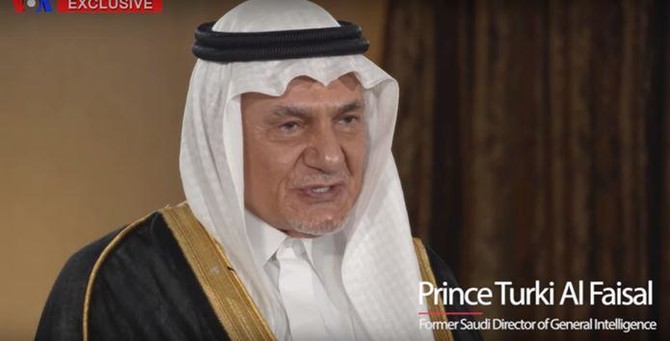
Saudi Prince calls for clarity in Iranian nuclear deal
Saudi Prince calls for clarity in Iranian nuclear deal
Latest updates


Recommended


© 2026 SAUDI RESEARCH & PUBLISHING COMPANY, All Rights Reserved And subject to Terms of Use Agreement.