Ghana wakes up and smells the coffee

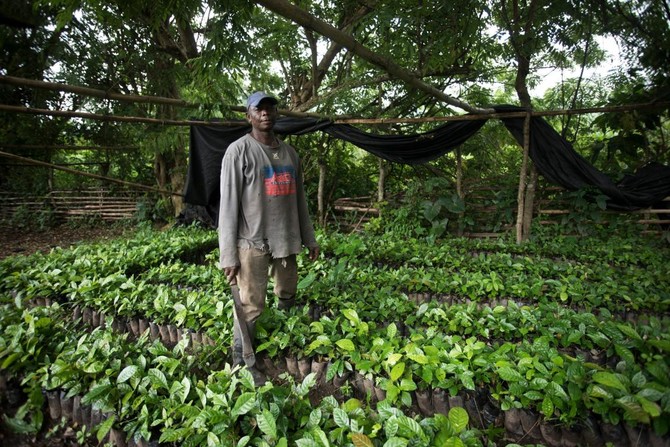
Coffee farmer George Klu poses at his coffee farm in the village of Leklebi Agbesia in the Volta Region of Ghana on August 23, 2017. (File photo by AFP)
Updated 01 October 2017
Follow

Ghana wakes up and smells the coffee

LEKLEBI FIAPE, Ghana: Like many people around the world, 80-year-old Kofi Afadi can’t start his morning without a cup of coffee.
“Every morning when I take coffee I feel happy and go about my day,” the farmer told AFP in his village in the green hills between Lake Volta in Ghana and the border with Togo.
“When there is no coffee it seems I am the most miserable person around here,” he said.
In common with many of his fellow coffee farmers, Afadi, whose dark hair and mustache are speckled white, also grows cocoa — Ghana’s biggest crop.
The country is the second largest cocoa exporter in the world behind neighboring Ivory Coast.
Production of coffee, which was introduced to Ghana at the same time in the 18th century, trails in comparison.
But it has rebounded in recent years, thanks to a growing overseas demand and a blossoming domestic market that is giving farmers hope of growing a major cash crop.
A collapse in the price of coffee in the 1980s caused many Ghanaian farmers to abandon the crop, according to Michael Owusu-Manu, a researcher at Ghana’s Cocoa Board.
But a government scheme launched in 2011 to revive the sector has transformed production and marketing of Ghanaian coffee.
It led to 2,400 hectares (5,930 acres) of new and revitalized coffee plantations, with farmers attracted by the introduction of fair prices for the crop.
Owusu-Manu said the impact of the scheme is easy to overlook because much of Ghana’s coffee is sold in West Africa and does not appear in official export statistics.
The beans that stay in Ghana are sold to local roasters, who must compete in a market where most coffee is imported.
Owusu-Manu now wants to connect local cafes popping up in Accra with local sellers.
Afadi hopes government support and a planned coffee farmers’ association will help them to wean locals off imports and establish Ghanaian beans in the home market.
Ghanaian coffee is a matter of heritage and personal pride for the country’s farmers.
Afadi’s coffee farm in Leklebi Fiape, some 200 kilometers (130 miles) northeast of the coastal capital, Accra, is on the same plot where his father grew coffee in the 1920s.
As a child, he remembers watching his father roast and grind his own beans, transforming them into a rich black brew — just like the ones he enjoys every day.
He is disdainful of the jars and single-serving sachets of instant coffee granules found on sale in supermarkets and shops.
“It doesn’t taste like coffee,” he says firmly.
For now he gets his coffee from neighboring farms, including the one run by nursery manager George Klu.
But Afadi is in the process of planting 900 seedlings that the government gave him for free.
He expects to harvest his first crop in four years’ time when he hopes global demand will only be higher.
The International Coffee Organization reports that global annual coffee consumption has grown an average of 1.3 percent every year since 2012.
Klu, 60, has two coffee farms and runs the nursery that produces the coffee seedlings for the government program.
He also hopes that coffee will be a silver bullet to Ghana’s burgeoning youth unemployment.
“Our youth are trying to be reluctant about farming,” he said, cutting back weeds with a machete.
“But I may say it is just not wise for them to do so because farming is a lucrative business.”
Local coffee retailers such as Kawa Mako may be part of the solution to boosting the local market.
The small coffee shop he runs was set up with local farmers in mind and proudly makes lattes, espressos, and Americanos with beans from Volta Region farms.
Manager Prince Twumasi Asare said he has seen coffee consumption grow across Ghana, especially as international chains such as South Africa’s Vida e Caffe and Canada’s Second Cup have set up shop in Accra.
“We want to export, to put our products in shops and malls across the country. We want people to know that coffee from Africa, from Ghana, is a high quality,” said Asare.


How TV shows like ‘Mo’ and ‘Muslim Matchmaker’ allow Arab and Muslim Americans to tell their stories

(Clockwise) Hoda Abrahim, founder and CEO of, "Love, Inshallah,", Actor Ramy Youssef, Mohammed Amer and Yasmin Elhady. (AP)
Updated 28 December 2025
Follow

How TV shows like ‘Mo’ and ‘Muslim Matchmaker’ allow Arab and Muslim Americans to tell their stories

  • In addition to “Mo,” shows like “Muslim Matchmaker,” hosted by matchmakers Hoda Abrahim and Yasmin Elhady, connect Muslim Americans from around the country with the goal of finding a spouse

COLUMBUS, Ohio: Whether it’s stand-up comedy specials or a dramedy series, when Muslim American Mo Amer sets out to create, he writes what he knows.
The comedian, writer and actor of Palestinian descent has received critical acclaim for it, too. The second season of Amer’s “Mo” documents Mo Najjar and his family’s tumultuous journey reaching asylum in the United States as Palestinian refugees.
Amer’s show is part of an ongoing wave of television from Arab American and Muslim American creators who are telling nuanced, complicated stories about identity without falling into stereotypes that Western media has historically portrayed.
“Whenever you want to make a grounded show that feels very real and authentic to the story and their cultural background, you write to that,” Amer told The Associated Press. “And once you do that, it just feels very natural, and when you accomplish that, other people can see themselves very easily.”
At the start of its second season, viewers find Najjar running a falafel taco stand in Mexico after he was locked in a van transporting stolen olive trees across the US-Mexico border. Najjar was trying to retrieve the olive trees and return them to the farm where he, his mother and brother are attempting to build an olive oil business.
Both seasons of “Mo” were smash hits on Netflix. The first season was awarded a Peabody. His third comedy special on Netflix, “Mo Amer: Wild World,” premiered in October.
Narratively, the second season ends before the Hamas attack in Israel on Oct. 7, 2023, but the series itself doesn’t shy away from addressing Israeli-Palestinian relations, the ongoing conflict in Gaza or what it’s like for asylum seekers detained in US Immigration and Customs Enforcement detention centers.
In addition to “Mo,” shows like “Muslim Matchmaker,” hosted by matchmakers Hoda Abrahim and Yasmin Elhady, connect Muslim Americans from around the country with the goal of finding a spouse.
The animated series, “#1 Happy Family USA,” created by Ramy Youssef, who worked with Amer to create “Mo,” and Pam Brady, follows an Egyptian American Muslim family navigating life in New Jersey after the 9/11 terrorists attack in New York.
Current events have an influence
The key to understanding the ways in which Arab or Muslim Americans have been represented on screen is to be aware of the “historical, political, cultural and social contexts” in which the content was created, said Sahar Mohamed Khamis, a University of Maryland professor who studies Arab and Muslim representation in media.
After the 9/11 attacks, Arabs and Muslims became the villains in many American films and TV shows. The ethnic background of Arabs and the religion of Islam were portrayed as synonymous, too, Khamis said. The villain, Khamis said, is often a man with brown skin with an Arab-sounding name.
A show like “Muslim Matchmaker” flips this narrative on its head, Elhady said, by showing the ethnic diversity of Muslim Americans.
“It’s really important to have shows that show us as everyday Americans,” said Elhady, who is Egyptian and Libyan American, “but also as people that live in different places and have kind of sometimes dual realities and a foot in the East and a foot in the West and the reality of really negotiating that context.”
Before 9/11, people living in the Middle East were often portrayed to Western audiences as exotic beings, living in tents in the desert and riding camels. Women often had little to no agency in these media depictions and were “confined to the harem” — a secluded location for women in a traditional Muslim home.
This idea, Khamis said, harkens back to the term “orientalism,” which Palestinian American academic, political activist and literary critic Edward Said coined in his 1978 book of the same name.
Khamis said, pointing to countries like Britain and France, the portrayal in media of people from the region was “created and manufactured, not by the people themselves, but through the gaze of an outsider. The outsiders in this case, he said, were the colonial/imperialist powers that were actually controlling these lands for long periods of time.”
Among those who study the ways Arabs have been depicted on Western television, a common critique is that the characters are “bombers, billionaires or belly dancers,” she said.
The limits of representation
Sanaz Alesafar, executive director of Storyline Partners and an Iranian American, said she has seen some “wins” with regard to Arab representation in Hollywood, noting the success of “Mo,” “Muslim Matchmaker” and “#1 Happy Family USA.” Storyline Partners helps writers, showrunners, executives and creators check the historical and cultural backgrounds of their characters and narratives to assure they’re represented fairly and that one creator’s ideas don’t infringe upon another’s.
Alesafar argues there is still a need for diverse stories told about people living in the Middle East and the English-speaking diaspora, written and produced by people from those backgrounds.
“In the popular imagination and popular culture, we’re still siloed in really harmful ways,” she said. “Yes, we’re having these wins and these are incredible, but that decision-making and centers of power still are relegating us to these tropes and these stereotypes.”
Deana Nassar, an Egyptian American who is head of creative talent at film production company Alamiya Filmed Entertainment, said it’s important for her children to see themselves reflected on screen “for their own self image.” Nassar said she would like to see a diverse group of people in decision-making roles in Hollywood. Without that, it’s “a clear indication that representation is just not going to get us all the way there,” she said.
Representation can impact audiences’ opinions on public policy, too, according to a recent study by the Institute for Social Policy and Understanding. Results showed that the participants who witnessed positive representation of Muslims were less likely to support anti-democratic and anti-Muslim policies compared to those who viewed negative representations.
For Amer, limitations to representation come from the decision-makers who greenlight projects, not from creators. He said the success of shows like his and others are a “start,” but he wants to see more industry recognition for his work and the work of others like him.
“That’s the thing, like just keep writing, that’s all it’s about,” he said. “Just keep creating and keep making and thankfully I have a really deep well for that, so I’m very excited about the next things,” he said.