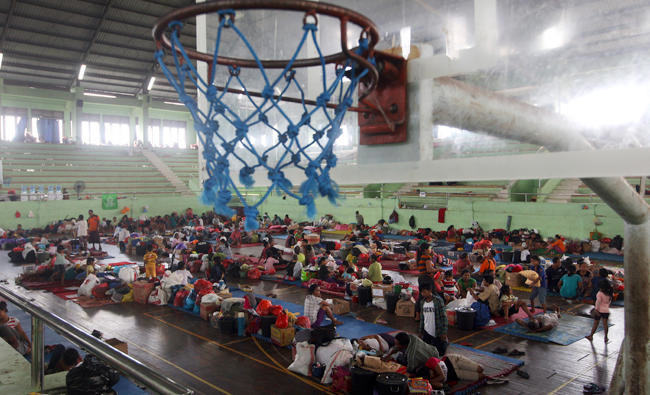
KLUNGKUNG, Indonesia: Authorities were trying to convince more than half of the 144,000 people who fled a menacing volcano on the Indonesian island of Bali to return home Saturday, saying they left areas that are safe.
The Mount Agung volcano on Bali, a tourist hotspot known for its lush interior, Hindu culture and beguiling beaches, has been at its highest alert level for more than a week, sparking an exodus from an official danger zone and areas farther away.
Authorities say the no-go zone, which in places extends 12 km from the crater, is the area at risk of lava, lahars and searing hot clouds of ash, gases and rock fragments if there is a powerful eruption.
“Those who live outside the danger zone, we urge them to go back home and carry on with their daily lives,” said Putu Widiada, head of the disaster mitigation agency in Klungkung district south of the volcano where some 22,000 people have fled. “We are trying to identify those who lived outside the danger zone.”
Bali’s governor has warned that people leaving what the government classifies as safe villages have become a “burden” on genuine evacuees and the temporary shelters set up to receive them.
Agung’s last eruptions in 1963 produced deadly clouds of searing hot ash, gases and rock fragments that traveled down its slopes at great speed. Lava spread for several kilometers and people were also killed by lahars — rivers of water and volcanic debris. About 1,100 people died in total.
Archive footage of the 1963 eruption shows buildings with roofs shredded by falling debris, a massive plume of ash gushing sideways from the crater and children in a row of hospital beds with their arms and legs bandaged.
Government volcanologists last week warned Agung could erupt at any time following a dramatic increase in tremors from the mountain.
Despite the government warning of temporary camps being overburdened, three visited by Associated Press reporters on Saturday were calm and orderly.
“I will stay here for as long as it takes,” said Suryani, a mother of two living with extended family in a tent on the grounds of a public sports center that is the main camp in Klungkung district.
Inside the center, families whiled away the time on mattresses, watching a giant TV screen, while cheerful music blared in the background.
“They are treating us well. I don’t want to go home if the mountain hasn’t exploded yet,” said Suryani, who goes by one name and is from a village inside the danger zone.
She said she sympathized with people who had fled from areas designated as safe by officials.
“If it’s not safe yet, they should allow them to stay,” she said. “We can stay here together so they’re not in danger.”
At another smaller temporary camp, officials said a dozen people had left of their own accord after the Bali governor’s statement and they were in the process of identifying others who can go home but would not compel them to.
Widiada, the disaster official, said longer-term plans for evacuees from the so-called red zone are still being worked out.
“This is a temporary shelter so it’s not as comfortable as your own house but we are trying to make it as good as we can by providing entertainment, counselors, a school for the children.”
Agung, about 70 km to the northeast of the Kuta tourist mecca, is among more than 120 active volcanoes in Indonesia. Another volcano, Mount Sinabung on Sumatra, has been erupting since 2010.
Officials say tourists on Bali, which had nearly 5 million visitors last year, are not in danger but they have prepared evacuation plans if ash fall from an eruption forces the closure of the island’s international airport.
Indonesia, an archipelago of thousands of islands, is prone to seismic upheaval due to its location on the Pacific “Ring of Fire,” an arc of volcanoes and fault lines encircling the Pacific Basin.

Bali urges many who fled volcano to return home

Abduction of Mexican mine workers raises doubts over touted security improvements
CONCORDIA: Deep in the coastal mountains above the sparkling Pacific resort of Mazatlan, towns spaced along a twisting road appear nearly deserted, the quiet broken only by the occasional passing truck.
It was near one of these towns, Panuco, that 10 employees of a Canadian-owned silver and gold mine were abducted in late January. The bodies of five were located nearby and five more await identification.
Most residents of these towns have fled out of fear as two factions of the Sinaloa Cartel have been locked in battle since September 2024, said Fermín Labrador, a 68-year-old from the nearby village of Chirimoyos. Others, he said, were “invited” to leave.
The abduction of the mine workers under still unclear circumstances has raised fears locally and more widely generated questions about the security improvements touted by President Claudia Sheinbaum. She signaled her more aggressive stance toward drug cartels in Sinaloa with captures and drug seizures after she took office in late 2024. It has been one year since she sent 10,000 National Guard troops to the northern border to try to head off US tariffs over the cartels’ fentanyl trafficking, much of which comes from Sinaloa.
In January, Sheinbaum held up a sharp decline in homicide rates last year as evidence that her security strategy was working.
“What these kinds of episodes do is demolish the federal government’s narrative that insists that little by little they are getting control of the situation,” said security analyst David Saucedo. He said Sheinbaum had tried to “manage the conflict” while the Sinaloa Cartel’s internal war spread and split the state by obliging people “to take a side with one of the two groups.”
Fleeting security
The mine workers’ disappearance in late January brought more troops into the mountains as they searched by air and on the ground for signs of them.
Mexico’s Security Secretary Omar García Harfuch came to coordinate the operation. Several arrests were made and from information gleaned from suspects, authorities found the clandestine graves.
But the increased security presence has not brought peace of mind to residents.
Roque Vargas, a human rights activist for people displaced by violence in the area, said that “all of the hubbub has scattered the organized crime guys” but he worries they could return. He and others are also concerned about being mistaken for bad guys and attacked by security forces when they leave their town, because it has happened elsewhere in the state.
“We’ve practically been abandoned,” he said.
Cartel infighting triggered violence
Sheinbaum took office in October 2024, when Sinaloa was entering a new spiral of violence following the abduction of Sinaloa Cartel leader Ismael “El Mayo” Zambada by a son of former cartel leader Joaquín “El Chapo” Guzmán. Zambada was handed over to US authorities and his faction of the cartel went to war with the faction led by Guzmán’s sons.
Initially, residents of the state capital, Culiacan, were caught in the crossfire, but the conflict eventually extended statewide. US President Donald Trump took office last year and designated the Sinaloa Cartel, among others, a foreign terrorist organization, upping the pressure on Sheinbaum’s administration to get tough with the cartels.
By last April, Vizsla Silver Corp., the Vancouver, Canada-based mine owner, announced it was halting activities at the mine because of security concerns in the area. The pause lasted a month.
García Harfuch said this month that the suspects arrested were part of the Sinaloa Cartel faction loyal to Guzmán’s sons, known as “los Chapitos,” and had mistaken the workers for belonging to the other faction. There has not been an explanation for how the confusion could have occurred since Vizsla said the workers were taken from their site.
Mines and crime
Mines, along with other businesses like avocado groves and pipelines carrying gasoline, have long attracted organized crime’s attention in Mexico as a source of extortion payments or to steal the extracted material.
Saucedo, who has researched cases in Guanajuato, Sinaloa and Sonora, said he has also seen cases where mines take advantage of armed groups to control mine opponents.
The Mexican government has said it has no reports that Vizsla was extorted. Sheinbaum said that her administration would talk with all mining companies in Mexico “to offer the support they require.”
Vizsla did not respond to questions emailed by The Associated Press, but has said in statements that its focus is on finding the remaining workers and supporting the affected families. Relatives of one of the workers declined to comment.
Search for the missing
In the community of El Verde, in the foothills that rise between the ocean and the mountains, Marisela Carrizales stood beside banners bearing the photographs of missing people. The road leading to a site where clandestine graves were discovered was blocked by a police car. The surrounding town was silent.
“I’m here waiting for answers,” said Carrizales, who belongs to one of the many search collectives that have spread all over Mexico to look for the missing. She has been looking for her son, Alejandro, for 5 ½ years and had come to El Verde with more than 20 others also looking for missing relatives to monitor authorities’ work and demand that they help them look in other places, too. “We have information that there are a lot more graves here … we have to come to look for them.”
It was here in the first week of February that authorities found a clandestine grave and then more in the days that followed. The Attorney General’s office said 10 bodies were found in one location, five of which have been identified as the missing mine workers. But the Sinaloa state prosecutor’s office also said additional remains were found in four other grave sites around the community.
There are many missing. In Mazatlan, a Mexican tourist was taken from a bar in October. In January, a businessman disappeared. In February, six other Mexican tourists were abducted from a ritzy part of the resort city. A woman and a girl who were part of that group were later found alive outside the city, but the men who were with them have not appeared.
While the government has strengthened security in Mazatlan ahead of carnival celebrations, back in the mountains, teachers, doctors or even buses are not coming to many of the communities out of fear, Vargas said.
Labrador, the man from Chirimoyos, said that when he is lucky, he borrows a friend’s motorcycle to go to his job in a highway toll booth. When he can’t borrow it, he has to walk more than 5 miles (8 kilometers) through the mountains, because the person in charge of local public transportation disappeared in December.
It was near one of these towns, Panuco, that 10 employees of a Canadian-owned silver and gold mine were abducted in late January. The bodies of five were located nearby and five more await identification.
Most residents of these towns have fled out of fear as two factions of the Sinaloa Cartel have been locked in battle since September 2024, said Fermín Labrador, a 68-year-old from the nearby village of Chirimoyos. Others, he said, were “invited” to leave.
The abduction of the mine workers under still unclear circumstances has raised fears locally and more widely generated questions about the security improvements touted by President Claudia Sheinbaum. She signaled her more aggressive stance toward drug cartels in Sinaloa with captures and drug seizures after she took office in late 2024. It has been one year since she sent 10,000 National Guard troops to the northern border to try to head off US tariffs over the cartels’ fentanyl trafficking, much of which comes from Sinaloa.
In January, Sheinbaum held up a sharp decline in homicide rates last year as evidence that her security strategy was working.
“What these kinds of episodes do is demolish the federal government’s narrative that insists that little by little they are getting control of the situation,” said security analyst David Saucedo. He said Sheinbaum had tried to “manage the conflict” while the Sinaloa Cartel’s internal war spread and split the state by obliging people “to take a side with one of the two groups.”
Fleeting security
The mine workers’ disappearance in late January brought more troops into the mountains as they searched by air and on the ground for signs of them.
Mexico’s Security Secretary Omar García Harfuch came to coordinate the operation. Several arrests were made and from information gleaned from suspects, authorities found the clandestine graves.
But the increased security presence has not brought peace of mind to residents.
Roque Vargas, a human rights activist for people displaced by violence in the area, said that “all of the hubbub has scattered the organized crime guys” but he worries they could return. He and others are also concerned about being mistaken for bad guys and attacked by security forces when they leave their town, because it has happened elsewhere in the state.
“We’ve practically been abandoned,” he said.
Cartel infighting triggered violence
Sheinbaum took office in October 2024, when Sinaloa was entering a new spiral of violence following the abduction of Sinaloa Cartel leader Ismael “El Mayo” Zambada by a son of former cartel leader Joaquín “El Chapo” Guzmán. Zambada was handed over to US authorities and his faction of the cartel went to war with the faction led by Guzmán’s sons.
Initially, residents of the state capital, Culiacan, were caught in the crossfire, but the conflict eventually extended statewide. US President Donald Trump took office last year and designated the Sinaloa Cartel, among others, a foreign terrorist organization, upping the pressure on Sheinbaum’s administration to get tough with the cartels.
By last April, Vizsla Silver Corp., the Vancouver, Canada-based mine owner, announced it was halting activities at the mine because of security concerns in the area. The pause lasted a month.
García Harfuch said this month that the suspects arrested were part of the Sinaloa Cartel faction loyal to Guzmán’s sons, known as “los Chapitos,” and had mistaken the workers for belonging to the other faction. There has not been an explanation for how the confusion could have occurred since Vizsla said the workers were taken from their site.
Mines and crime
Mines, along with other businesses like avocado groves and pipelines carrying gasoline, have long attracted organized crime’s attention in Mexico as a source of extortion payments or to steal the extracted material.
Saucedo, who has researched cases in Guanajuato, Sinaloa and Sonora, said he has also seen cases where mines take advantage of armed groups to control mine opponents.
The Mexican government has said it has no reports that Vizsla was extorted. Sheinbaum said that her administration would talk with all mining companies in Mexico “to offer the support they require.”
Vizsla did not respond to questions emailed by The Associated Press, but has said in statements that its focus is on finding the remaining workers and supporting the affected families. Relatives of one of the workers declined to comment.
Search for the missing
In the community of El Verde, in the foothills that rise between the ocean and the mountains, Marisela Carrizales stood beside banners bearing the photographs of missing people. The road leading to a site where clandestine graves were discovered was blocked by a police car. The surrounding town was silent.
“I’m here waiting for answers,” said Carrizales, who belongs to one of the many search collectives that have spread all over Mexico to look for the missing. She has been looking for her son, Alejandro, for 5 ½ years and had come to El Verde with more than 20 others also looking for missing relatives to monitor authorities’ work and demand that they help them look in other places, too. “We have information that there are a lot more graves here … we have to come to look for them.”
It was here in the first week of February that authorities found a clandestine grave and then more in the days that followed. The Attorney General’s office said 10 bodies were found in one location, five of which have been identified as the missing mine workers. But the Sinaloa state prosecutor’s office also said additional remains were found in four other grave sites around the community.
There are many missing. In Mazatlan, a Mexican tourist was taken from a bar in October. In January, a businessman disappeared. In February, six other Mexican tourists were abducted from a ritzy part of the resort city. A woman and a girl who were part of that group were later found alive outside the city, but the men who were with them have not appeared.
While the government has strengthened security in Mazatlan ahead of carnival celebrations, back in the mountains, teachers, doctors or even buses are not coming to many of the communities out of fear, Vargas said.
Labrador, the man from Chirimoyos, said that when he is lucky, he borrows a friend’s motorcycle to go to his job in a highway toll booth. When he can’t borrow it, he has to walk more than 5 miles (8 kilometers) through the mountains, because the person in charge of local public transportation disappeared in December.
© 2026 SAUDI RESEARCH & PUBLISHING COMPANY, All Rights Reserved And subject to Terms of Use Agreement.