UN warning over school closures in NE Nigeria

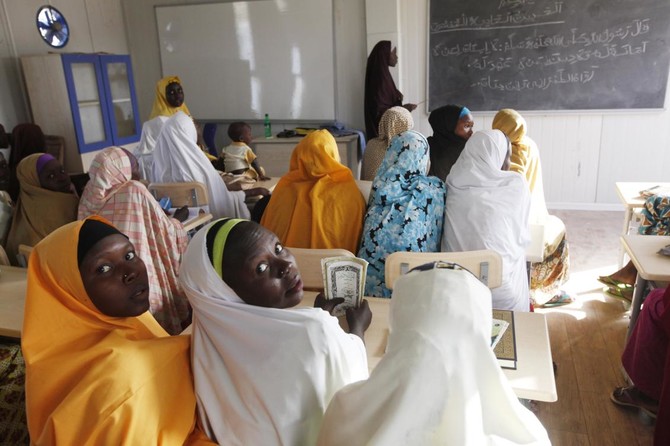
Boko Haram's ongoing insurgency in northern Nigeria has forced the closure of more than 57 percent of schools in Borno state. (AP)
Updated 29 September 2017
Follow

UN warning over school closures in NE Nigeria

LAGOS: Most schools in the state worst-hit by the Boko Haram conflict remain shut, the UN children’s agency said on Friday, blaming the militants for deliberating targeting education.
Unicef said at least 57 percent of schools in Borno state were closed as the new academic year began this month, with teacher numbers as well as buildings badly hit by the violence.
More than 2,295 teachers have been killed and 19,000 displaced, while nearly 1,400 schools have been destroyed in eight years of fighting, it added in a statement.
Schools were shut because they were too badly damaged or were located in areas still deemed unsafe despite a sustained military fight-back against the militants since 2015.
Unicef warned the situation threatened to create “a lost generation of children, threatening their and the country’s future” if nothing was done.
The agency’s deputy executive director Justin Forsyth said on a visit to the northeast that the effect of the insurgency on education was “no accident.”
“This was a deliberate strategy (by Boko Haram) to destroy opportunity for children to go to school,” he told AFP in a telephone interview from the Borno state capital, Maiduguri.
Boko Haram’s name roughly translates from the Hausa language spoken widely across northern Nigerian to “Western education is sin.”
Its fighters have repeatedly targeted schools teaching a secular curriculum.
In March last year, the Borno state government said 5,335 classrooms and school buildings in 512 primary, 38 secondary and two tertiary institutions had been damaged or destroyed.
Boko Haram’s kidnapping of more than 200 girls from their school in the Borno town of Chibok in April 2014 brought global attention to the conflict.
Forsyth said some three million children needed emergency education support but there was a huge shortfall to fund Unicef’s programs in the region, he added.
Some 750,000 children have been enrolled in school this year in Borno and neighboring Yobe and Adamawa, which have also been badly hit by the fighting.
For some, such as those in camps for those made homeless by the conflict, it is the first time they have received formal teaching.
Overall, at least 20,000 people have been killed in the fighting and more than 2.6 million made homeless.
Nigeria’s military and government claim the Daesh group affiliate is a spent force but attacks, including suicide bombings, remain a constant threat.
Unicef has repeatedly highlighted the effect of the insurgency on children and called the rebels’ use of boys and particularly girls as human bombs an “atrocity.”
As of late last month, 83 children had been strapped with explosives and used to carry out bomb attacks — four times as many as in all of last year.
The agency has also warned about acute food shortages that have left hundreds of thousands of people on the brink of famine in northeast Nigeria.
The UN’s head of humanitarian affairs and emergency relief, Mark Lowcock, said this month that the threat of famine had been “averted.”
Unicef said the intervention of aid agencies was making a difference but some 450,000 children under five were still expected to suffer from severe acute malnutrition this year.
Forsyth said there were currently some 2,800 cases of severe acute malnutrition at the camp in the border town of Banki and high numbers also in Maiduguri.
“It’s not out of control but the levels are very high,” he said, attributing the rise in cases in part to greater accessibility to areas previously cut off by the fighting.


US judge blocks Trump plans to end of deportation protections for South Sudanese migrants

Updated 7 sec ago
Follow

US judge blocks Trump plans to end of deportation protections for South Sudanese migrants

  • Kelley issued the order after four migrants from South Sudan along with African Communities Together, a non-profit group, sued

BOSTON: A federal judge on Tuesday blocked plans ​by US President Donald Trump’s administration to end temporary protections from deportation that had been granted to hundreds of South Sudanese nationals living in the United States.
US District Judge Angel Kelley in Boston granted an emergency request by several South Sudanese nationals and an immigrant rights group to prevent the temporary protected status they had been granted from expiring as planned after January 5.
The ruling is a temporary victory for immigrant advocates and a setback for the Trump administration’s broader effort to curtail the humanitarian program. It is the latest in a series of legal ‌challenges to the ‌administration’s moves to end similar protections for nationals from several ‌other ⁠countries, including ​Syria, Venezuela, ‌Haiti and Nicaragua.
Kelley issued the order after four migrants from South Sudan along with African Communities Together, a non-profit group, sued. The lawsuit alleged that action by the US Department of Homeland Security was unlawful and would expose them to being deported to a country facing a series of humanitarian crises.
Kelley, who was appointed by Democratic former President Joe Biden, issued an administrative stay that temporarily blocks the policy pending further litigation.
She wrote that allowing it to take effect before the courts had time ⁠to consider the case’s merits “would result in an immediate impact on the South Sudanese nationals, stripping current beneficiaries of lawful status, ‌which could imminently result in their deportation.”
Homeland Security Department spokesperson ‍Tricia McLaughlin said in a statement that the ‍judge’s ruling ignored Trump’s constitutional and statutory authority and that the temporary protected status extended to ‍South Sudanese nationals “was never intended to be a de facto asylum program.”
Conflict has ravaged South Sudan since it won independence from Sudan in 2011. Fighting has persisted in much of the country since a five-year civil war that killed an estimated 400,000 people ended in 2018. The US State Department advises citizens not ​to travel there.
The United States began designating South Sudan for temporary protected status, or TPS, in 2011.
That status is available to people whose home countries ⁠have experienced natural disasters, armed conflicts or other extraordinary events. It provides eligible migrants with work authorization and temporary protection from deportation.
About 232 South Sudanese nationals have been beneficiaries of TPS and have found refuge in the United States, and another 73 have pending applications, according to the lawsuit.
Homeland Security Secretary Kristi Noem published a notice on November 5 terminating TPS for South Sudan, saying the country no longer met the conditions for the designation.
The lawsuit argues the agency’s action violated the statute governing the TPS program, ignored the dire humanitarian conditions that remain in South Sudan, and was motivated by discrimination against migrants who are not white in violation of the US Constitution’s Fifth Amendment.
“The singular aim of this mass deportation agenda is to remove as many Black and Brown immigrants from this ‌country as quickly and as cruelly as possible,” Diana Konate, deputy executive director of policy and advocacy at African Communities Together, said in a statement.