Formula One: Drain cover blow-out prompts track safety check

1 / 2
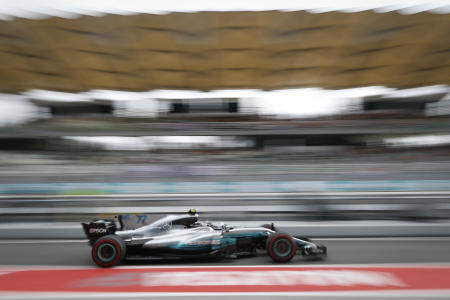
Mercedes driver Valtteri Bottas of Finland drives in the pit lane during during the second practice at the Sepang International Circuit for the first practice session for the Malaysian Formula One Grand Prix in Sepang, Malaysia, Friday, Sept. 29, 2017. (AP)
2 / 2
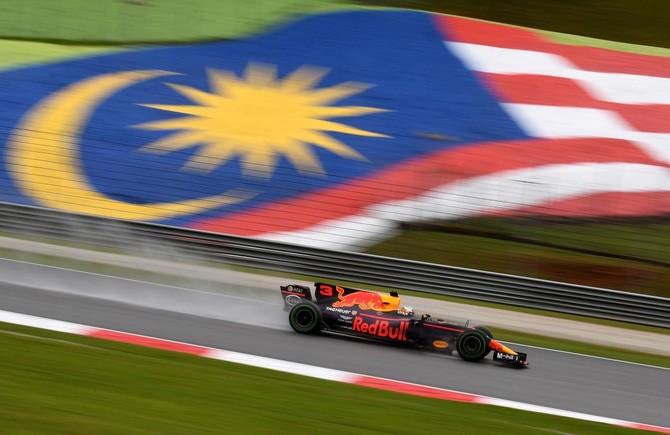
Red Bull’s Australian driver Daniel Ricciardo powers his car during the first practice session of the Formula One Malaysia Grand Prix in Sepang on Sept. 29, 2017. (AFP)
Updated 29 September 2017
Follow

Formula One: Drain cover blow-out prompts track safety check

SEPANG, Malaysia: Formula One officials launched an inspection of every drain cover at the Sepang circuit Friday after Romain Grosjean suffered a frightening tire explosion during Malaysian Grand Prix practice.
A drain grille, which should have been welded down securely, popped up at a kerb on turn nine after Kimi Raikkonen’s Ferrari drove over it.
A few seconds later Grosjean hit the same spot at more than 200 kilometers (124 miles) an hour, with disastrous effect.
The impact instantly ripped his right rear tire from its rim and threw his Haas into the barriers.
Happily Grosjean was able to walk away, and declared “I’m all right” as the second practice session was red-flagged with 20 minutes remaining with a gaping hole left in the track.
“I’ve just seen the footage. I didn’t see anything,” Grosjean told reporters.
“The next thing I knew was that the car was not there any more. It was just spinning and heading for the wall.”
Race director Charlie Whiting said that the cover had been welded down but had broken loose and would be replaced.
Asked if that meant his crew now had to inspect and repair every drain cover on the 5.543-kilometer layout, Whiting said: “Yes. For the rest of the day we shall concentrate on that. They’ve been welded a long time I expect.
“So we shall re-weld where necessary and then tonight we shall check everything. We have to get it fixed for tomorrow.”
Red Bull’s Daniel Ricciardo said it was not something that any driver wanted to worry about when entering a corner at high speed.
“Hopefully they check all the drains tonight,” the Australian told reporters after practice.
“Obviously it needs some attention. Because you do not want to think about it in the race. Some corners you really need to use the kerbs to let the corner flow and to use the momentum flow. So hopefully they fix it all.”
His team boss Christian Horner echoed the concern. “It was a good thing that nobody was hurt,” he told a press conference.
“Obviously the session was stopped and I’m sure all the covers will be inspected vigorously before tomorrow’s running so there are no repeat issues.”


Football’s return to Syrian pitches brings fanfare — and friction

Updated 31 December 2025
Follow

Football’s return to Syrian pitches brings fanfare — and friction

RIYADH: Just 10 days after the first anniversary of Syria’s Liberation Day, and one week after the historic performance of the country’s football team at the 2025 Arab Cup — where they reached the quarterfinals — domestic football returned as the Syrian Premier League kicked off its new season.

While league football has continued intermittently since a one-year suspension in 2011, this season represents a notable shift.

For the first time since 2017, the competition features 16 teams playing a full round-robin format — a return to structural normality after years of disrupted campaigns, withdrawals and operational challenges caused by conflict and deteriorating infrastructure.

Foreign players have also returned in significant numbers. A total of 25 overseas players are registered across the 16 clubs in what is now known as the “Prime TV” Syrian Premier League, following the broadcaster’s acquisition of domestic broadcasting rights for the season.

Yet despite the sense of renewal, the league’s reset has been far from smooth. Average attendances remain well below pre-war levels, while the season itself was delayed multiple times before eventually beginning in mid-December — a schedule that is now expected to extend deep into the summer months.

Concerns over facilities and fan safety have already sparked internal tension. The anticipated Matchday Two fixture between Tishreen and Hottin — also known as the Latakia Derby — was postponed by the Syrian Football Association until further notice. No official explanation was provided, but stadium readiness and crowd safety has been at the core of football discussion in Syria.

Supporters have also voiced their frustration over the newly announced ticket prices. Entry fees increased from 5,000 Syrian pounds ($0.45) to 15,000 SYP, a threefold rise announced by the SFA and widely cited as a factor behind subdued crowds.

Infrastructure remains a pressing issue. Historic venues such as Khalid Ibn Al-Walid Stadium in the city of Homs are still not cleared to host games due to pitch conditions and safety requirements, reinforcing the sense of uneven progress — advances made, but frequently offset by new obstacles.

Operational shortcomings were evident as early as the first game of the season. In the opening fixture between Al-Shorta and Hottin, a formal warning was issued to the former by the Disciplinary and Ethics Committee due to a breach in organizational arrangements for the match, including the failure to provide ball boys, which led to a five-minute delay to kick-off.

Political sensitivities have not been easy to navigate either. Al-Karamah were fined 1,500,000 SYP after fans directed verbal abuse at Al-Wahda player Milad Hamad, due to previous political posts made on his Facebook account.

Five days later, Al-Wahda announced Hamad’s suspension from all sporting activities pending review by the relevant committee at the SFA. “This decision comes in solidarity with all our beloved Syrian fans and as a reaffirmation of our commitment to the unity of our people and our land, and to the fact that the blood of our martyrs in the Syrian Revolution has not been shed in vain,” the club said in a statement posted via their official Facebook page.

Rebuilding a sustainable football system in Syria has proven complex. The league’s return has brought moments of excitement alongside renewed tension — a reminder that restoring domestic football is not simply about restarting competition, but about addressing the structures that support it. The Syrian Football Association was contacted for comment, but did not respond.