MOSCOW: Three years ago, Petimat Atagayeva’s daughter Zalina secretly left Russia for Syria, taking her 10-month-old baby boy with her, to join Daesh.
Since then, her mother has led an agonizing search, desperate for any trace of her daughter and grandchild.
“She was a beautiful and intelligent young woman. She was the best in the family. How could she have done this?” Atagayeva told AFP in Moscow, where she and several other women whose daughters had joined Daesh were meeting officials.
The women, who mostly come from the regions of Chechnya, Dagestan and Ingushetia in Russia’s North Caucasus, spoke to AFP in a hotel, on a trip to the Russian capital organized by Chechnya’s rights ombudsman.
The stories they tell are eerily similar: Their well-educated daughters, some of whom had just left school, secretly went to join husbands in Iraq or Syria where they lived for years with the terrorists and brought up children before disappearing without a trace as Daesh retreated.
Another missing woman, Zyarat, a young English teacher at a school in Dagestan went to Turkey in 2015, ostensibly for a family holiday.
“I was happy for them,” said her mother Zhanet Erezhebova, her voice trembling with emotion.
“But a month later, I received a text message from an unfamiliar number: ‘Mum, I can’t come home’,” she said.
“I tried to contact her husband, to ask him to give me back my daughter, to ask him why, but he didn’t want to talk to me,” said Erezhebova, who has come to Moscow with the other women in search of help.
A few months later, her daughter told her that her husband had been killed in Mosul, then the Daesh bastion in Iraq. “She was pregnant with twins. She was crying, she was asking for my forgiveness.”
Their contact became less and less frequent as Iraqi troops advanced against the terrorists.
Her daughter’s last message came in November last year: “Mum, our situation is difficult. If you don’t get any more news from me, please find and save my children.”
“Since then I have been searching for them, but I haven’t found them,” said the elderly woman, weeping.
A Chechen woman, who gave her name only as Patimat, said she had managed to visit her daughter and grandchildren in Manbij in Syria in 2015 when it was a Daesh hub.
“Their situation was precarious. They didn’t have electricity or hot water,” she said.
“I begged her to come back with me to Russia, but she said her husband would never let her leave — that it was pointless.
“She hadn’t wanted to come to Syria but she was obliged to follow her husband, as is the tradition. She was 19.”
In April, Patimat’s daughter told her that her husband was dead, then there was no more word from her.
“All we can do is wait and hope,” she said.
Aza Khayurina from Ingushetia had never traveled abroad before. But in 2015 when her daughter told her she was in Iraq, she immediately took a bus to Istanbul, hoping to get some news.
“She wasn’t allowed to go out of the house without her husband, but he was sent on exercises. Three days later, they told her he was dead. She was pregnant,” Khayurina said.
Khayurina later went seven times to Turkey, hoping to get her daughter back using people smugglers, who all turned out to be swindlers.
In her last message, her daughter told her she had lost 70 percent of her vision.
“She sent me a photo. She had lost so much weight, it was horrible. She looked like an 80-year-old woman,” Khayurina said, fighting back tears.
Several thousand Russians, most from the majority-Muslim regions in the Caucasus, traveled to join terrorists in Syria and Iraq, according to estimates from the Russian security services.
As Daesh loses ground, relatives are now turning to the authorities in the hope of finding their loved ones lost in the chaos of the conflict.
“We are going mad. We don’t even know where to turn anymore,” said one of the women, Larisa, whose daughter Khava went to Mosul two years ago.
“We can’t sleep at night anymore. We constantly see their faces.”


![]()
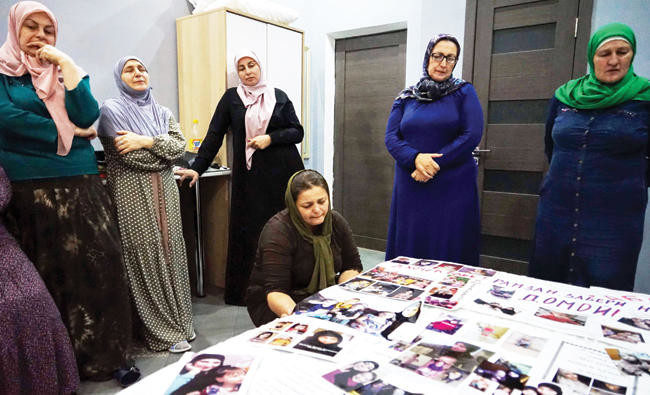
Russian women desperately seek daughters who became Daesh wives in Syria, Iraq
Russian women desperately seek daughters who became Daesh wives in Syria, Iraq

Latest updates


© 2026 SAUDI RESEARCH & PUBLISHING COMPANY, All Rights Reserved And subject to Terms of Use Agreement.