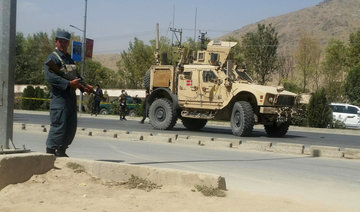
KABUL: More than 30 rockets were fired on Kabul international airport in attacks reportedly lasting more than six hours on Wednesday. The bombardment took place just hours after US Defense Secretary James Mattis and NATO General Secretary Jens Stoltenberg arrived in Afghanistan on an unannounced visit.
One resident was killed and 11 others were wounded, the Interior Ministry said. One salvo, according to police sources, included at least 12 rockets originating from two locations — to the east and northeast of the airport. It was the first major attack on the airport for many years. All flights were canceled.
The Taliban claimed responsibility and said Mattis was the target of the attack. Daesh also claimed responsibility. Both Mattis and Stoltenberg had already left the airport before the attack, Najib Danish, spokesman for the Afghan Interior Ministry, told CNN.
The defense secretary was visiting Kabul for talks with President Ahsraf Ghani, their first such meeting since US President Donald Trump announced his new strategy for Afghanistan in late August that included increased action against the Taliban who have gained ground in various parts of the country in recent months.
Both Mattis and Stoltenberg appeared at a press conference with Ghani, who described the rocket strike as a sign of the Taliban’s “weakness, not strength.”
“I want to reiterate to the Taliban that the only path to peace and political legitimacy for them is through a negotiated settlement,” Mattis said at the press conference.
Afghan officials said that Mattis and Stoltenberg spoke with Ghani about plans to strengthen Afghanistan’s military.
Trump has urged NATO allies to step up contributions of both troops and funding to the Afghanistan mission. Stoltenberg said the credibility of the international alliance depended on maintaining its support, adding that the coalition realized the importance of staying in Afghanistan.
Mattis also urged Pakistan to join the US in its new strategy for South Asia in the campaign against terrorism, describing it as a “good opportunity” for Islamabad.
Ghani also said: “It is a golden opportunity for (Pakistan),” adding that, if the peace process with the Taliban bears fruit, it will be a major boost for the fight against terrorism.
Stoltenberg urged the Taliban to join the peace process, saying they “cannot win on the battlefield.”
He added that NATO is aware of the cost of staying in Afghanistan, but explained, “The cost of leaving would be higher. If NATO forces leave too soon, there is a risk Afghanistan may return to a state of chaos and once again become a safe haven for international terrorism.”
Najib Mahmoud, a professor at Kabul University’s Law and Political Science faculty, believes it was a coincidence that the attack coincided with Mattis’ visit, and that the Taliban claimed he was the target to make it appear as though they had prior knowledge of his officially unannounced arrival.
“The Taliban and their supporters want to pass on two messages with the attack; their opposition to (Trump’s) strategy and to show the weakness of Afghanistan’s intelligence for not being able to discover and foil the attack in advance,” Mahmoud said.
He pointed out that Mattis’ Kabul trip followed his visit to India, during which “he urged Indian authorities to get more engaged in Afghanistan.” The arrival of Mattis and the NATO secretary general in the country would deliver “a serious message to the militants and the region,” said Mahmoud said.


![]()

Taliban claim responsibility for Kabul airport attack during Mattis visit
Taliban claim responsibility for Kabul airport attack during Mattis visit


Latest updates


© 2026 SAUDI RESEARCH & PUBLISHING COMPANY, All Rights Reserved And subject to Terms of Use Agreement.