MANILA: The Philippines has banned companies from compelling women to wear high heels to work under a government order hailed by a labor group Monday as a victory against sexism and pain.
The labor department order took effect on Sunday as the government took up the cudgels for long-suffering shopping mall clerks, hotel receptionists and flight attendants.
Employers should implement the use of “practical and comfortable footwear” to improve the health of workers who stand for long periods, said the order, which applies to heels measuring 2.54-centimeters (one inch) or higher unless the employee chooses to wear them.
“It’s a form of torture. It’s a form of oppression and slavery. Imagine having to endure that pain for eight to 10 hours a day,” Alan Tanjusay, spokesman for the Associated Labor Unions, told AFP.
“It’s also a form of sexism because culturally employers say women wearing high heels look taller and sexier and are then more attractive, more effective in selling products. They don’t know the women are suffering.”
The department order said female sales clerks and security guards who had been compelled to work in high heels suffered from sore feet, aching muscles and “hazardous” pressure on joints.
“These (work shoes) should not pinch the feet or toes; are well-fitted and non-slipping; provide adequate cushion and support to the arch of the feet; either flat or with low heels that must be wide-based or wedge type,” it said.
The labor department also ordered companies to give these workers rest periods or seats to reduce the time they spend standing or walking.
Tanjusay said unions lobbied the labor department last month following complaints from saleswomen, hotel receptionists and flight attendants.
Malls are a mainstay in the Southeast Asian nation, mainly employing women as sales clerks, cashiers and so-called “promo girls.”
Most of these women are short-term contract workers, Tanjusay said.
Under the department order female workers can still wear high heels if they prefer them, Tanjusay added.


![]()
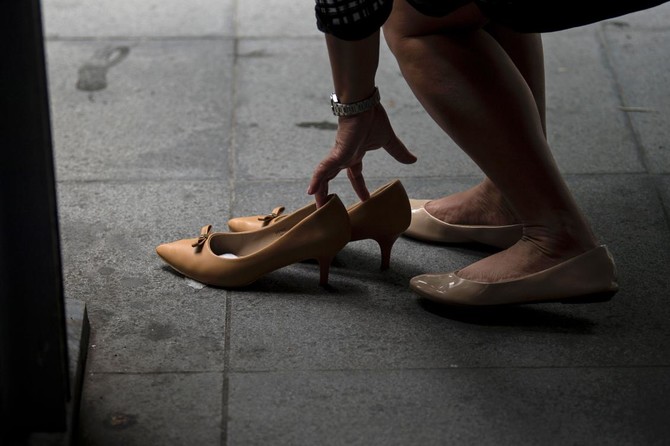

Philippines bans compulsory high heels in workplace
Philippines bans compulsory high heels in workplace
Trump praises new Honduras leader after talks in US
- Nasry Asfura was sworn in last week after winning November elections with Donald Trump’s backing
- US president threatened to cut aid to Honduras if his ‘friend’ was defeated
WASHINGTON: US President Donald Trump on Saturday praised Honduran counterpart Nasry Asfura, whom he endorsed on the campaign trail, following a meeting at his Mar-a-Lago resort.
Asfura, a conservative businessman and former mayor of Honduran capital Tegucigalpa, was sworn in last week after winning November elections with Trump’s backing.
Trump had threatened to cut aid to Central America’s poorest country if his “friend” was defeated.
“I had a very important meeting with my friend, and the President of Honduras, Nasry ‘Tito’ Asfura,” Trump wrote on his Truth Social platform.
“Once I gave him my strong Endorsement, he won his Election! Tito and I share many of the same America First Values. We have a close partnership on Security.”
He said the pair discussed investment and trade between the two nations.
Asfura is set to speak to media about the talks Sunday.
The Honduran presidency released a photo of the two leaders smiling and giving a thumbs up.
Asfura already met with US Secretary of State Marco Rubio on January 12, after which the two countries announced plans for a free trade deal.
His win gave Trump another ally in Latin America after conservatives campaigning heavily on crime and corruption replaced leftists in Chile, Bolivia, Peru and Argentina.
Trump has been pressuring countries in Washington’s backyard to choose between close ties with Washington or Beijing.
Asfura, who succeeded left-wing leader Xiomara Castro, has said he is considering switching diplomatic ties from China to the self-ruled island of Taiwan.
On the eve of the Honduran election, Trump in a surprise move pardoned former president Juan Orlando Hernandez, from Asfura’s party, who was serving a 45-year prison sentence in the US for drug trafficking.
Hernandez was convicted of helping to smuggle 400 tonnes of cocaine into the United States.
Trump’s decision to pardon him, even as US forces were blowing up alleged drug boats in the Caribbean and tightening the noose on Venezuela’s Nicolas Maduro, whom Washington accuses of drug trafficking, drew heavy criticism.
Asfura, a conservative businessman and former mayor of Honduran capital Tegucigalpa, was sworn in last week after winning November elections with Trump’s backing.
Trump had threatened to cut aid to Central America’s poorest country if his “friend” was defeated.
“I had a very important meeting with my friend, and the President of Honduras, Nasry ‘Tito’ Asfura,” Trump wrote on his Truth Social platform.
“Once I gave him my strong Endorsement, he won his Election! Tito and I share many of the same America First Values. We have a close partnership on Security.”
He said the pair discussed investment and trade between the two nations.
Asfura is set to speak to media about the talks Sunday.
The Honduran presidency released a photo of the two leaders smiling and giving a thumbs up.
Asfura already met with US Secretary of State Marco Rubio on January 12, after which the two countries announced plans for a free trade deal.
His win gave Trump another ally in Latin America after conservatives campaigning heavily on crime and corruption replaced leftists in Chile, Bolivia, Peru and Argentina.
Trump has been pressuring countries in Washington’s backyard to choose between close ties with Washington or Beijing.
Asfura, who succeeded left-wing leader Xiomara Castro, has said he is considering switching diplomatic ties from China to the self-ruled island of Taiwan.
On the eve of the Honduran election, Trump in a surprise move pardoned former president Juan Orlando Hernandez, from Asfura’s party, who was serving a 45-year prison sentence in the US for drug trafficking.
Hernandez was convicted of helping to smuggle 400 tonnes of cocaine into the United States.
Trump’s decision to pardon him, even as US forces were blowing up alleged drug boats in the Caribbean and tightening the noose on Venezuela’s Nicolas Maduro, whom Washington accuses of drug trafficking, drew heavy criticism.
Latest updates


Recommended


© 2026 SAUDI RESEARCH & PUBLISHING COMPANY, All Rights Reserved And subject to Terms of Use Agreement.