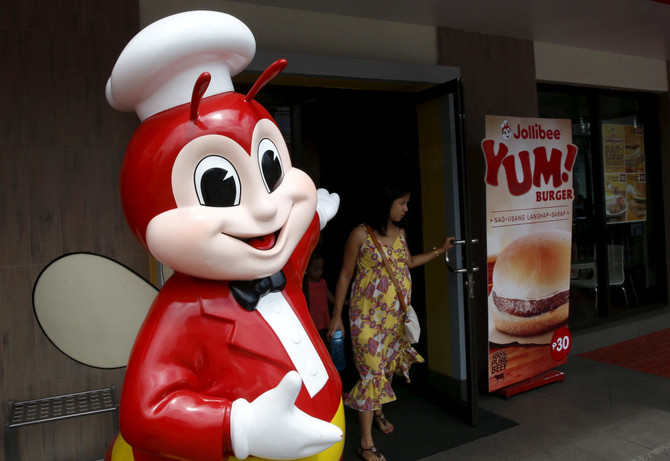
MANILA/SINGAPORE: Filipino billionaire Tony Tan Caktiong, who has built Jollibee Foods Corp. into a near-4,000 store purveyor of sweet-style spaghetti, burgers and fried chicken, is looking to buy existing brands in mature markets to help fuel future growth.
Dominant at home, where Jollibee has 1,000 eponymous stores welcoming diners with its smiling bee logo, Tan now wants to reshape the $5 billion group as a global fast-food company, bankers and fund managers say.
Primary targets include the United States and China, where it already has joint ventures, including Dunkin’ Donuts .
Tan, 64, said at a company event in July that half of Jollibee’s total sales would come from overseas stores in the next five years. Currently, foreign stores including joint ventures account for 30 percent of sales.
This week, people familiar with the matter said Jollibee was considering bidding for Pret A Manger, a UK-based chain selling organic coffee and wholesome sandwiches to office workers. It is still working out a valuation and has not yet decided to bid, the people said.
“Jollibee has to keep chasing growth. They own pretty much every large chain in their home market,” said a regional banker who has dealt with the company. “They are definitely not shy when it comes to looking at mature markets.”
Ysmael Baysa, Jollibee’s chief finance officer, told Reuters this week that buying new businesses “has always been part of our growth strategy.”
Tan started out with two ice cream parlours in the 1970s, and expanded Jollibee rapidly into a fast food chain dubbed “the McDonald’s of the Philippines.” Forbes ranks him as the country’s eighth-wealthiest man.
“They see where they could utilize the knowledge and synergies they have,” said Robert Ramos at Unionbank, who helps manage $795 million in funds and holds Jollibee stock. “They are increasing the revenue stream beyond the businesses they have now... They are choosing businesses in line with their core competence.”
As discretionary incomes have grown in Asia, the region has become the second-largest fast food market globally after North America.
Jollibee has created new domestic brands and has tie-ups with foreign chains. It bought a stake in Highlands Coffee, which outsells Starbucks in Vietnam, and opened its own outlets in Saudi Arabia and the United States.
“Premium credit”
Jollibee’s interest in Pret A Manger — which owner Bridgepoint is said to be preparing for a US listing this year — comes just two years after Tan paid around $100 million for a 40 percent stake in US-based chain Smashburger, his biggest overseas deal to date.
“If Jollibee wanted to do a $1 billion acquisition, it will have access to capital. It’s very liquid whether overseas or onshore. Jollibee is a premium credit,” said a person close to the company, who was not authorized to speak to the media and asked not to be named.
“Jollibee is very clear where they would like to grow: the Philippines, China and the US”
In China, the company operates about 400 stores of various brands, including joint ventures.
While Jollibee’s original menu is a hit at home and among the diaspora of millions of Filipinos working overseas, it’s a challenge to broaden its appeal to international diners — hence the drive to acquire global brands.
Jollibee’s revenue has more than tripled over the past decade to 113.9 billion pesos ($2.2 billion), its net income has jumped to 6.16 billion pesos, powered by strong consumer spending in one of the world’s fastest-growing economies, and its shares trade at around 242 pesos each, up from 51.50 pesos a decade ago.
Other Philippine companies, too, have used their plentiful cash and access to bank credit to make overseas deals, such as Universal Robina Corp’s acquisition of Snackbrands Australia for $462 million last year, and Alliance Global Group’s earlier $291 million buy of Bodegas Fundador from Beam Suntory. ($1 = 50.9390 Philippine pesos)

Fried chicken to crayfish wraps: Philippines’ Jollibee eyes deals to grow

Saudi Arabia sets global benchmark in AI modernization
- Executives hail the Kingdom’s robust infrastructure and strategic workforce programs
RIYADH: Saudi Arabia is emerging as a global leader in artificial intelligence, according to executives from OpenText, one of the world’s largest enterprise information management companies.
With 22 years of international AI experience, Harald Adams, OpenText’s senior vice president of sales for international markets, said the Kingdom’s modernization efforts are now setting a global standard.
“From my perspective, Saudi Arabia is not only leading the modernization towards artificial intelligence in the Middle East, I think it is even not leading it only in the MENA region. I think it is leading it globally,” Adams told Arab News.
In an interview, Adams and George Schembri, vice president and general manager for the Middle East at OpenText, discussed the Kingdom’s significant investments in AI during the inauguration of OpenText’s new regional headquarters in Riyadh.

“So for us (OpenText), from our perspective, it was a strategic decision to move our MENA headquarters to Saudi Arabia because we believe that we will see here a lot of innovation coming out of the country, we can replicate not only to the MENA region, maybe even further to the global level,” Adams said.
The new headquarters, located in the King Abdullah Financial District, will serve as a central hub for OpenText customers and partners across the Middle East. Its opening reflects a broader trend of tech giants relocating to Riyadh, signaling the Kingdom’s rise as a hub for global AI innovation.
Adams attributed Saudi Arabia’s lead in AI modernization to a combination of substantial financial backing, a unified national strategy, and a remarkable pace of execution.
“I mean, a couple of things, because the ingredients in Saudi Arabia are of course, quite interesting. On the one hand side, Saudi Arabia has deep pockets and great ambitions. And they are, I mean, and they are executing fast, yeah,” he said.
“So from that perspective, at the moment, what we see is that there are, especially on the government side, I can’t see any other government organizations globally moving faster into that direction than it is happening in Saudi Arabia. Not in the region, not even on a global level, they are leading the game,” he underlined.
Schembri added, “Saudi’s AI vision is one of the most ambitious in the world, and AI on a national scale is not good without trusted, secured, and governed, and this is where OpenText helps to enable the Saudi organizations to be able to deliver on the 2030 Vision.”
“The Kingdom’s focus on AI and digital transformation creates a powerful opportunity for organizations to unlock value from their information,” Schembri stated.
“With OpenText on the ground in Riyadh, our customers gain direct access to trusted global expertise combined with local insight — enabling them to manage information securely, scale AI with confidence, and compete on a global stage,” he added.
DID YOU KNOW?
• Saudi Arabia ranks 5th globally and 1st in the region for AI growth under the 2025 Global AI Index.
• The Kingdom is also 3rd globally in advanced AI model development, trailing only the US and China.
• AI is projected to contribute $235.2 billion — or 12.4 percent — to Saudi Arabia’s GDP by 2030.
The inauguration of OpenText’s new regional headquarters was attended by Canada’s Minister of International Trade and Economic Development, Maninder Sidhu, and Jean-Philippe Linteau, Canada’s ambassador to Saudi Arabia.
Sidhu emphasized the alignment of Saudi Vision 2030 with Canada’s economic and innovation goals.
“His Highness (Crown Prince Mohammed bin Salman) and Vision 2030, there is a lot of alignment with Canada, as you know, with the economic collaboration, with his vision around mining, around education, tourism, healthcare, you look at AI and tech, there’s a lot of alignment here at OpenText Grand opening their regional headquarters,” Sidhu told Arab News.
Saudi Arabia’s AI ambitions are projected to contribute $235.2 billion — or 12.4 percent — to its GDP by 2030, according to PwC. The Saudi Data and AI Authority, established by a royal decree in 2019, drives the Kingdom’s national data and AI strategy.
One flagship initiative, Humain, chaired by Crown Prince Mohammed bin Salman, was launched in May 2025 under the Public Investment Fund. It aims to build a full AI stack — from data centers and cloud infrastructure to models and applications — positioning Saudi Arabia as a globally competitive AI hub. The project plans to establish a data center capacity of 1.8 GW by 2030 and 100 GW of AI compute capacity by 2026.
Saudi Arabia is also expanding international partnerships. In May 2025, Humain signed a $5 billion agreement with Amazon Web Services to accelerate AI adoption domestically and globally, focusing on infrastructure, services, and talent development.

The Kingdom ranked fifth globally and first in the Arab region for AI sector growth under the 2025 Global AI Index, and third worldwide in advanced AI model development, behind only the US and China, according to the Stanford University AI Index 2025.
Education is another pillar of Saudi AI strategy. Starting in the 2025-26 academic year, AI will be taught as a core subject across all public school grades, reaching roughly 6.7 million students. The curriculum will cover algorithmic thinking, data literacy, and AI ethics.
OpenText executives emphasized their commitment to supporting Vision 2030 and the national AI strategy through workforce development.
“OpenText has put a lot of investment in the Kingdom, right. We brought cloud to the Kingdom, we’ve opened our headquarters in the Kingdom, we’ve basically hiring Saudis in the Kingdom, We basically building, if you like, an ecosystem to support the Kingdom. And on top of that, what we’re doing is we’re putting a plan together, if you like, a program to look at how we can educate, if you like, the students at universities,” Schembri said.
“So this is something that we are looking into, we are basically investigating and to see how we can support the Saudi nationals when they come into the workplace. And I’m really excited. I have Harry who is, our leadership who’s supporting this program.”
“It’s something that we are putting together. It’ll take some effort. So it’s still in play because we want to make sure what we put it basically delivers on what we're trying to achieve based on the vision of Saudi,” he added.
“The younger generation is sooner or later either working for us or maybe for a partner or for maybe for a customer. So that’s why we are to 100 percent committed to enable all of that,” Adams said.