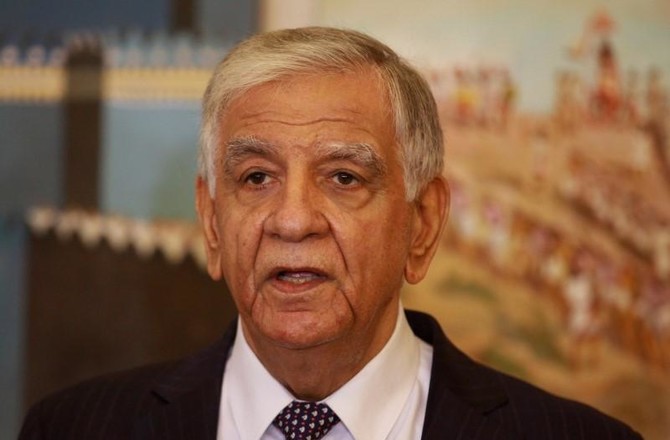
BAGHDAD: Iraq is committed to respecting its reduced oil production quota as agreed with the OPEC and other exporters, Oil Minister Jabar Al-Luaibi told a news conference on Sunday in Baghdad.
Al-Luaibi also said that talks are continuing with Royal Dutch Shell on the Majnoon oil field that the company is said to be seeking to quit.
“There are still negotiations, things are not clear,” Al-Luaibi said. “We haven’t initiated talks with other companies.”
A letter signed by Al-Luaibi, dated August 23 and seen by Reuters, gave approval for Shell to quit Majnoon, a major oilfield near Basra which started production in 2014.
OPEC ministers who met in Vienna on Friday said they may wait until January before deciding whether to extend output curbs meant to support prices beyond the first quarter of 2018.
OPEC members and other producers including Russia have cut production by about 1.8 million barrels per day (bpd) since the start of 2017, helping lift oil prices by 15 percent in the past three months.
OPEC and its allies have been considering extending the deal beyond the end of March 2018 when it is due to expire.
“We support the unity of OPEC and its consensus,” Al-Luaibi said when asked about whether Iraq would support an extension to the production cuts.

Iraq oil minister says committed to respecting its OPEC production quota
Saudi consumer inflation eases to 1.8% in January: GASTAT
RIYADH: Saudi Arabia’s inflation softened to 1.8 percent in January, signaling contained price pressures even as housing rents remained the main driver of consumer costs, official data showed.
According to the General Authority for Statistics, average prices for housing, water, electricity, gas and other fuels rose 4.2 percent in January, reflecting a 5.2 percent increase in actual residential rents.
Saudi Arabia’s inflation trajectory broadly aligns with projections by the International Monetary Fund, which said in October the Kingdom is expected to maintain an annual inflation rate of about 2 percent in 2026.
In its latest report, GASTAT stated: “The Consumer Price Index in Saudi Arabia recorded an annual increase of 1.8 percent in January 2026, compared to the same month of the previous year.”
It added: “This increase was mainly driven by a rise in housing, water, electricity, gas, and other fuel prices by 4.2 percent, transport prices by 1.5 percent and restaurant and accommodation services prices by 1 percent.”
According to the report, expenses for personal care, social protection and miscellaneous goods and services increased 7.9 percent year on year in January, while insurance and financial services costs rose 3.3 percent.
Prices for recreation, sport and culture increased 2.3 percent, driven by a 3.7 percent rise in package holiday expenses. Education service prices rose 1.6 percent, reflecting higher secondary education costs.
Food and beverage prices increased 0.2 percent year on year.
Conversely, prices for furnishings, household equipment and routine household maintenance fell 0.3 percent in January, while healthcare expenses declined 0.1 percent over the same period.
On a month-on-month basis, Saudi Arabia’s CPI rose 0.2 percent in January from December.
Housing, water, electricity, gas and other fuels increased 0.5 percent month on month, again driven by higher residential rents. Transport prices rose 0.2 percent, while restaurant and accommodation services gained 1 percent.
Food and beverage prices fell 0.6 percent during the month, and information and communication costs slipped 0.1 percent. Education, healthcare, furnishings and tobacco prices were largely unchanged.
Wholesale Price Index
In a separate report, GASTAT said Saudi Arabia’s Wholesale Price Index rose 2.9 percent in January compared with the same month in 2025.
The increase was attributed to higher prices for other transportable goods — excluding metal products, machinery and equipment — which climbed 4.9 percent, as well as agricultural and fishery products, which rose 4.2 percent.
Metal products, machinery and equipment prices increased 1.2 percent year on year in January, while food products, beverages, tobacco and textiles rose 0.3 percent. Ores and mineral prices declined 0.1 percent.
Compared with December, the Kingdom’s WPI increased 1.5 percent, driven by a 3.4 percent rise in other transportable goods excluding metal products, machinery and equipment.
On a month-on-month basis, agricultural and fishery product prices increased 0.5 percent, while food products, beverages, tobacco and textiles posted a modest 0.2 percent gain.
Average prices
In another report, GASTAT highlighted notable changes in average prices of goods and services across Saudi Arabia in January.
Local watermelon recorded the largest month-on-month increase at 7.5 percent, followed by local black eggplants at 6.5 percent, local okra at 6.3 percent and Indian pomegranates at 6.1 percent.
Conversely, several items posted sharp price declines.
Abu Sorra Egyptian oranges recorded the steepest fall at 28.2 percent, followed by Pakistani mandarins at 21.3 percent and green beans at 12.3 percent.