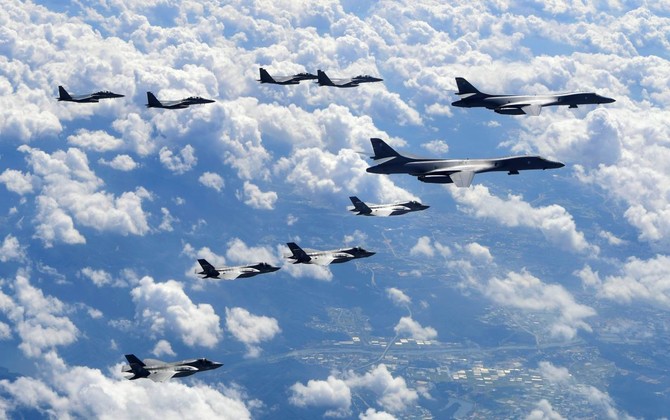
WASHINGTON: US bombers flew off the coast of North Korea Saturday in a show of force designed to project American military power in the face of Pyongyang’s weapons programs, the Pentagon said.
“This is the farthest north of the Demilitarized Zone (DMZ) any US fighter or bomber aircraft have flown off North Korea’s coast in the 21st century, underscoring the seriousness with which we take the DPRK’s reckless behavior,” Pentagon spokesman Dana White said in a statement, using the acronym for North Korea.

US bombers fly off east coast of North Korea: Pentagon
Russia increasing hybrid threats around Sweden: Swedish military intelligence
- “Russia has, in certain cases, stepped up actions and increased its presence,” Nilsson said
- Russia was “constantly developing its capabilities and was ready to take greater risks and use them“
STOCKHOLM: Russia has stepped up its hybrid threat activities and seems willing to take greater risks in Sweden and the region, the head of Sweden’s military intelligence told AFP on Tuesday.
“Russia has, in certain cases, stepped up actions and increased its presence — and perhaps with a greater risk appetite — in our vicinity,” Thomas Nilsson, head of Sweden’s Military Intelligence and Security Service (MUST), told AFP.
He added that he believed Moscow would “unfortunately” continue doing so — regardless of whether it succeeds in Ukraine or not.
Nilsson did not cite any particular attacks, but MUST said in its yearly threat review released Tuesday that Russia “has developed a wide range of methods that can be used within the framework of hybrid warfare,” including disinformation, cyberattacks, economic sanctions, intelligence operations, and election interference.
“A certain desperation can set in, where you push even harder to reach your goals,” Nilsson said, referring to Russia.
Conversely, he said that if Russia were to succeed “that can lead to an increased appetite for risk.”
Russia was “constantly developing its capabilities and was ready to take greater risks and use them.”
“Including what I call advanced sabotage. Including assassination plots, serious arson, and attacks on critical societal infrastructure,” he said.
In its review, the agency noted that so far “the most risk-prone actions through sabotage and hybrid measures have mainly affected other allies.”
But Nilsson also told AFP that Sweden’s security situation had continued to deteriorate, as it has in previous years, particularly since Russia’s 2022 invasion of Ukraine.
Russia is also the main “military threat to Sweden and NATO,” the review stated, warning the threat was likely to grow as Russia increases resources for its armed forces.
“Alongside resources for the war in Ukraine, Russia is reinforcing its resources in the Baltic Sea region, as it is a strategically very important region for Russia, both economically and militarily,” MUST wrote in the review.
MUST said that the Baltic Sea build-up “has already begun,” but added that “the pace will be affected” by the course of the war in Ukraine as well as the Russian economy and the country’s relations with China.
The report came as Russian and Ukrainian negotiators were due to meet in Geneva for fresh US-brokered talks seeking to end the four-year war, as both sides accused the other of a fresh wave of long-range strikes.