MADRID: Spain’s conservative government has dealt a serious blow to Catalonia’s plans to hold an independence referendum but it faces growing indignation in the region, which is closing ranks on Madrid.
Prime Minister Mariano Rajoy has said that after enforcing the law by blocking the referendum he is ready for dialogue with Catalonia, but his margin of maneuver is slim since party hard-liners and other Spanish regions are hostile to Catalan demands.
Following the arrest of 14 Catalan government officials and the seizure of nearly 10 million ballots, Catalonia’s vice president Oriol Junqueras acknowledged Thursday that the referendum slated for October 1 was compromised.
But the wealthy northeastern region of Spain, which is deeply divided on the question of secession, is more than ever united against Madrid. Thousands of people protested in Barcelona for the second day in a row against the referendum crackdown.
“Social indignation has spilled beyond the independence movement and spread to unions, university rectors, professional associations and emblematic institutions like FC Barcelona,” wrote Catalan daily El Periodico de Catalunya, which is opposed to independence, in an editorial.
Rival Catalan daily La Vanguardia agreed, writing that “many citizens without any ties to the sovereignty movement are deeply disgusted.”
“The logistics of the October 1 referendum are practically dismantled but the discontent of citizens is enormous,” it added.
The situation would be different if the measures taken to block the referendum had been “accompanied by a sincere proposal for political dialogue,” added La Vanguardia, which also opposes independence.
But since Rajoy came to power in December 2011 there has been no dialogue with Catalonia.
With an absolute majority in parliament he did not have to make concessions, unlike his predecessors, to Catalan lawmakers to get their votes.
He concentrated instead on measures to get Spain out of a deep economic crisis and was not willing to discuss Catalonia’s demands for greater fiscal autonomy.
Rajoy now says he is willing to discuss everything including a reform of how Spain’s regions are financed. But he has to take into account the position of the hard-liners in his Popular Party.
“I think there is a faction of the PP which would be willing to accept some reform but the hard-line faction is not willing to give an inch,” said Oriol Bartomeus, a political scientist at the Autonomous University of Barcelona.
Rajoy and his party were mistaken about the nature of the independence movement, which has surged since Spain’s Constitutional Court in 2010 struck down part of a 2016 autonomy statute in response to an appeal by the PP, he added.
The autonomy statute, which granted more powers to Catalonia and recognized it as a nation, had been approved by the Spanish parliament.
The PP always compared the rise in separatism to a soufflé that could collapse, said Bartomeus.
“They believed that (the independence movement) was organized by a nationalist elite to remain in power but in fact 80 percent of the Catalan population felt ‘I can’t take it anymore’,” he said.
Catalans want a new constitution to replace the one adopted in 1978 following the death of longtime dictator Francisco Franco and a statute like the one in place in the northern Basque Country which collects its own taxes and contributes little to Spain’s central coffers, Bartomeus said.
Juan Montades, a political scientist at the University of Granada, said that if the rules are changed, Andalusia, Spain’s most populous region which benefits from the redistribution of wealth from Catalonia, has warned that it would “be in the front line to defend its interests.”
Spain’s two main parties, the conservative PP and the Socialist Party (PSOE), “have always been acutely conscious of the fact that if they give a better deal to Catalonia they are going to lose voters in other parts of Spain,” said Caroline Gray, an expert on Spanish independence movements at Britain’s Aston University.
But “they can’t solve the Catalan crisis by playing to voters in other parts of Spain,” she added.


![]()
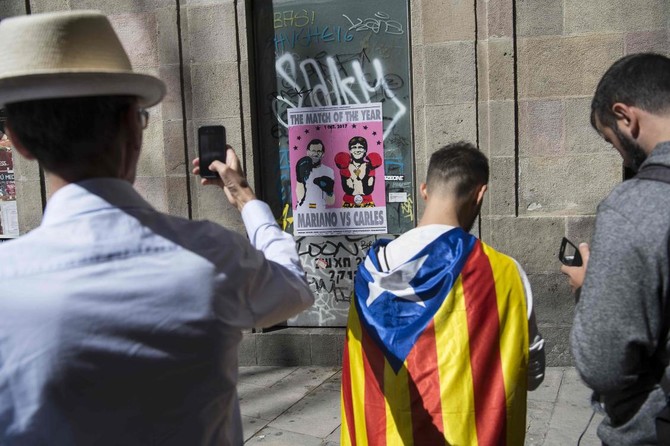
Catalonia closes ranks against Spain in referendum row
Catalonia closes ranks against Spain in referendum row


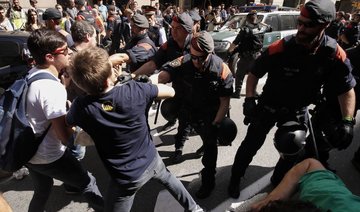
Latest updates




© 2026 SAUDI RESEARCH & PUBLISHING COMPANY, All Rights Reserved And subject to Terms of Use Agreement.