Egypt’s president urges Palestinians to unite, co-exist with Israel

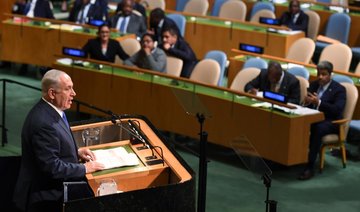
Abdel Fattah Al Sisi, president of Egypt, addresses the United Nations General Assembly in New York on Tuesday. (Drew Angerer/Getty Images/AFP)
Updated 20 September 2017
Follow

Egypt’s president urges Palestinians to unite, co-exist with Israel

UNITED NATIONS: Egypt’s President Abdel Fattah El-Sisi on Tuesday urged Palestinians to unite and “be ready to co-exist” in peace with Israelis, in his address to the United Nations.
Speaking a day after a first meeting with Israeli Prime Minister Benjamin Netanyahu, El-Sisi said an Israeli-Palestinian peace deal was a “necessary precondition for the entire region” to enjoy stability.
Egypt has been leading mediation efforts between Palestinian arch-rivals Fatah and Hamas as part of a push to return to the forefront of Middle East diplomacy.
Departing from his prepared remarks to the UN General Assembly, El-Sisi said he wanted to “tell the Palestinian people, it is important to unite ... to overcome the differences and to be ready to accept co-existence with the other, with Israelis, in safety and security.”
The Egyptian leader made a similar appeal to Israelis, saying that decades of Israeli-Egyptian peace could be expanded to the Palestinians to “overcome the barrier of hatred forever.”
“We can repeat this experience, this excellent step once again, together with the peace and security of the Palestinian citizens,” he said.
Egypt, which signed a peace treaty with Israel in 1979, has called for steps to kick-start Israeli-Palestinian talks that have been comatose since 2014.
In his address, Netanyahu said Israel was committed to achieving peace with all Arab countries and with the Palestinians, but he did not elaborate on how this could be achieved.
El-Sisi said “an independent Palestinian state” with east Jerusalem as its capital is “a necessary precondition for the entire region to transit into a new phase of stability and development.”
An Israeli-Palestinian peace deal would eliminate “one of the main excuses” used by terrorists in the region, he argued.
Turning to the United States where President Donald Trump has said he is pushing for negotiations, El-Sisi declared that there was an “opportunity to write a new page in history to achieve peace in this region.”
The meeting between Sissi and Netanyahu in New York on Monday followed a rare phone conversation between Palestinian leader Mahmud Abbas of Fatah and Hamas chief Ismail Haniya.
Egypt has been mediating between Abbas’ internationally recognized Palestinian Authority located in the West Bank and Hamas, which has controlled the Gaza Strip since 2007.
After Haniya met Egyptian officials in Cairo last week, Hamas announced it agreed to demands by Fatah to dissolve what is seen as a rival administration in Gaza, while saying it was ready for elections and negotiations to form a unity government.


Israeli police kill Bedouin man during raid in southern Israel, local official says

Updated 58 min 48 sec ago
Follow

Israeli police kill Bedouin man during raid in southern Israel, local official says

  • The shooting of 36-year-old Muhammed Hussein Tarabin threatened to worsen the already strained relations between the Israeli government and the country’s Bedouin minority

TEL AVIV: Israeli police shot and killed a Bedouin Arab man during an overnight raid in his village in southern Israel, according to media reports and a local official.
The shooting of 36-year-old Muhammed Hussein Tarabin threatened to worsen the already strained relations between the Israeli government and the country’s Bedouin minority.
Israeli police have been conducting a large-scale operation in the village of Tarabin for the past week in what they describe as a crackdown on local crime.
Talal Alkernawi, the mayor of the nearby town of Rahat, confirmed the man’s death.
Israeli police said they opened fire on a man who had “endangered” forces during an arrest raid.
The Israeli news site Haaretz cited relatives as saying Tarabin, whose family name shares the name of the village, was in his home.
In a video statement, Tarabin’s 11-year-old son, Hussein, said that men in uniform came to their house at night. He heard shots and saw his father’s body lying on the ground.
Israel’s far-right National Security Minister Itamar Ben-Gvir, who oversees the police force, expressed support for the police. “Anyone who endangers our police officers and fighters must be neutralized,” he posted on X.
Prime Minister Benjamin Netanyahu said Sunday that the country would do everything to prevent the Negev desert in southern Israel from becoming the “wild south”. He congratulated Ben-Gvir on leading the initiative and said he would visit the region in the coming days.
Israel’s more than 200,000 Bedouin are the poorest members of the country’s Arab minority, which also includes Christian and Muslim urban communities. Israel’s Arab population makes up roughly 20 percent of the country’s 10 million people. While they are citizens with the right to vote, they often suffer discrimination and tend to identify with Palestinians in the occupied West Bank and the Gaza Strip.
The Bedouin sector has grappled with crime and poverty, and about one-third of its members live in villages that the Israeli government considers illegal. Israel says it is trying to bring order to a lawless area, but Bedouin leaders accuse the government of neglect, trying to destroy their way of life or pushing to relocate them to less desirable areas.
Residents say police have made around two dozen arrests in the village of Tarabin over the past week. Nati Yefet, a spokesman for the regional council of unrecognized villages in the area, said most have been quickly released.
“They’re looking for people, crime-related things, but they didn’t find anything,” Yefet said. He accused Ben-Gvir of intensifying the raids in the run-up to elections expected later this year.
Marwan Abu Frieh, of the Arab rights group Adalah, said Israel has stepped up house demolitions in recent years, leaving thousands of residents without shelter and worsening the plight of communities often denied basic services.