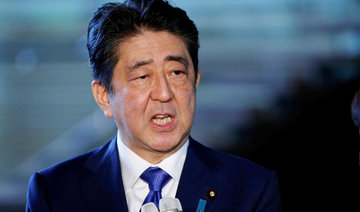
TOKYO: Pledges to spend on education and child care, stay tough on North Korea and revise the pacifist constitution are likely to be pillars of Japanese Prime Minister Shinzo Abe’s campaign in a snap election next month, government sources said on Tuesday.
Abe is considering calling the lower house poll when the legislature convenes on Sept. 28 to take advantage of his improved ratings and disarray in the opposition, ruling party and government sources have said.
The prime minister, whose ratings have recovered from below 30 percent in July, is betting his ruling bloc can at a minimum retain a simple majority in the chamber and at best keep the two-thirds super-majority needed to achieve his long-held goal of revising the constitution to clarify the military’s role.
Abe wants to go ahead with a planned rise in the nation’s sales tax to 10 percent from 8 percent and use some of the revenue to create a “social security system for all generations,” which would invest in education while decreasing the proportion of sales tax revenue used to pay down government debt, the sources said.
Japan’s social welfare system is weighted toward spending on the elderly, with people aged 65 and over accounting for a whopping 27.7 percent of the population according to the latest government data.
“You can promise anything you want — make a nod toward a more equitable society, empowering women, work-life balance, welfare for all generations,” said Jeffrey Kingston, director of Asian studies at Temple University Japan.
“He’s got a strategy that is going to win.”
Using less tax revenue to pay down debt, however, would make it more difficult to achieve the government’s target of returning to a primary budget surplus in fiscal 2020, which could in turn raise concerns about less rigid fiscal discipline.
“We have to maintain fiscal discipline, regardless,” Finance Minister Taro Aso told reporters when asked about the reports.
Abe has told reporters he will make a decision on the snap election after he returns from the United States on Sept. 22.
Japan’s opposition Democratic Party is struggling with single-digit support and a succession of defections. And while the nascent “Japan First” party, which boasts ties to popular Tokyo Governor Yuriko Koike, could be a viable challenger to Abe’s government, it has yet to draft a platform, pick candidates or formally register as a party.
That means Abe’s Liberal Democratic Party and its junior partner, the Komeito, have a shot at retaining their two-thirds majority in the lower house, political analysts said.
However, some analysts believe Abe’s electoral base could be undermined by voter distaste over suspected cronyism scandals and concerns about a political vacuum forming amid heightened tensions over North Korea’s nuclear and missile programs.
“I don’t dismiss the possibility of the voters giving Abe a nasty surprise,” said Gerry Curtis, professor emeritus at Columbia University in New York.

Japan’s Abe to pledge something for all generations in snap election-source
Ukraine says Russia launched a major aerial attack before Kyiv’s talks with US
- The bombardment targeted critical infrastructure and residential areas across eight regions of Ukraine, Zelensky said
- Dozens of people, including children, were injured, officials said
KYIV: Russia launched a barrage of 420 drones and 39 missiles at Ukraine overnight, President Volodymyr Zelensky said Thursday, as US and Ukrainian envoys held more talks in Geneva on ending the war that is now in its fifth year.
The bombardment, which included 11 ballistic missiles, targeted critical infrastructure and residential areas across eight regions of Ukraine, Zelensky said. Dozens of people, including children, were injured, officials said, though authorities did not immediately publish a confirmed total.
Zelensky said late Wednesday he had spoken by phone with US President Donald Trump and thanked him for his “efforts and engagement” in pursuing peace negotiations.
The US-brokered talks between Moscow and Kyiv are continuing but are deadlocked on the issue of the future of Ukrainian territory that Russia claims as its own.
Zelensky has pushed for a summit with Russia’s President Vladimir Putin, saying a face-to-face meeting could be decisive in unlocking an agreement, but the Kremlin has rebuffed that proposal beyond inviting the Ukrainian president to Moscow, which Zelensky refused.
Trump representatives Steve Witkoff and Jared Kushner, who were also discussing nuclear negotiations with Iran in Geneva before turning to the war in Europe, met with Rustem Umerov, the head of Ukraine’s National Security and Defense Council. They also joined Trump’s call with Zelensky.
The envoys were to discuss economic support and the recovery of Ukraine, ways of attracting investment to the country, and frameworks for long-term cooperation, Umerov said on X.
Also, the meeting would look at preparations for the next round of trilateral negotiations involving Russia and consider possible further exchanges of prisoner, according to Umerov.
Washington is looking to keep momentum in its yearlong push to stop the fighting and overcome deep enmity between the warring countries.
Ukrainian and European officials have accused Putin of feigning interest in peace negotiations, hoping to avoid punitive US measures such as additional sanctions while pressing forward with the invasion.
Thursday’s talks between the American and Ukrainian envoys were to address details of a possible postwar recovery plan for Ukraine and discuss preparations for an upcoming trilateral meeting with Moscow officials, perhaps next week, according to Zelensky.
He said he has also tasked Umerov with discussing a possible prisoner exchange.
Russia returned 1,000 bodies of fallen soldiers to Ukraine, and got back 35 bodies of its fallen troops, Vladimir Medinsky, the head of the Russian delegation at previous talks with Ukraine, said Thursday. He did not say when the exchange happened.
Ukraine’s Coordination Headquarters for the Treatment of Prisoners of War later confirmed the return, though it referred to “bodies which, according to preliminary information provided by the Russian side, may belong to Ukrainian defenders.”
Russia struck gas infrastructure in the Poltava region and electrical substations in the Kyiv and Dnipropetrovsk regions, Zelensky said. Emergency crews responded in five other regions, as well as in the capital.
Ukraine’s air defenses shot down most of the Russian missiles, Zelensky said, crediting Western partners for timely delivery of additional air defense interceptors. Ukraine needs foreign help to sustain its fight against Russia’s bigger forces.
Ukrainian Foreign Minister Andrii Sybiha urged allied countries to provide more military aid.
“When the whole world demands Moscow to finally stop this senseless war, Putin bets on more terror, attacks and aggression,” Sybiha said in a post on the Ministry of Foreign Affairs website.
The Russian Defense Ministry said its air defenses shot down 17 Ukrainian drones overnight over a number of Russian regions, as well as the Black and Azov Seas.
Ukraine’s domestically developed long-range drones have struck oil refineries, fuel depots and military logistics hubs deep inside Russia.
Meanwhile, Russia continued to push allegations of a purported plot by European nations to provide Kyiv with a nuclear bomb, without providing any evidence.
The Kremlin-controlled lower house of the Russian parliament on Thursday unanimously approved an address urging the United Nations and European lawmakers to prevent the alleged plan.
It followed a statement on Tuesday by the Russian foreign intelligence service alleging that France and the UK were planning to covertly transfer nuclear weapons or components of a “dirty bomb” device.
British and French officials said the claim was a lie.