Myanmar army chief urges unity over Rohingya ‘issue’

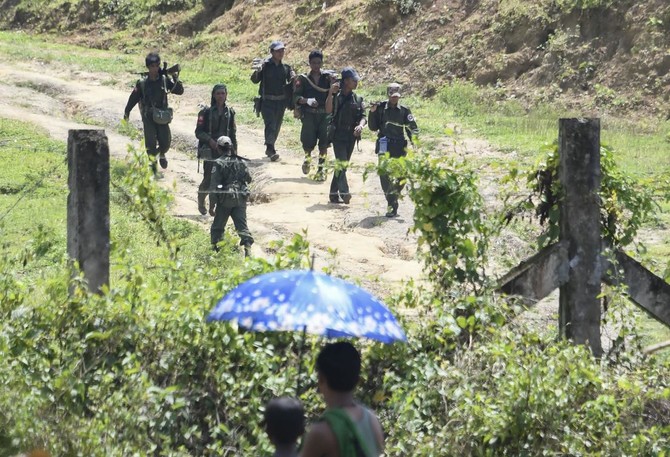
Myanmar soldiers patrol the other side of the no-man’s land area between Myanmar and Bangladesh. AFP
Updated 17 September 2017
Follow

Myanmar army chief urges unity over Rohingya ‘issue’

YANGON: Myanmar’s army chief has urged the country to unite over the “issue” of the Rohingya, a Muslim group he says has no roots in the country, and which his troops are accused of systematically purging.
The military says its “clearance operations” in northern Rakhine state are aimed at taking out Rohingya militants who attacked police posts on August 25.
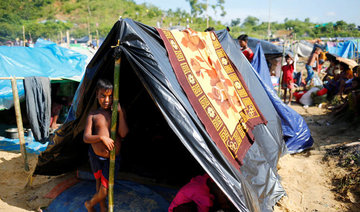
But the violence has engulfed the border region and triggered an exodus of more than 400,000 Rohingya to Bangladesh, where they have told of soldiers slaughtering civilians and burning down entire villages.
UN leaders have described the campaign as having all the hallmarks of “ethnic cleansing” of the Rohingya, a stateless group that has endured years of persecution and repression.
The status of the Muslim minority has long been an explosive topic in Myanmar.
Many in the Buddhist majority view the group as foreign interlopers from Bangladesh and deny the existence of a Rohingya ethnicity, insisting they be called “Bengalis”.
General Min Aung Hlaing, Myanmar’s globe-trotting army chief, trumpeted that view in comments posted on his official Facebook page Saturday.
“They have demanded recognition as Rohingya, which has never been an ethnic group in Myanmar. (The) Bengali issue is a national cause and we need to be united in establishing the truth,” the post said.
The defense of his army’s operations comes amid strident global condemnation of the violence, which has left Bangladesh with the overwhelming task of providing shelter and food to a rising tide of desperate refugees.
Myanmar’s civilian leader, former democracy activist Aung San Suu Kyi, has no power to control the army, which retains sweeping powers from its years of junta rule.
But she has been castigated for failing to voice sympathy for the Rohingya – a group she has asked her government to refer to only as “Muslims of Rakhine state”.
All eyes will be on the Nobel laureate as she addresses the nation on the crisis for the first time Tuesday, a high stakes speech that many outside the country hope will explain her near silence on the human tragedy that is unfolding.
The US has dispatched an envoy to Myanmar to express its “grave concern” with the violence in Rakhine, a US State Department official told AFP.
Patrick Murphy, Deputy Assistant Secretary for Southeast Asia, will meet with government leaders and travel to the state capital of Rakhine but not the conflict zone further north, the official said.
The US was a key partner in pushing along Myanmar’s democratic transition, which saw the army step down from 50 years of brutal junta rule and allow the free elections in 2015 that swept Suu Kyi into office.
The army still plays a powerful role in politics, with control over key ministries like borders and defense, plus a quarter of parliament.
Suu Kyi’s supporters inside the country, where she still enjoys saint-like status for her democracy struggle, have balked at the global criticism heaped on their leader and argued she must tread carefully around a military that still looms large in the fragile democracy.


Vatican offers dialogue with breakaway Latin Mass traditionalist group, but with a catch

Updated 4 sec ago
Follow

Vatican offers dialogue with breakaway Latin Mass traditionalist group, but with a catch

  • The Society of St. Pius X has been a thorn in the side of the Holy See for four decades
  • SSPX first broke with Rome in 1988 after its founder consecrated four bishops without papal consent
ROME: The Vatican warned a breakaway traditionalist Catholic group on Thursday that it risked going into schism if it goes ahead with plans to consecrate new bishops without papal consent, setting a hard line against a big doctrinal challenge facing Pope Leo XIV.
Cardinal Víctor Manuel Fernandez, head of the Vatican’s doctrine office, issued the warning during a meeting Thursday with the superior general of the Society of St. Pius X, the Rev. Davide Pagliarani, the Vatican said. The meeting was scheduled after the Swiss-based society, which celebrates the traditional Latin Mass but isn’t in communion with Rome, announced plans to consecrate new bishops July 1 without papal consent.
Fernandez offered a new round of theological talks to regularize the SSPX’s status, but only if it calls off the planned ceremony.
Pagliarani, for his part, defended the new consecrations but said he would take the Vatican proposal to his counselors for a final decision, which is expected in a few days, the SSPX said in a statement.
The SSPX has been a thorn in the side of the Holy See for four decades, founded in opposition to the modernizing reforms of the 1960s Second Vatican Council, which among other things allowed Mass to be celebrated in the vernacular.
The SSPX first broke with Rome in 1988, after its founder, Archbishop Marcel Lefebvre, consecrated four bishops without papal consent, arguing that it was necessary for the survival of the church’s tradition. The Vatican promptly excommunicated Lefebvre and the four other bishops, and the group today still has no legal status in the Catholic Church.
But in the decades since that original break with Rome, the group has continued to grow, with schools, seminaries and parishes around the world and branches of priests, nuns and lay Catholics who are attached to the pre-Vatican II traditional Latin Mass.
Growth of a parallel church
According to SSPX statistics, it counts two bishops, 733 priests, 264 seminarians, 145 religious brothers, 88 oblates and 250 religious sisters representing 50 nationalities, a Catholic reality that poses a real threat to Rome because of the specter of the growth of a parallel church.
For the Vatican, papal consent for the consecration of bishops is a fundamental doctrine, guaranteeing the lineage of apostolic succession from the time of Christ’s original apostles. As a result, the consecration of bishops without papal consent is considered a grave threat to church unity and a cause of schism, since bishops can ordain new priests. Under church law, a consecration without papal consent incurs an automatic excommunication for the person who celebrates it and the purported new bishop.
Pagliarani has said in comments on the SSPX website, and in the SSPX statement, that the consecrations of new bishops are necessary for the society’s survival, because the remaining two are getting old and are increasingly unable to tend to the needs of SSPX members around the world.
Offer of dialogue, with a catch
During the talks Thursday at the Vatican, Fernandez offered to open a theological dialogue with the SSPX to address concerns that they have outlined to the Vatican starting in 2017, especially concerning Catholic relations with other religions.
The aim, according to the Vatican statement, would be to identify the minimum points of agreement necessary to bring the SSPX back into communion with the Holy See and outline a legal status so it could exist within the church.
But it warned that such a dialogue would require the suspension of the planned bishop consecrations. Going ahead with them, the Vatican warned, “would imply a decisive break in the ecclesial communion (schism) with grave consequences for the Fraternity.”
Pagliarani justified the ordination of new bishops as both “realistic and reasonable,” given the number of people who attend SSPX Masses.
Long history of dialogue
The Vatican has tried for years to reconcile with the SSPX. Pope Benedict XVI in 2009 lifted the excommunications of the surviving bishops and relaxed restrictions on celebrating the old Latin Mass.
While offering some gestures to the SSPX, Francis reversed Benedict’s reform that allowed greater celebration of the old Latin Mass, arguing it had become a source of division in the church.
Catholic traditionalists say Francis’ crackdown had the result of pushing more faithful who were in communion with Rome into the arms of the breakaway SSPX, since they couldn’t find Latin Masses that were permitted by Rome.
Leo has acknowledged the tensions and sought to pacify the debate, expressing an openness to dialogue and allowing exceptions to Francis’ crackdown.
The Vatican, for example, said that Leo had explicitly approved Thursday’s encounter, which it described as “cordial and sincere.”