

Trump tweet on London police draws UK rebuke

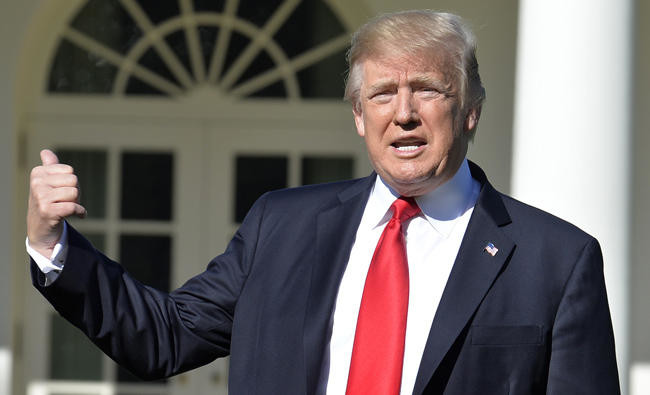
US President Donald Trump speaks about the bombing in London as he attends a photo opportunity in the White House, Washington, D.C. on September 15, 2017. (AFP / Mike Theiler)
Updated 15 September 2017
Follow

Trump tweet on London police draws UK rebuke

WASHINGTON: President Donald Trump’s tweeted suggestion that London police missed an opportunity to prevent a homemade bomb explosion drew speedy pushback Friday from British Prime Minister Theresa May.
In a series of early-morning tweets, Trump called the explosion another attack “by a loser terrorist.” He also offered implied criticism of law enforcement, saying “these are sick and demented people who were in the sights of Scotland Yard. Must be proactive!“
Asked about Trump’s comments, May said: “I never think it’s helpful for anybody to speculate on what is an ongoing investigation.”
The bomb exploded on a packed train during morning rush hour Friday, leaving at least 22 people injured but no one with life-threatening injuries. Police said the explosion was a terrorist attack, the fifth in Britain this year.
Trump told reporters Friday morning that he had been briefed on the explosion, but did not provide further details. He said he planned to call May and described the bombing as a “terrible thing.” He said “we have to be very smart. We have to be very, very tough.”

Trump has lobbed trans-Atlantic criticism after previous attacks.
In June, after attacks in the London Bridge area that claimed seven lives, London Mayor Sadiq Khan warned locals not to be alarmed by the large presence of armed officers on the capital’s streets. Trump accused the mayor — whom he has long sparred with — on Twitter of suggesting there was “no reason to be alarmed” by the attack itself.
Trump’s rapid reaction Friday contrasts with a statement he made defending his muted response to the violence in Charlottesville last month, when he said he wanted to ensure he had the facts and not make a “quick statement.”
Trump also used the moment to argue on Twitter that his travel ban targeting six mostly Muslim nations should be “far larger, tougher and more specific — but stupidly, that would not be politically correct!“
On Twitter, Trump promoted his handling of extremist militants and said the government should cut off the Internet to such groups.
“Loser terrorists must be dealt with in a much tougher manner. The Internet is their main recruitment tool which we must cut off & use better!,” said Trump. And he argued that his administration has “made more progress in the last nine months against ISIS than the Obama Administration has made in 8 years.”
Trump concluded: “Must be proactive & nasty!“
The tough talk came a day after Trump drew conservative criticism for pursuing an agreement with Democrats on young immigrants who had been living in the country illegally. Trump said Thursday he was “fairly close” to an agreement that could protect these so-called “dreamers” while also adding border security, as long as his wall with Mexico would be separately addressed.
Trump’s travel ban has been ensnared in the courts since the president’s first attempt to enact the policy in January. The Supreme Court is scheduled to hear arguments on Oct. 10 on the legality of the bans on travelers from six mostly Muslim countries and refugees anywhere in the world.
It’s unclear, though, what will be left for the court to decide. The 90-day travel ban on visitors from Iran, Libya, Somalia, Sudan, Syria and Yemen lapses in late September, and the 120-day refugee ban will expire a month later. The administration has yet to say whether it will seek to renew the bans, make them permanent or expand the travel ban to other countries.


Beetles block mining of Europe’s biggest rare earths deposit

Updated 4 sec ago
Follow

Beetles block mining of Europe’s biggest rare earths deposit

ULEFOSS: As Europe seeks to curb its dependence on China for rare earths, plans to mine the continent’s biggest deposit have hit a roadblock over fears that mining operations could harm endangered beetles, mosses and mushrooms.
A two-hour drive southwest of Oslo, in the former mining community of Ulefoss home to 2,000 people, lies the Fensfeltet treasure: an estimated 8.8 million tons of rare earths.
These elements, used to make magnets crucial to the auto, electronics and defense industries, have been defined by the European Union as critical raw materials.
“You have rare earths in your pocket when you carry a smartphone,” said Tor Espen Simonsen, a local official at Rare Earths Norway, the company that owns the extraction rights.
“You’re driving with rare earths when you’re at the wheel of an electric car, and you need rare earths to make defense materiel like F-35 jets,” he added.
“Today, European industry imports almost all of the rare earths it needs — 98 percent — from one single country: China,” he added.
“We are therefore in a situation where Europe must procure more of these raw materials on its own,” he said.
In its Critical Raw Materials Act (CRMA) aimed at securing Europe’s supply, the EU has set as an objective that at least 10 percent of its needs should be extracted within the bloc by 2030.
No rare earth deposits are currently being mined in Europe.

- ‘Rush slowly’ -

Due to environmental concerns, Rare Earths Norway has already been forced to push back its schedule. Now it aims to begin mining in the first half of the 2030s.
Its so-called “invisible mine” project is intended to limit the mine’s environmental footprint. It plans to use underground extraction and crushing — as opposed to an open-pit mine — and re-inject a large part of the mining residue.
But the location of the mineral processing park, where ore extracted underground would be handled and pre-processed, has posed a problem.
The company had planned to transport the minerals on an underground conveyor belt emerging above ground behind a hill, in an area out of sight from the town and largely covered by ancient natural forests, rich in biodiversity.
But experts who examined that site found 78 fauna and flora species on Norway’s “red list” — species at risk of extinction to varying degrees. They included saproxylic beetles (which depend on deadwood), wych elms, common ash trees, 40 types of mushrooms, and various mosses.
As a result, the county governor formally opposed the location during a recent consultation process.
Adding to concerns was the fact that disposing of waste rock would take place within a protected water system.
“We need to start mining as quickly as possible so we can bypass polluting value chains originating in China,” said Martin Molvaer, an adviser at Bellona, a Norwegian tech-focused environmental NGO.
“But things should not move so quickly that we destroy a large part of nature in the process: we must therefore rush slowly,” he said.

- ‘Lesser of two evils’ -

Faced with such objections, the municipality has been forced to review the plans and take a closer look at alternate locations for the above-ground part of the mine.
While there is another less environmentally sensitive zone, neither the mining developers nor the local population favor it.
“We accept that we will have to sacrifice a significant part of our nature,” local mayor Linda Thorstensen said.
“It comes down to choosing the lesser of two evils.”
Thorstensen supports the mine project, given the small town has seen jobs and young people move elsewhere for decades. It is “a new adventure,” she said.
“A lot of people live outside the job market, many receive social welfare assistance or disability pensions. So we need jobs and opportunities,” she said.
In the almost-empty streets of Ulefoss, locals were cautiously optimistic.
“We want a dynamic that makes it possible for us to become wealthy, so that the community benefits. We need money and more residents,” Inger Norendal, a 70-year-old retired teacher, told AFP.
“But mining obviously has its downsides too.”