UK nurses bid for 3.9 percent salary rise in latest push against pay cap

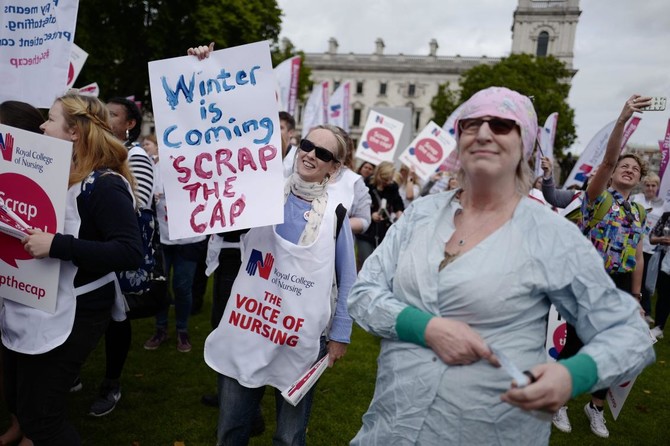
Demonstrators hold placards as they participate in a protest organized by nurses against the British government’s pay cap on public sector workers. (AFP)
Updated 15 September 2017
Follow

UK nurses bid for 3.9 percent salary rise in latest push against pay cap

LONDON: Nurses, midwives and cleaners working in Britain’s publicly-funded National Health Service (NHS) called on ministers to boost their salaries by 3.9 percent, in the latest push against a government-imposed cap on pay rises.
Public-sector pay was frozen for all but the lowest earners in 2010 and increases were limited to 1 percent a year from 2013 while inflation currently stands at 2.9 percent, having risen since last year’s Brexit vote.
Prime Minister Theresa May has been under increasing pressure to end the cap since her party lost its parliamentary majority in a snap election in June. Earlier this week, the government said it would boost pay for police and prison officers.
On Friday, fourteen unions wrote to finance minister Philip Hammond asking for a 3.9 percent pay rise and a further £800 pounds to reflect lost spending power over the last seven years of pay restraint.
“Health workers have gone without a proper pay rise for far too long. Their wages continue to fall behind inflation as food and fuel bills, housing and transport costs rise,” said the head of health at trade union UNISON Sara Gorton.
“NHS staff and their families need a pay award that stops the rot and starts to restore some of the earning that have been missing out on,” she said.


Swiss interior minister open to social media ban for children

Updated 3 sec ago
Follow

Swiss interior minister open to social media ban for children

ZURICH: Switzerland must do more to shield children from social media risks, Interior Minister Elisabeth Baume-Schneider was quoted as ​saying on Sunday, signalling she was open to a potential ban on the platforms for youngsters.
Following Australia’s recent ban on social media for under-16s, Baume-Schneider told SonntagsBlick newspaper that Switzerland should examine similar measures.
“The debate in Australia and the ‌EU is ‌important. It must also ‌be ⁠conducted ​in Switzerland. ‌I am open to a social media ban,” said the minister, a member of the center-left Social Democrats. “We must better protect our children.”
She said authorities needed to look at what should be restricted, listing options ⁠such as banning social media use by children, ‌curbing harmful content, and addressing ‍algorithms that prey on ‍young people’s vulnerabilities.
Detailed discussions will begin ‍in the new year, supported by a report on the issue, Baume-Schneider said, adding: “We mustn’t forget social media platforms themselves: they must ​take responsibility for what children and young people consume.”
Australia’s ban has won praise ⁠from many parents and groups advocating for the welfare of children, and drawn criticism from major technology companies and defenders of free speech.
Earlier this month, the parliament of the Swiss canton of Fribourg voted to prohibit children from using mobile phones at school until they are about 15, the latest step taken at ‌a local level in Switzerland to curb their use in schools.