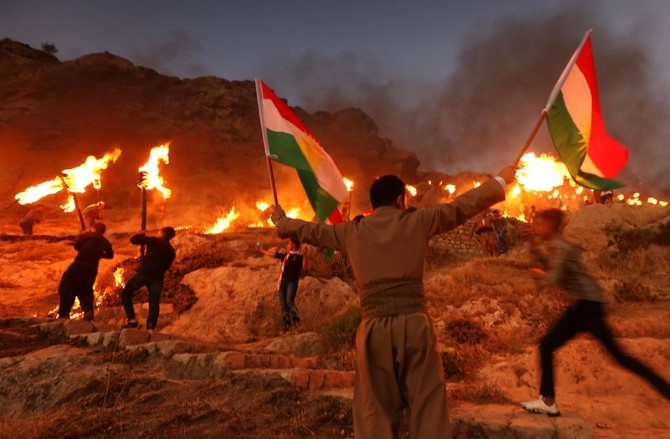
SULAIMANIYA, IRAQ: On the eve of an independence referendum in Iraq’s Kurdistan region, one man is campaigning against a “Yes” vote which he fears could stoke tension in the Middle East.
With the 5 million Kurds in Iraq who are eligible to vote united by dreams of statehood, the outcome of the Sept. 25 referendum in the autonomous region in northern Iraq is in no doubt.
But with Baghdad making clear it opposes independence for a region that has abundant oil reserves, some voters fear now is not the time to start moves to break away from Iraq — and rich businessman Shaswar Abdulwahid Qadir has taken up their cause.
Despite being branded a traitor by political enemies, he has taken on the establishment by launching a “No for now” campaign to explain the economic and political risks of a “Yes” vote.
“A ‘No’ vote is better for our people, better for Kurdistan’s future,” the 39-year-old businessman told Reuters after a rally on Saturday in a soccer stadium in Sulaimaniya, Iraqi Kurdistan’s second largest city.
Warning against the consequences of an independence declaration, he said: “It will bring to our people an unstable situation after the referendum.”
Qadir’s goal is not to resist independence forever. But he fears a “Yes” vote now would unleash the wrath of governments in Iraq, Iran, Turkey and Syria which could see it as a precedent that could encourage separatist-minded Kurds in those countries.
Iraq’s parliament voted on Tuesday to reject the referendum and authorized the prime minister to “take all measures” to preserve Iraq’s unity.
Western powers want a delay because they are worried the vote will derail cooperation between Iraq and the Kurds against Islamic State in Syria and Iraq.
Dancers
Qadir is almost alone among Kurds in raising his voice openly against the “Yes” campaign led by President Masoud Barzani and his Kurdish Democratic Party (KDP), which say independence would be preceded by dialogue with Baghdad.
But Qadir believes there are others who share his concerns.
At the rally in Sulaimaniya, Qadir was welcomed into the stadium by dancers in colorful traditional dress and by a crowd chanting his name.
But he delayed the start by an hour to allow the stadium he helped refurbish to fill up — and it never did. About 2,500 people attended, filling only about one third of the arena.
After he began speaking, a scuffle broke out when a man in the crowd tried to throw something at Qadir during his speech.
The businessman says he is undeterred by criticism and attacks which he says have affected his business.
“I’m ok with all of it, because I believe in another way for Kurdistan,” he said.
Critics say Qadir has used his media conglomerate to advance his agenda and the fortune he made through a business empire that includes real estate, television stations and a theme park make his life very different to those he says he represents.
Many Kurds have been hit by Baghdad’s decision to cut funding to Iraqi Kurdistan in 2014 in protest at its construction of a pipeline to export oil to Turkey.
Such actions by Baghdad have increased antagonism among the Kurds, who suffered under late Iraqi dictator Saddam Hussein, and increased their desire for independence — a desire uniting the about 30 million Kurds in Iraq, Iran, Syria and Turkey.
But interviews by Reuters in several cities in Iraqi Kurdistan showed that some voters are worried about the possible fallout of the referendum even though they favor independence.
Voters’ concerns
Some are worried it could embolden the entrenched elite in Iraqi Kurdistan, which has long been plagued by political disunity and where Barzani has been a powerful force for more than two decades and president since 2005.
“This referendum is not for the country, it’s for the dictators in power,” said Ahmed Nana, a 22-year-old barista at a coffee shop in Sulaimaniya. “We all want a passport, a nationality, we want a reason to be proud, to have our own country. But right now, this referendum is a sideshow to distract from our political problems.”
Parliament has not met since a coalition government broke up in 2015 and some factions support independence but not necessarily under Barzani’s leadership.
The regional government has called presidential and parliamentary elections for Nov. 1, but many Kurds doubt the voting will go ahead and the independence referendum has widened political divisions.
“Nothing has polarized Kurdish society as much as this vote,” said Bahra Saleh, an analyst at the American University of Iraq, Sulaimani.
Compounding the stalemate is the economic crisis triggered by Baghdad’s decision to cut funding and compounded by low oil prices and the conflict with Islamic State.
The region is billions of dollars in debt and public salaries have been steeply cut since 2014, particularly affecting civil servants, Peshmerga fighters and teachers.
Before holding the referendum, the regional government “needs to prepare the region economically for the region to sustain itself,” said Mohammad Tofiq Raheem, a leader of the Gorran party which was part of the coalition that ended in 2015.
The regional economy depends partly on Turkey’s goodwill to allow oil exports but also on trade with Iraq.
There is also a generational split. Older Kurds hope the long struggle for statehood, dating at least to the division of the Middle East by colonial powers after World War One, will now end but younger people are driven by more than nationalism.
“Independence is what we’ve been dreaming of for years,” the said Saleh, the analyst. “But not like this. In a way that makes sense, in a way that won’t risk civil war.”


![]()
Rich tycoon takes on Iraqi Kurdish leaders over independence
Rich tycoon takes on Iraqi Kurdish leaders over independence
Latest updates


Recommended


© 2026 SAUDI RESEARCH & PUBLISHING COMPANY, All Rights Reserved And subject to Terms of Use Agreement.