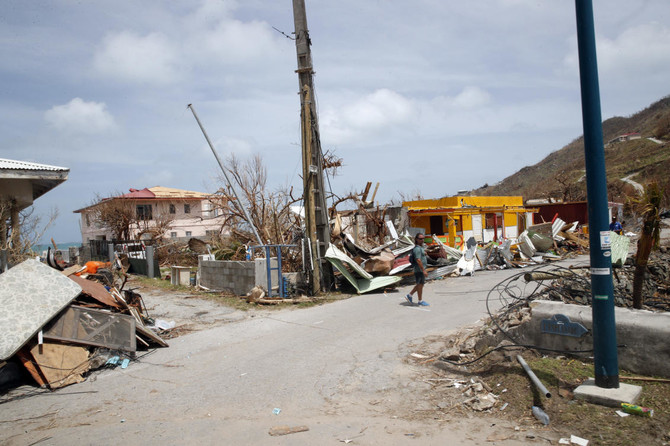
MARIGOT, ST. MARTIN: France’s president promised to quickly evacuate residents of his country’s Caribbean territories and provide services and shelter for those who choose to stay, wrapping up a sweeping visit of the destroyed island of St. Martin and responding to anger that his government didn’t do enough to handle Hurricane Irma’s wrath.
French President Emmanuel Macron outlined a plan to distribute drinking water, food and medical help using the islands’ radio stations and even megaphones, if necessary. He also said about half of the island’s mobile connectivity had been restored and all “essential communication” would be back by next week.
“What we have seen today are people determined to rebuild and return to a normal life,” he said Tuesday in a press conference. “They are impatient for answers and some are very, very angry. The anger is legitimate because it is a result of the fear they have faced and of being very fatigued. It is certain that some want to leave, and we will help them in that effort.”
He said France was bringing in air-conditioned tents so children can start classes again soon, and he said a center would be established by Monday to begin processing requests for financial help.
Macron pledged to rebuild St. Martin as a “model” for withstanding future storms.
“I don’t want to rebuild St. Martin as it was,” he said. “We have seen there are many homes that were built too precariously, with fragile infrastructure. The geography of the homes was not adapted to the risks.”
Macron said the Category 5 hurricane killed 11 people in St. Martin, while another four people died on the Dutch side of the island, bringing the death toll in the Caribbean to at least 37.
The visit came as residents tried to revive a sense of normalcy with small gestures like sharing radios and rescuing dogs.
The Dutch Red Cross said more than 200 people were still listed as missing on St. Maarten, but with communications extremely spotty a week after the storm hit, it wasn’t clear how many were simply without cell service and power and unable to let friends and family know they survived. The organization said 90 percent of buildings on the Dutch territory were damaged and a third destroyed as Irma roared across the island it shares with French St. Martin.
Yogesh Bodha, a jewelry store employee, said there was no response from European officials for two days and he hasn’t seen many changes since Dutch authorities arrived on St. Maarten.
“They should’ve been more organized than they were,” he said. “We have not received any food or water. They say it’s on its way. Let’s see.”
For Liseth Echevarría, who works as a bartender in St. Maarten, offering whatever she could to family, strangers and abandoned pets was helping her cope — and those around her were doing the same.
The manager of a marina next door threw over a hose so Echevarría and her husband could have a semblance of an outdoor shower. He also offered them a temporary power connection from his generator so they could charge phones and listen to the sole radio station still broadcasting.
“This is the only communication that St. Maarten has with the world right now,” she said.
It was thanks to that radio station that she found out about a flight for all Latin Americans stuck in St. Maarten. She rushed to the airport with her brother, who was evacuating back to Colombia. As she dropped him off, Echevarría saw a Yorkshire terrier tied to a metal barricade, abandoned by a passenger fleeing the island and told they couldn’t bring pets on the plane.
Echevarría scooped up the dog named Oliver and took him home to meet her three other dogs, including one rescued from a neighbor’s property. The neighbor fled with her son after the hurricane destroyed their home. There was nothing left of it other than jagged pieces of wood and a shower curtain covered in colorful butterflies tangled in a toppled tree.
Echevarría’s husband, Lex Kools, a civil engineer, jumps over the fence every day to feed the other two dogs on the property.
“They were attacking each other, they were so hungry,” he said.
At Echevarria’s and Kools’ home, the couple fed relatives and the girlfriend and two children of Echevarria’s cousin, all of whom were staying with them.
Near the front door, a large plastic table sagged under the weight of boxes of spaghetti and cookies, soup cans, chips, bags of almonds and macadamia nuts and rice. Underneath were dozens of bottles of water.
The couple said they took the goods from a grocery store blown open during the storm.
They said they had planned on buying the items, but no one was working at the store and they were running out of food and water. They looked at each other as they observed looting.
“Do we do this as well?” Kools recalled thinking. “Everybody was just running inside. It was chaos.”
Dozens of people stood in line for hours Tuesday waiting for flights, some of which never materialized.
“We’ve been here since 7 a.m.,” said Rosa Vanderpool, an accountant who was trying to get her stepdaughter and 4-year-old step-granddaughter on a flight to Curacao.
“We only have two days of food left,” she said. “We don’t know if there are any planes. We don’t know anything.”

Europe leaders answer anger over Irma response in Caribbean
Cuba pays tribute to soldiers killed in Maduro capture
- President Miguel Diaz-Canel and Castro, the 94-year-old retired former Cuban leader, were present in full military uniform to receive the soldiers’ remains
- Twenty-three Venezuelan soldiers were also killed in the US strike that saw Maduro and his wife whisked away to stand trial in New York
HAVANA: Cuba paid tribute on Thursday to 32 soldiers killed in the US military strike that ousted Venezuelan leader Nicolas Maduro, in a ceremony attended by revolutionary leader Raul Castro.
Havana, under pressure from US President Donald Trump, had decreed two days of tribute for the men, some of whom had been assigned to Maduro’s protection team.
Twenty-one of the soldiers were from the Cuban interior ministry, which oversees the intelligence services, officials have said. The others were from the military.
President Miguel Diaz-Canel and Castro, the 94-year-old retired former Cuban leader, were present in full military uniform to receive the soldiers’ remains early Thursday.
Their urns, draped in Cuban flags, were unloaded from a plane at Havana’s Jose Marti International Airport, according to footage broadcast on state TV.
At the event, Interior Minister General Lazaro Alberto Alvarez expressed the country’s respect and gratitude for the soldiers he said had “fought to the last bullet” during US bombings and a raid by US special forces who seized Maduro and his wife from their Caracas residence on January 3.
“We do not receive them with resignation; we do so with profound pride,” the minister added, and said the United States “will never be able to buy the dignity of the Cuban people.”
The soldiers’ bodies were then transported in Jeeps to the Ministry of the Revolutionary Armed Forces, with Cubans lining the streets and applauding the procession.
Residents of the capital can pay their respects throughout the day, which will close with a gathering outside the US embassy in Havana.
‘Manipulation’
The homage serves as an opportunity for Cuba to make a display of national unity at a time it is batting away pressure from US President Donald Trump.
Trump on Sunday urged Cuba to “make a deal,” the nature of which he did not divulge, or face the consequences.
The Republican president, who says Washington is now effectively running Venezuela, has vowed to cut off all oil and money that Caracas had been providing to ailing Cuba.
Cuba, which is struggling through its worst economic crisis in decades, has reacted defiantly to the US threats even as it reels from the loss of a key source of economic support.
Havana has dismissed as “political manipulation” a US announcement of humanitarian aid for victims of Hurricane Melissa, which hit last October and killed nearly 60 people across the Caribbean.
“The US government is exploiting what might seem like a humanitarian gesture for opportunistic purposes and political manipulation,” Cuba’s foreign ministry said in a statement in response.
It added Washington had not been in touch about the delivery, which it would welcome “without conditions.”
Jeremy Lewin, the senior US official for foreign assistance, on Thursday cautioned Havana not to “politicize” the help.
“We look at this as the first, the beginning of what we hope will be a much broader ability to deliver assistance directly to the Cuban people,” he said.
US-Cuba relations have been tense for decades but hit a new low after the US capture of Maduro and his wife.
Twenty-three Venezuelan soldiers were also killed in the US strike that saw Maduro and his wife whisked away to stand trial in New York on drug-trafficking charges.
Havana, under pressure from US President Donald Trump, had decreed two days of tribute for the men, some of whom had been assigned to Maduro’s protection team.
Twenty-one of the soldiers were from the Cuban interior ministry, which oversees the intelligence services, officials have said. The others were from the military.
President Miguel Diaz-Canel and Castro, the 94-year-old retired former Cuban leader, were present in full military uniform to receive the soldiers’ remains early Thursday.
Their urns, draped in Cuban flags, were unloaded from a plane at Havana’s Jose Marti International Airport, according to footage broadcast on state TV.
At the event, Interior Minister General Lazaro Alberto Alvarez expressed the country’s respect and gratitude for the soldiers he said had “fought to the last bullet” during US bombings and a raid by US special forces who seized Maduro and his wife from their Caracas residence on January 3.
“We do not receive them with resignation; we do so with profound pride,” the minister added, and said the United States “will never be able to buy the dignity of the Cuban people.”
The soldiers’ bodies were then transported in Jeeps to the Ministry of the Revolutionary Armed Forces, with Cubans lining the streets and applauding the procession.
Residents of the capital can pay their respects throughout the day, which will close with a gathering outside the US embassy in Havana.
‘Manipulation’
The homage serves as an opportunity for Cuba to make a display of national unity at a time it is batting away pressure from US President Donald Trump.
Trump on Sunday urged Cuba to “make a deal,” the nature of which he did not divulge, or face the consequences.
The Republican president, who says Washington is now effectively running Venezuela, has vowed to cut off all oil and money that Caracas had been providing to ailing Cuba.
Cuba, which is struggling through its worst economic crisis in decades, has reacted defiantly to the US threats even as it reels from the loss of a key source of economic support.
Havana has dismissed as “political manipulation” a US announcement of humanitarian aid for victims of Hurricane Melissa, which hit last October and killed nearly 60 people across the Caribbean.
“The US government is exploiting what might seem like a humanitarian gesture for opportunistic purposes and political manipulation,” Cuba’s foreign ministry said in a statement in response.
It added Washington had not been in touch about the delivery, which it would welcome “without conditions.”
Jeremy Lewin, the senior US official for foreign assistance, on Thursday cautioned Havana not to “politicize” the help.
“We look at this as the first, the beginning of what we hope will be a much broader ability to deliver assistance directly to the Cuban people,” he said.
US-Cuba relations have been tense for decades but hit a new low after the US capture of Maduro and his wife.
Twenty-three Venezuelan soldiers were also killed in the US strike that saw Maduro and his wife whisked away to stand trial in New York on drug-trafficking charges.
© 2026 SAUDI RESEARCH & PUBLISHING COMPANY, All Rights Reserved And subject to Terms of Use Agreement.