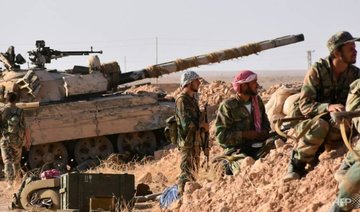
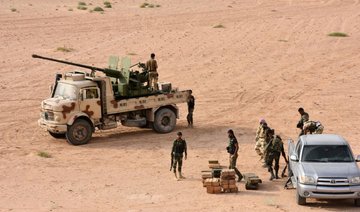
BEIRUT: Syria’s army sent massive reinforcements to territory under its control in Deir Ezzor on Monday ahead of a final push for Daesh-held half of the eastern city.
The metropolis is the capital of the oil-rich eastern province of Deir Ezzor, regarded as a strategic prize by both Russian-backed Syrian troops and US-backed fighters.
Regime forces have scored major advances in recent days, breaking a pair of Daesh sieges on the city and capturing territory around it.
They were now looking to make a push into the eastern Daesh-held part of the city, according to the Britain-based Syrian Observatory for Human Rights monitor.
“Huge military reinforcements, including equipment, vehicles and fighters have arrived in Deir Ezzor ahead of an attack to push Daesh from the city’s eastern neighborhoods,” said Observatory chief Rami Abdel Rahman.
“Russian and Syrian regime warplanes are striking Daesh positions in the city and its outskirts,” he added.
Since 2014, Daesh has controlled most of Deir Ezzor city and the surrounding province, which borders territory the terrorists hold in Iraq.
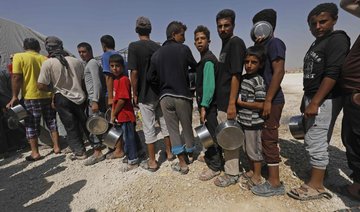
The remaining 40 percent of the city still held by the government — and home to around 100,000 civilians — was under crippling Daesh siege.
Backed by Russian air power, government troops have breached Daesh’s sieges, captured the strategic Jabal Thardah region and expanded their control to half of Deir Ezzor city, according to the Observatory.
Moscow intervened in Syria in September 2015 in support of its ally President Bashar Assad.
Russia’s Defense Ministry said Monday a demining unit comprising more than 40 experts and special equipment had been sent to Syria, adding that they will be sent to Deir Ezzor “in the nearest future.”
On Sunday, Russian airstrikes killed 34 civilians fleeing the violence in Deir Ezzor aboard ferries along the Euphrates River, the Observatory said.
The long river cuts diagonally across Deir Ezzor province, slicing it in half.
Fighters from the US-backed Syrian Democratic Forces on Saturday announced a separate offensive to capture Daesh territory east of the river.
By Monday, the SDF’s Deir Ezzor Military Council (DEMC) had seized much of the province’s northeast and were just a few kilometers away from the river.
Abdel Rahman said they had advanced to 6 km from its eastern banks, at a point across the river from Deir Ezzor city.
The SDF, an alliance of Arab and Kurdish fighters, is also battling Daesh in the terrorists’ de facto capital Raqqa with backing from the US-led air coalition.
Although the SDF had yet to reach Deir Ezzor city itself, tribal figures affiliated with the alliance said they were laying the groundwork for governing the city after Daesh’s defeat.
The statement, published by the SDF’s media council, announced the establishment of “a preparatory committee that will discuss the basis and starting points for a civil council for Deir Ezzor.”
According to the statement, consultations would aim to reach a “formulation that will express the aspirations of all our people in Deir Ezzor.”
The Deir Ezzor Civil Council “will be responsible for running the city immediately after its liberation.”
It made no mention of regime forces and did not say whether the civil council would coordinate with, or rival, government authorities.
The SDF has said its assault in Deir Ezzor province is not in coordination with Russian or regime forces.
But the coalition, the SDF, Syria’s government and Russia have agreed on a “de-confliction line” in northeastern Syria to prevent the two offensives from clashing.
Syria’s conflict erupted in 2011 with protests calling for Assad’s ouster, but it has since morphed into a complex war drawing in world powers.
More than 330,000 people have been killed and millions have been forced to flee their homes.


![]()

Syria regime readies push into Daesh-held parts of Deir Ezzor
Syria regime readies push into Daesh-held parts of Deir Ezzor

Latest updates


© 2026 SAUDI RESEARCH & PUBLISHING COMPANY, All Rights Reserved And subject to Terms of Use Agreement.