Ukraine vows punishments over Saakashvili border breach

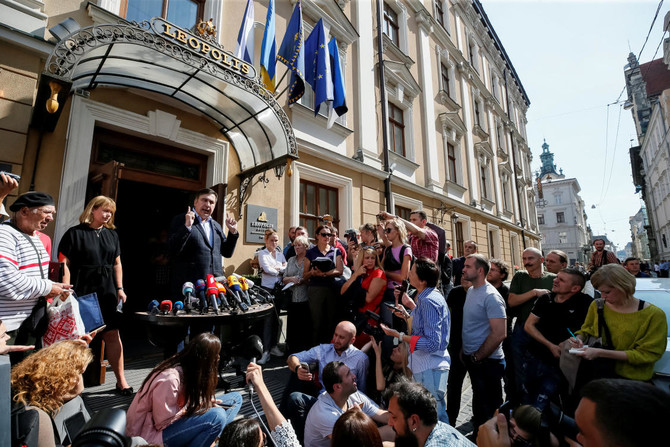
Former Georgian President Mikheil Saakashvili speaks during a press conference in Lviv, Ukraine, on September 11, 2017. (REUTERS)
Updated 11 September 2017
Follow

Ukraine vows punishments over Saakashvili border breach

KIEV: Ukrainian authorities on Monday vowed to punish those responsible after ex-Georgian leader Mikheil Saakashvili forced his way back into the country in the latest twist in a feud with President Petro Poroshenko.
Saakashvili, a one-time regional governor in Ukraine, and hundreds of his supporters on Sunday barged their way past border guards at a crossing with Poland to make a defiant return.
Saakashvili was stripped of Ukrainian citizenship in July by Poroshenko while he was out of the country after a major falling out with Kiev’s leadership over criticisms of their flagging fight against corruption.
That move left the charismatic pro-Western politician stateless as he was also stripped of his citizenship in his homeland Georgia.
Saakashvili has said he is determined to reclaim Ukrainian citizenship and get back into politics, but his re-entry drew a furious response from Kiev.
“A forceful breakthrough of the Ukranian border is a crime and those who were involved in the organization of this breakthrough should be held responsible,” Ukrainian Prime Minister Volodymyr Groysman wrote on Facebook on Monday.
The stand-off with Saakashvili is yet another headache for Poroshenko, who is battling a Russian-backed insurgency in the east and trying to revive a struggling economy.
Prime Minister Groysman urged against attempts to destabilize the country further.
“It’s time to fight for the state and not for power,” he said.
Interior Minister Arsen Avakov called the border breach “an attack on the state’s basic institutions,” saying all those responsible should turn themselves in.
Saakashvili’s whereabouts on Monday were not immediately clear but upon crossing the border Sunday he went to the Western city of Lviv.
He forced his way through the border even though Ukrainian authorities blocked a Kiev-bound train in Poland carrying Saakashvili, who eventually got off and took a bus to the Medyka crossing.
Saakashvili said that Kiev was “panicking,” claiming that he did “not want to overthrow President Poroshenko” but just defend his rights.
The interior ministry has said that 11 policemen and five border guards were injured in clashes with Saakashvili supporters.
Saakashvili, 49, is credited with pushing through pro-Western reforms in his native Georgia which he led from 2004 to 2013.
In the wake of the pro-Western revolution in Kiev he moved to Ukraine in 2015 to work for the country’s authorities as governor of the key Odessa region on the Black Sea.
But he had a major falling out with Poroshenko and accused Kiev of stalling in the fight against corruption.
Poroshenko stripped him of his Ukrainian citizenship at the end of July, when the charismatic reformer was out of the country.
Georgian authorities have asked Kiev to extradite the firebrand politician, saying he is defendant in four criminal cases.
Saakashvili denies the accusations, branding them a political witch hunt.


Cuba says attacking speedboat had nearly 13,000 rounds of ammunition

Updated 9 sec ago
Follow

Cuba says attacking speedboat had nearly 13,000 rounds of ammunition

  • Firefight took place at a range of 20 meters, Cuba says
  • Incoming crew originally ‌set out on two vessels but ditched one
HAVANA: A commando of Cuban exiles who intended to infiltrate Cuba on a speedboat was armed with nearly 13,000 rounds of ammunition, 13 rifles and 11 pistols, Cuban officials said on Friday, providing new details about Wednesday’s deadly exchange of gunfire at sea. The government in Havana has said 10 Cuban nationals coming from the United States entered Cuban waters and opened fire on a border guard vessel, leading Cuban forces to return fire killing four and wounding six others, who were taken into custody.
In an attempt to dispel doubts about its account to date, senior Cuban Interior Ministry officers displayed the captured armaments from the studio on a special television program, including bins full of at least some of the 12,846 recovered rounds. They also showed pictures of the vessels, each peppered with bullet holes from ‌the firefight they ‌said took place at a range of 20 meters (66 feet).
The confrontation took place ‌at ⁠a fraught moment ⁠in US-Cuban relations, with US President Donald Trump pressuring the island by imposing a virtual oil blockade after capturing and ousting Venezuelan President Nicolas Maduro, a crucial Cuban ally, on January 3.
Cuba has identified the assailants as Cuban exiles, some of whom had been previously placed on a list of accused terrorists, who came from the United States with the intent to sow chaos and attack military units on the Communist-ruled island.
“The intent of this group is to infiltrate, to promote public disorder. To incite the people to unite. To carry out something violent. Attack military units ⁠in order to incite social unrest and to unite the people in order to ‌steal the revolution. That has been duly proven,” said Col. Victor Alvarez ‌of the Interior Ministry.
Cuba says response ‘proportional’
US politicians have expressed skepticism over Cuba’s version of events. Secretary of State Marco ‌Rubio on Wednesday said his government would independently investigate, adding that it was not a US operation and ‌that no US government personnel were involved.
Cuban officers said the infiltrators set out from Marathon in the Florida Keys on two vessels but ditched one at some point due to technical difficulties. They united on one speedboat, which a US official said was reported stolen in Florida. Cuba said it recovered a drone, radios, knives, a portable power plant, bolt cutters and ‌other materiel. They also found emblems of the November 30th Movement and People’s Self-Defense, anti-communist groups that oppose the Cuban government.
Cuba says a patrol of five ⁠border guard members on ⁠a 9-meter boat spotted the incoming vessel shortly after 7 a.m., with some members of the incoming crew in the water, about one nautical mile off a cay on the Caribbean island’s northern coast, about 100 miles (160 km) from Marathon.
The infiltrators opened fire at a distance of 185 meters, striking the captain of the Cuban vessel in the abdomen, Cuba said. Bleeding heavily, the wounded captain remained at the helm and steered toward the enemy vessel, leading to a firefight at a distance of about 20 meters, the officers said.
Cuba called its response “proportional.”
“It is a defensive model that practically never uses firearms, and the use of firearms is proportional to the type of action being carried out against our force,” said Interior Ministry Col. Ybey Carballo.
The captured Cuban nationals were receiving medical care and face charges including armed aggression, illegal entry into national territory, crimes associated with terrorist acts, and arms trafficking, prosecutor Edward Robert Campbell told the program. He said they face prison terms of up to 10 to 15 years for the lesser offenses and 20 to 30 years — or even the death penalty — for the more serious charges.