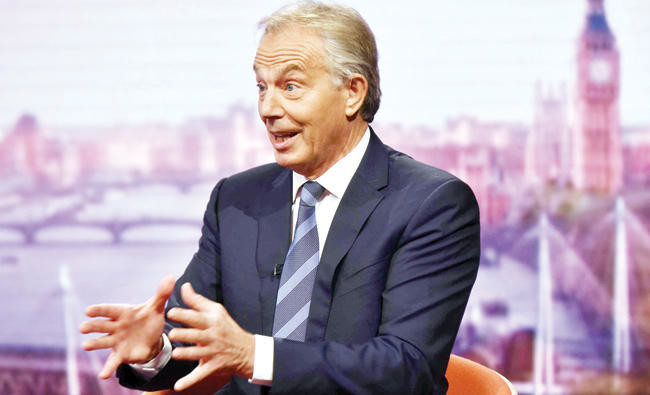
LONDON: Britain could bring in tough new controls on immigration from the EU without actually having to leave the bloc, former Prime Minister Tony Blair said on Sunday.
Concerns over the impact of high levels of immigration on public services and housing were cited as a factor by many who voted to leave the EU in last year’s referendum.
Prime Minister Theresa May’s Conservative government has said free movement of EU citizens coming to Britain must end.
Many Brexit supporters blame Blair’s government, which allowed citizens of former communist states to settle immediately in Britain despite a long transition period implemented by other EU countries, for a big influx of EU migrants from 2004.
“There is no diversion possible from Brexit without addressing the grievances that gave rise to it. Paradoxically, we have to respect the referendum vote to change it,” Blair, who has said Brexit can and should be stopped, wrote in the Sunday Times newspaper.
“We can curtail the things that people feel are damaging about European immigration, both by domestic policy change and by agreeing change within Europe to the freedom of movement principle,” added Blair, who led a Labour government for a decade from 1997.
Asked about Blair’s proposals, Defense Minister Michael Fallon said the government had to get on with delivering Brexit.
“The country has taken its decision, we are leaving the EU now and that means freedom of movement has to end ... there have got to be restrictions on those coming here,” he told BBC Television.
A leaked government document last week said Britain was considering measures to restrict immigration for all but the highest-skilled EU workers, plans some companies called alarming.
A paper published on Sunday by Blair’s Institute for Global Change said the government could take steps including registering EU migrants when they arrive to keep track of whether they meet EU rules about finding work.
EU migrants could also be forced to show evidence of a job offer before being allowed to enter Britain, and those without permission to reside could be banned from renting, opening a bank account or accessing welfare benefits, it said.
The paper also proposes seeking an “emergency brake” to implement temporary controls on migration when services are stretched — a strengthened version of a deal offered to former Prime Minister David Cameron ahead of the referendum.

UK does not need Brexit to curb EU immigration, says Blair
Philippines signs free trade pact with UAE
- UAE deal is Philippines’ fourth free trade pact, after South Korea, Japan, and EFTA
- Business body warns of uneven gains if domestic safeguard mechanisms insufficient
MANILLA: The Philippines signed on Tuesday a comprehensive economic partnership agreement with the UAE, its first such deal with a Middle Eastern nation.
The Philippines and the UAE first agreed to explore a free trade pact in February 2022 and formalized the process with terms of reference in late 2023. Negotiations started in May 2024 and were finalized in 2025.
The CEPA signing was witnessed by President Ferdinand R. Marcos Jr. who led the Philippine delegation to Abu Dhabi.
“The CEPA is the Philippines’ first free trade pact with a Middle Eastern country, marking a milestone in expanding the nation’s global trade footprint,” Marcos’s office said.
“The agreement aims to reduce tariffs, enhance market access for goods and services, increase investment flows, and create new opportunities for Filipino professionals and service providers in the UAE.”
The UAE is home to some 700,000 Filipinos, the second-largest Filipino diaspora after Saudi Arabia.
With bilateral trade worth about $1.8 billion, it is also a key trading partner of the Philippines in the Middle East, and accounted for almost 39 percent of Philippine exports to the region in 2024.
The Philippine Department of Trade and Industry earlier estimated it would lead to at least 90 percent liberalization in tariffs and give the Philippines wider access to the GCC region.
“Preliminary studies indicate the CEPA could boost Philippine exports to the UAE by 9.13 percent, generate consumer savings, and strengthen overall trade linkages with the Gulf region,” Marcos’s office said.
The Philippine Chamber of Commerce and Industry-Makati expects the pact to bring stronger trade flows, capital and technology for renewable energy, infrastructure, food, and water security projects as long as domestic policy supports it.
“CEPA can serve as a trade accelerator and investment catalyst for the Philippines,” Nunnatus Cortez, the chamber’s chairman, told Arab News.
The pact could result in “expanding exports, attracting capital, diversifying economic partners, upgrading industries, and supporting long-term growth — provided the country actively supports exporters and converts provisions into concrete commercial outcomes,” said Cortez.
“The main downside risk of CEPA lies in domestic readiness. Without strong industrial policy, MSME (Micro, Small and Medium Enterprises) support, safeguard mechanisms, and export development, CEPA could lead to import dominance, uneven gains, fiscal pressure, and limited structural transformation.”
The deal with the UAE is the Philippines’ fourth bilateral free trade pact, following agreements with South Korea, Japan, and the European Free Trade Association, which comprises Iceland, Liechtenstein, Norway, and Switzerland.