


Full Anti-Terror Quartet statement on the Emir of Kuwait’s comments in Washington

Updated 08 September 2017
Follow

Full Anti-Terror Quartet statement on the Emir of Kuwait’s comments in Washington

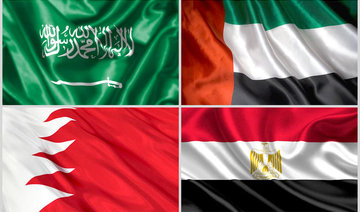
JEDDAH: In a joint statement, the Anti-Terror Quartet (ATQ) — Saudi Arabia, UAE, Bahrain and Egypt — declared their appreciation for the mediation of the Kuwaiti Emir Sabah al-Ahmad al-Jaber al-Sabah.

The statement also thanked him for his efforts in bringing back the Qatari authority to the righteous path, as well as his announcement that Qatar is prepared to acknowledge the 13 demands and to have negotiations around them.

The ATQ, however, stressed that discussions around implementing these demands shouldn't be preceded by any conditions.

The Quartet also regretted what the Kuwaiti Emir mentioned about the "success of the mediation in preventing a military intervention". The ATQ statement stressed that a military option was not — and will not be — an option in any way.

The statement added that the crisis with Qatar isn't only a Gulf dispute, but rather a dispute with a number of Arab and Muslim countries which have made their position from Qatari intervention and support for terror clear.

The ATQ added that there are also other countries around the world which couldn't announce their position because of Qatari meddling in its internal affairs. This (the meddling) makes them (these countries) fear the consequences particularly given Doha's record in supporting coups and harboring/financing terror, extremist ideology and hate speech.

The statement also said that comments made by the Qatari foreign minister after the press conference of the Emir of Kuwait confirm Qatar's refusal for a dialogue except if the sanctions — imposed legally by the ATQ countries — are lifted. It also proves that Qatar is not serious about the discussions, combating terror and its financing, nor stopping its intervention in internal affairs.

The ATQ appreciated the assertion of President Donald Trump that the only way to resolve the crisis is in stopping the support and financing of terrorism and his unwillingness to resolve the crisis unless this is achieved.

(Arab News translation)

Iranian ambassador thanks Saudi for not allowing territory to be used during

Updated 8 sec ago
Follow

Iranian ambassador thanks Saudi for not allowing territory to be used during

  • Alireza Enayati tells AFP Iran appreciates Kingdom's pledge not to allow its 'airspace, waters, or territory' to be used in US attacks
  • Envoy also denies that his country hit the US embassy in Riyadh this week with drones
RIYADH: Iran’s ambassador to Saudi Arabia Alireza Enayati said on Thursday his country remained appreciative of Saudi Arabia’s pledge to not allow its airspace or territory to be used during the ongoing war with the US and Israel.
“We appreciate what we have repeatedly heard from Saudi Arabia — that it does not allow its airspace, waters, or territory to be used against the Islamic Republic of Iran,” he told AFP.
Before the outbreak of war, Riyadh had thrown its support behind diplomatic efforts to diffuse tensions between Tehran and Washington and vowed that its airspace would not be allowed to be used for attacks against Iran.
Enayati also categorically denied that his country hit the US embassy in Riyadh this week, after Saudi officials said Iran targeted the compound with drones.
Saudi Arabia has repeatedly accused Tehran of launching missile salvos and drone attacks at its territory and warned that the kingdom reserved the right to defend itself, including by retaliating.
Iran had earlier denied attacking the sprawling Ras Tanura refinery — one of the largest in the Middle East — which Riyadh had also accused Tehran of targeting twice with drones.
Enayati added to the denial, saying Iran also had no hand in the targeting of the US embassy that triggered a fire at the compound.
“We confirmed that Iran has no role in the attack on the US embassy in Riyadh,” the ambassador told AFP.
“If the operations command in Tehran attacks somewhere, it takes responsibility for it.”
The war in the Middle East has engulfed the otherwise stable Gulf region as Iran retaliates over US and Israeli strikes that killed its supreme leader, launching strikes at Israel, the wider region and beyond.
At least 13 people have been killed in the Gulf, including seven civilians, since Iran began its attacks on Saturday.
Enayati, however, denied that Iran was waging a regional war as retaliation for the attacks on his country by the US and Israel.
“This is not a regional war and it is not our war. It was imposed on the region,” he told AFP.