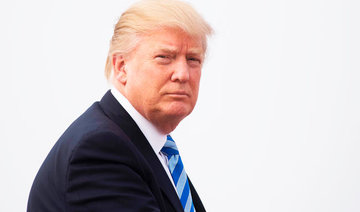
WASHINGTON: President Donald Trump on Tuesday ended an amnesty for 800,000 people brought illegally to the United States as minors, throwing their future in serious doubt and triggering fierce condemnation from across the political spectrum.
Business leaders, unions, religious groups, opposition Democrats and many within Trump’s own ruling Republican party joined forces to criticize the phased end of protections for people who arrived in the United States under the age of 16.
So-called “Dreamers” — many Hispanic, now in their twenties — will have somewhere between six and around 24 months before they become illegal and subject to potential deportation.
“This is the only country I know,” said Ivan Ceja, a 26-year-old computer science student and immigrant rights advocate who arrived in the country as a baby.
“My future is here. I’m not going to go without a fight.”
Trump later insisted he had “great heart for the folks we are talking about, a great love for them” and called on Congress to pass wide-ranging immigration reform — something lawmakers have tried and failed to do for decades.
“I am not going to just cut DACA off, but rather provide a window of opportunity for Congress to finally act,” he said.
Trump had argued that the amnesty introduced by Barack Obama in 2012 was an unconstitutional overreach of presidential powers and would likely be struck down by the courts eventually.
Amid a smattering of street protests across the country, the announcement prompted ex-president Obama to make a rare re-entry onto the political stage to decry the decision as “wrong,” “self-defeating” and “cruel.”
“Let’s be clear: the action taken today isn’t required legally. It’s a political decision, and a moral question,” Obama said.
Around 800,000 people took up the offer to get two-year renewable permits under the DACA scheme, but a similar number opted to stay in the shadows largely because of uncertainty over policy once Obama left office.
Trump, who ran for office on a hard-right immigration and law and order platform, painted his decision as an effort to put natural-born Americans first.
“Before we ask what is fair to illegal immigrants, we must also ask what is fair to American families, students, taxpayers and jobseekers,” he said.
Senior Department of Homeland Security officials admitted that the addresses and other sensitive information provided by current permit holders would be kept on record indefinitely.
But, one official said, there was “no plan at this time” to specifically target recipients for deportation.
Texas, which led a coalition of 10 conservative states threatening court action against the federal government unless DACA was rescinded, said it was dropping a 2015 lawsuit that provided the basis for its legal challenge — with Attorney General Ken Paxton claiming “victory.”
But elsewhere, Trump’s decision was met with broad opprobrium.
The Mexican government, mayors from across the US and the Service Employees International Union were among those who issued statements of condemnation.
The US Conference of Catholic Bishops called the decision “reprehensible” and said “today, our nation has done the opposite of how Scripture calls us to respond.”
Opponents hinted that they may challenge Trump’s decision in the courts.
“We warned you not to threaten our neighbors, @realDonaldTrump. New York City will fight to defend our Dreamers,” said New York Mayor Bill de Blasio.
Even Trump allies in business and the Republican Party voiced concern, arguing the policy would damage the economy and was not in keeping with US values.
“To reverse course now and deport these individuals is contrary to fundamental American principles and the best interests of our country,” the American Chamber of Commerce said in a statement.
“With approximately 700,000 DACA recipients working for all sorts of businesses across the country, terminating their employment eligibility runs contrary to the president’s goal of growing the US economy.”
Much of the business world, especially the high-tech firms of California’s Silicon Valley, stood firmly against a DACA repeal. The program offers the equivalent of a renewable residence permit to young people who were under the age of 16 when they arrived and have no criminal record.
Top congressional Republican Paul Ryan called on lawmakers to step in — although the chances of a badly divided Congress reaching a long-elusive agreement on immigration reform in months appear dim.
“It is my hope that the House and Senate, with the president’s leadership, will be able to find consensus on a permanent legislative solution that includes ensuring that those who have done nothing wrong can still contribute as a valued part of this great country,” Ryan said.