

Expat artists revive theater in cosmopolitan Dubai

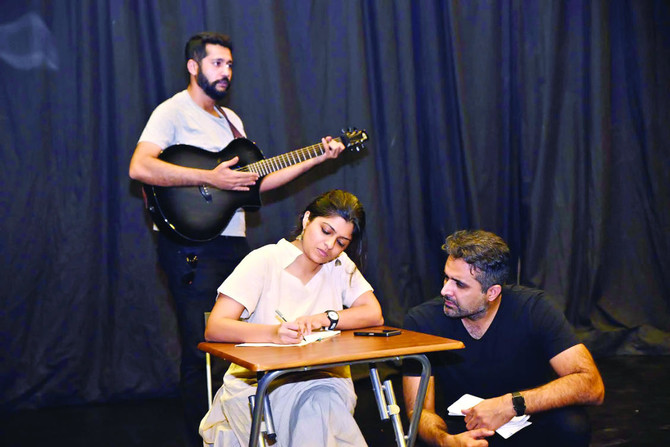
Dhruti Shah, center, along with her co-actors Johan Dsuza, behind, and Mohammed Majid during the rehearsal of local Urdu theater show ‘Mian Biwi Aur Wagah.’ (AN photo)
Updated 07 September 2017
Follow

Expat artists revive theater in cosmopolitan Dubai

DUBAI: Dubai’s burgeoning theater and performing arts industry has the potential to be a big-hitter, but only if it gets the patronage and sponsorship to grow and thrive, local professionals have warned.
The city has long been known as a haven for international big-budget, larger-than-life, entertainment. From big-budget movies filming in the emirate to well-known theater productions stopping off there, the challenges facing residents looking to produce their own community theater and attract interest have been numerous.
However, according to Dhruti Shah, an award-winning director who has has written and directed dozens of productions in the city, the growing expanse of arts and creativity has created considerable opportunities for budding actors and directors.
“Dubai is a diverse melting pot of cultures, tastes, and interests, the city has reinforced itself to be an archetypical center for a wide scope of sustainable artistic pursuits,” Shah told Arab News.
“There was a time we used to watch only imported theater production in the city. But things are changing; the city is now pacing toward its very own original theater production. However, it is a long way to make it a success story.”

Way to go
While optimistic about the future of theater in Dubai Shah warned that a lot more needs to be done to make it a success story.
“The performing arts industry has never been an independent means to earn livelihood in the city and artists associated with the production and presentations of theater and performing arts have not been entirely dependent on it for their sustenance,” she said.
Her thoughts were echoed by Gautam Goenka, who has been involved in Dubai theater for over 17 years and runs H72 production house.
As if to illustrate the problems facing him and his fellow thespians, Goenka has only been able to pursue his passion after 5 p.m., as during the day he works as a corporate trainer in a leading multinational company.
He is in no doubt as to the main problem theater faces.
“Putting up a community production in Dubai is expensive,” Goenka said.
“In fact it’s more expensive than anywhere in the world. I used to be part of a community group when I lived in the Netherlands. Costs never even came close to what we incur here.”

Unhealthy obsession
Obsession with big names and brands is another big challenge to bringing people to the theater. According to Goenka, Dubai audiences like a big-brand name play and well-known actors.
“It is harder to convince them to come to the theater, spend a 100 dirhams and watch a relatively new play with no famous actors in it. People would much rather buy a cinema ticket and go to the mall (and see star-studded film),” he said.
Goenka also stressed the need for more auditoriums in the city to encourage community theater culture. “Right now, we have only box community theater, The Junction, which supports theater at the grass root level.”

A bright future
Akansha Goenka, co-founder of The Junction Community Theater, believes that it is a great time to be part of the industry in Dubai.
“Over the past few years the theater scene in Dubai has grown exponentially. So I believe there is so much potential here and it is going to grow immensely.
“We need to stimulate this growth at the grass root level. Once that happens, I believe that the industry of theater as a whole will grow. In fact, we are starting to see that already,” she said.
Nevertheless, she also stressed providing financial support toward the development of grassroots and community theater.
“Funding can go a long way to encourage even more productions and indeed the growth of community theater in Dubai,” she added.
“Dubai has great stories to tell, which must be told and heard — diverse and multicultural stories. We are a wonderful and dynamic city with a character and voice like no other. I vehemently believe that theater will help a society like Dubai to export its culture to the world and establish our unique brand around the world.”

Trump says Iran government change ‘best thing that could happen’

Updated 14 February 2026
Follow

Trump says Iran government change ‘best thing that could happen’

  • US president's comments come after he ordered a second aircraft carrier to head to the Middle East

FORT BRAGG, United States: US President Donald Trump said a change of government in Iran would be the “best thing that could happen,” as he ordered a second aircraft carrier to head to the Middle East.
“Seems like that would be the best thing that could happen,” Trump told reporters at the Fort Bragg military base in North Carolina when a journalist asked if he wanted “regime change” in Iran.
“For 47 years, they’ve been talking and talking and talking. In the meantime, we’ve lost a lot of lives while they talk,” he told reporters.

Trump declined to say who he would want to take over in Iran from supreme leader Ayatollah Ali Khamenei, but he added that “there are people.”
He has previously backed off full-throated calls for a change of government in Iran, warning that it could cause chaos, although he has made threats toward Khamenei in the past.
Speaking earlier at the White House, Trump said that the USS Gerald R. Ford — the world’s largest warship — would be “leaving very soon” for the Middle East to up the pressure on Iran.
“In case we don’t make a deal, we’ll need it,” Trump said.
The giant vessel is currently in the Caribbean following the US overthrow of Venezuela’s Nicolas Maduro. Another carrier, the USS Abraham Lincoln, is one of 12 US ships already in the Middle East.

When Iran began its crackdown on protests last month — which rights groups say killed thousands — Trump initially said that the United States was “locked and loaded” to help demonstrators.
But he has recently focused his military threats on Tehran’s nuclear program, which US forces struck last July during Israel’s unprecedented 12-day war with Iran.
The protests have subsided for now but US-based Reza Pahlavi, the son of Iran’s last shah, urged international intervention to support the Iranian people.
“We are asking for a humanitarian intervention to prevent more innocent lives being killed in the process,” he told the Munich Security Conference.
It followed a call by the opposition leader, who has not returned to his country since before the revolution, for Iranians at home and abroad to continue demonstrations this weekend.
Iran and the United States, who have had no diplomatic relations since shortly after the revolution, held talks on the nuclear issue last week in Oman. No dates have been set for new talks yet.
The West fears the program is aimed at making a bomb, which Tehran denies.
The head of the UN nuclear watchdog, Rafael Grossi, said Friday that reaching an accord with Iran on inspections of its processing facilities was possible but “terribly difficult.”

Trump said after talks with Israeli Prime Minister Benjamin Netanyahu earlier this week that he wanted to continue talks with Iran, defying pressure from his key ally for a tougher stance.
The Israeli prime minister himself expressed skepticism at the quality of any agreement if it didn’t also cover Iran’s ballistic missiles and support for regional proxies.
According to the US-based Human Rights Activists News Agency, 7,008 people, mostly protesters, were killed in the recent crackdown, although rights groups warn the toll is likely far higher.
More than 53,000 people have also been arrested, it added.
The Norway-based Iran Human Rights (IHR) NGO said “hundreds” of people were facing charges linked to the protests that could see them sentenced to death.
Figures working within the Iranian system have also been arrested, with three politicians detained this week from the so-called reformist wing of Iranian politics supportive of President Masoud Pezeshkian.
The three — Azar Mansouri, Javad Emam and Ebrahim Asgharzadeh — were released on bail Thursday and Friday, their lawyer Hojjat Kermani told the ISNA news agency.