Irma strengthens to Category 5 hurricane

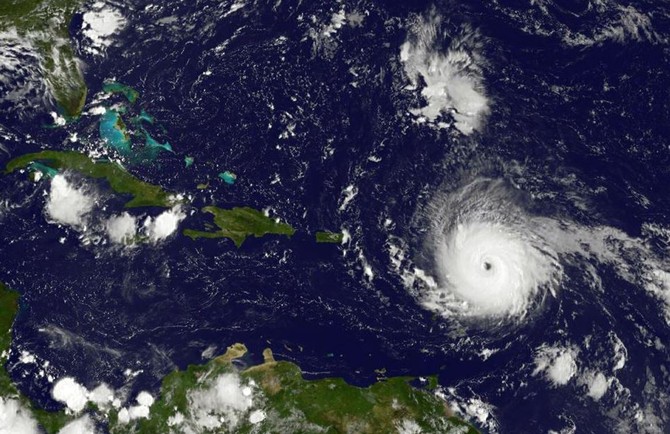
This image obtained from NASA's GOES Project shows Hurricane Irma. (AFP/NASA)
Updated 05 September 2017
Follow

Irma strengthens to Category 5 hurricane

MARIGOT: Irma strengthened Tuesday into an “extremely dangerous” Category Five hurricane, meteorologists warned, sparking alarm and flooding alerts as it barrelled toward the Caribbean.
The monster hurricane coming on the heels of Harvey, which struck Texas and Louisiana late last month is expected to make landfall along the string of French islands including Guadeloupe late Tuesday before heading to Haiti and Florida.
The Miami-based National Hurricane Center in its 1200 GMT bulletin said Irma had strengthened to the most powerful Category Five, packing winds of 175 miles (280 kilometers) per hour.
The front was moving west at 14 miles (22 kilometers) per hour, and is expected to drop between four and eight inches (10 and 20 centimeters) of rain when it hits land.
“These rainfall amounts may cause life-threatening flash floods and mudslides,” the NHC warned.
Irma’s center was located about 320 miles (515 km) east of the West Indies’ Leeward Islands, the NHC said, urging that “preparations to protect life and property should be rushed to completion” in the region.
Schools and government offices in Guadeloupe have been ordered shut, while hospitals are stocking up on medicines, food and drinking water. People living on shorelines will be moved to safety, authorities said.
Saint Barthelemy and St. Martin islands, both popular holiday destinations, are expected to be especially hard hit.
The top French official of the islands, Anne Laubies, said in Saint Martin’s capital Marigot the hurricane posed the greatest threat in 20 years, with more people endangered in flood-prone areas because of a rise in population.


The governor of the US state of Florida, Rick Scott, declared a state of emergency, saying Irma posed “a severe threat to the entire state of Florida,” barely a week after Harvey claimed at least 42 lives.
Long queues of people rushed to get batteries and bottled water, while many cut trees around their dwellings and sought to tie down objects and seal up their windows.
Category Five hurricanes are rare and are capable of inflicting life-threatening winds, storm surges and rainfall.
A hurricane of this magnitude can tear off roofing, shatter windows, uproot palm trees and turn them into projectiles that can kill people.
Irma is projected to make landfall late Tuesday or early Wednesday, bringing water levels up to nine feet (3 meters) above normal levels, rainfall of up to 10 inches (25 centimeters) in areas, and “large and destructive waves,” the US National Hurricane Center warned.
Harvey, which dumped as many as 50 inches of rain in some parts of Houston, turning neighborhoods into lakes and causing material damage estimated at around $100 billion (85 billion euros), was a Category Four hurricane.
In Puerto Rico, a US territory of 3.5 million, Governor Ricardo Rossello activated the National Guard and announced the opening of storm shelters able to house up to 62,000 people.
The mayor of the Puerto Rican capital San Juan, Carmen Yulin Cruz Soto, ordered 900 municipal employees — police, emergency personnel, and aid and social workers — to report for rotating 12-hour shifts.
Even if Puerto Rico is spared a direct hit, the mayor said, three days of pounding rain will do heavy damage.
A US aircraft carrier with a field hospital and dozens of aircraft able to conduct rescue or supply missions has been positioned protectively in the area, according to Alejandro de la Campa of the Caribbean division of the US Federal Emergency Management Agency (FEMA). Local press identified the carrier as the USS Kearsarge.
Irma’s precise path remains unclear. But several projection have it passing over the Dominican Republic, Haiti and Cuba before turning north toward Florida and then possibly swinging up the US East Coast.
Irma is expected to produce total rainfall accumulations of 3 to 6 inches across the islands of the northeastern Caribbean, with isolated maximum amounts of 10 inches across the northern section.


US hotels seek World Cup boost after tourism dip under Trump

Updated 2 sec ago
Follow

US hotels seek World Cup boost after tourism dip under Trump

  • At the US hotels that Meade Atkeson manages, a drop in tourism weighs heavily on business — but hoteliers like him hope that World Cup enthusiasm will soon eclipse wariness over President
WASHINGTON: At the US hotels that Meade Atkeson manages, a drop in tourism weighs heavily on business — but hoteliers like him hope that World Cup enthusiasm will soon eclipse wariness over President Donald Trump’s policies.
The US hospitality sector has been reeling from a tourism slump in the world’s biggest economy, which became the only major destination to see a drop in foreign visitors last year.
“Just financially, it’s difficult when international travel is down,” Atkeson told AFP, noting that such visitors tend to stay longer and spend more.
Foreign travelers account for nearly a quarter of business at the three hotels under Sonesta group that he manages — two in Washington and a third in Miami Beach.
Yet, in the first eleven months of 2025, US official data showed that inbound travel dropped by 5.4 percent.
Canadians were noticeably absent, with travel plunging by 21.7 percent from 2024, translating to about four million fewer people. The decline was nearly seven percent for French visitors.
Industry professionals see this as a consequence of Trump’s policies, even if they may not openly say so.
Visitors have chafed at the Republican president’s sweeping tariffs on foreign goods, broadsides against other countries, tightening immigration rules and portrayal of certain Democrat-led cities as ridden with crime.
Canadians “were asked to be the 51st state, right?” Atkeson said.
“If you talk to Canadians, many of them have chosen not to travel out of conscience” or on principle, he added.
Brazilian tourists meanwhile “can go anywhere they want,” he said. “And so they may have gone to Europe, they may have gone to the islands.”
‘Fear’
Thousands of kilometers away, the major resort city of Las Vegas in Nevada — boasting 150,000 hotel rooms — has also had a bad year.
Elsa Rodan, a chambermaid at the Bellagio resort and casino, says her establishment is “blessed” compared with others.
But even so, it has had to lower prices to attract guests, added Rodan, a representative of the Unite Here union who spoke at a Washington press conference.
Unite Here President Gwen Mills urges for a renewed effort to lobby the Trump administration over policies and rhetoric that she believes are jeopardizing the sector employing more than two million people.
According to her, hoteliers are not pushing the government enough.
Employers express “fear, the fear of picking your head up,” she said.
Hopefully ‘better’
Fewer visitors and overnight stays, alongside a drop in revenue, have triggered a $6.7 billion shortfall for Nevada hotels in 2025, according to the American Hotel and Lodging Association (AHLA).
But the organization hopes that 2026 will be a turning point — it is counting on the World Cup, from June 11 to July 19, to attract visitors.
Eleven US cities will be hosting matches.
“It’s being equated to having nearly 80 Super Bowls in just over a month,” AHLA spokesman Ralph Posner told AFP.
“The economic lift won’t be limited to host cities,” he added. “Destinations across the country are hoping to benefit as international visitors extend their trips and travel between markets.”
Las Vegas, for example, hopes to draw fans who might stop there before or after a game in Los Angeles or Kansas City.
Organizers say that besides the seven million spectators in stadiums, the World Cup is set to attract 20-30 million tourists.
The whole event, they believe, can generate $30 billion for the US economy.
“I hope that things will look better,” Atkeson said.
His Miami hotel is under renovations and cannot host much World Cup-related activity.
But his Washington establishments are highlighting their proximity to Philadelphia, where several matches will be held.
Another complication is war in the Middle East following US-Israeli strikes on Iran, which could snarl travel.
“It’s a little too soon to tell how we’re going to do with that, but we’ll see,” he said.