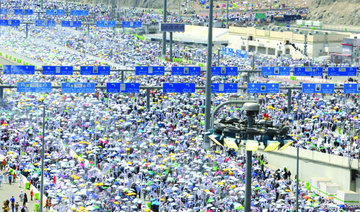
MAKKAH: Palestinian press photographer Rami Fathi never thought his hobby would be the cause of his death at the hands of Israeli soldiers.
His 68-year-old father Hajj Hussain Rayan, from Gaza, told Arab News while on pilgrimage in Mina: “I had my first child, Rami, after 14 years of sterility. We were so happy, and remained so until he became a victim of an Israeli sniper. The wound of our loss remains so painful.”
He spoke about how his son, who has two boys and two girls, joined the Palestine News Network. “Despite attempts by his mother to dissuade him, he used to say, ‘we have to expose the crimes of the Zionists to the world’,” said Rayan.
“He recorded many stories about the courage of Palestinians. We saw his photographs on international news agencies and satellite channels. So he became a target for the Zionists, who wanted to block stories and photographs of what was really happening by intimidating and killing journalists.”
Rayan described how three years ago, his son, who was 26 at the time, went to Shuja’iyya neighborhood in Gaza to record aggression by Israeli soldiers on camera. They violated a three-hour truce and attacked people. Fathi was hit, fell next to his camera and was taken to hospital.
“I was at home. My wife was listening to the news, and she told me about the battle in Shuja’iyya. I asked her to turn off the radio because I didn’t want my blood pressure and diabetes to get worse,” said Rayan with tears in his eyes.
“Later I went out and found the neighbors at my door. They told me Rami had a foot injury. But on my way to the hospital, I met a Palestinian soldier who told me my son had been martyred. I passed out, and regained consciousness at the hospital with doctors around me. We’ve suffered ever since.”
But Rayan said having his Hajj expenses, and those of his wife, covered by King Salman “has relieved that deep pain by his gift for us to perform the pilgrimage for the first time. Throughout Hajj, we’ve prayed for King Salman and our martyred son.”
Meanwhile, leaders of Islamic institutions and centers in European countries praised the efforts exerted by the Kingdom led by King Salman to serve pilgrims in performing Hajj.
The president of the Spanish Islamic Community, Mohammed Kamal Mustafa said: “The Kingdom exerts major efforts to unify Muslims. It has always worked toward the success of matters related to the Islamic nation, despite the political, economic and cultural challenges it is facing. It has assumed a great role in fighting terrorism, and it works toward world peace and humanitarian action. Thus, the Kingdom is the leader of the Islamic world and the heart of all Muslims.”
He said that Muslims around the world appreciate the efforts exerted by the Kingdom to serve pilgrims and guests, expand the Two Holy Mosques and equip Makkah, Madinah and the holy sites.
The president of the European Islamic Institute in Brussels, Cheikh Abd Al-Hadi, also spoke of the efforts of the Kingdom as reflected in the expansion of the Two Holy Mosques and the reception of over 2 million pilgrims who were able to perform Hajj this year.
The executive director of Al-Risalah Scandinavian Foundation, Hussein Al-Daoudi, thanked the Kingdom for its efforts in Muslim-minority countries in the West and the ongoing attempts to achieve success in Islamic matters at the regional and international levels, especially the Palestinian cause.
The governor of Strasbourg Mosque in France, Cheaib Al-Sukari, said that the Kingdom seeks to unify the Islamic nation and advocate for just causes in order to overcome obstacles. He emphasized the important and effective role of the Kingdom in supporting the joint work at the Arab and Islamic level, and assisting the Organization of Islamic Cooperation (OIC) in development and cultural spheres in Islamic member states.

Palestinian pilgrim: King Salman’s Hajj gift relieved pain of son’s death
Saudi Arabia designates 2026 the Year of Artificial Intelligence
- SDAIA unveils official logo after it was approved by the Cabinet
RIYADH: Saudi Arabia has designated 2026 as the Year of Artificial Intelligence, underscoring the Kingdom’s growing leadership in global AI adoption, and reaffirming AI as a top priority by supporting the nation’s AI ambitions in line with Saudi Vision 2030.
With the Kingdom emerging as a global hub for data and AI, driven by the support of Crown Prince Mohammed bin Salman, the move was underscored by the Saudi Cabinet’s approval on Tuesday.
The Saudi Data and Artificial Intelligence Authority, meanwhile, launched the official logo for the Year of Artificial Intelligence, Saudi Press Agency reported Wednesday.
The logo integrates symbolism in its elements: a palm tree signifies the national emblem and the Kingdom’s cultural heritage, while the letters “AI” highlight the technological and innovative aspects central to promoting digital inclusion as part of Vision 2030.
The palm tree’s green color symbolizes the Saudi flag and the Kingdom’s national identity, while the accompanying blue color represents digital technology and progression toward advanced technological development.
The logo is accompanied by the official hashtag for the Year of Artificial Intelligence: #SaudiAIYear.
Muhammad Khurram Khan, a professor of cybersecurity at King Saud University, told Arab News: “Saudi Arabia’s decision to designate 2026 as the Year of Artificial Intelligence represents a strategic milestone in the Kingdom’s digital transformation under Vision 2030.
“Over the past several years, SDAIA has successfully moved the national AI agenda from planning to large-scale implementation. The progress is visible in the Kingdom’s rapid rise in global AI rankings, its significant investment in emerging technologies, and the development of advanced infrastructure such as national data platforms and large-scale data centers,” he said.
The Kingdom ranked 14th in the 2025 Global AI Index and holds a leading position in the Arab world for AI model development.
Investment in the sector has grown significantly, with government spending on emerging technologies rising by more than 56 percent in 2024 and AI companies securing $9.1 billion in funding.
“The newly unveiled logo effectively reflects this vision. The logo thoughtfully blends Saudi Arabia’s heritage with its technological ambitions, reflecting the Kingdom’s forward-looking vision for a technology-driven future,” said the professor.
“What distinguishes Saudi Arabia’s approach is its holistic strategy. Rather than focusing solely on technology deployment, the Kingdom has invested heavily in talent development, regulatory frameworks, and ecosystem building. Training thousands of specialists and engaging more than a million participants through national AI initiatives demonstrates a long-term commitment to building a sustainable knowledge economy. Equally important is the Kingdom’s emphasis on responsible AI governance, reflected in its participation in international AI partnerships focused on ethics,” he added.
Welcoming the Cabinet’s decision to designate 2026 as the Year of Artificial Intelligence, Abdullah bin Sharaf Al-Ghamdi, SDAIA president, said on Tuesday the decision reflects the crown prince’s vision to strengthen the Kingdom’s global standing in advanced technologies.
He described it as an important step toward creating national momentum around innovation and the role of artificial intelligence in shaping a smarter and more sustainable future.
Since its establishment in 2019, SDAIA has led the National Strategy for Data and Artificial Intelligence, which focuses on six pillars: ambition, competencies, policies, investment, innovation, and ecosystem.
These efforts have moved the Kingdom from strategic planning to implementation, including regulating AI sectors and developing advanced digital infrastructure.
Infrastructure has expanded with the launch of the Shaheen III supercomputer and the Hexagon data center, the world’s largest government data facility with a capacity of 480 megawatts.
The Kingdom has also established a National Data Lake integrating more than 430 government systems.
Human capital development remains a priority. More than 11,000 specialists have been trained, and the SAMAI program has reached over one million participants.
Internationally, Saudi Arabia has strengthened its presence in the AI sector. It became the first Arab nation to join the Global Partnership on AI and hosts the UNESCO-sponsored International Center for Artificial Intelligence Research and Ethics in Riyadh.
These initiatives reflect the Kingdom’s commitment to the responsible and ethical use of artificial intelligence to support economic diversification and serve humanity globally.