Total sells Norwegian assets to Kuwait

French oil giant Total has agreed to sell its remaining stake in a Norwegian oil field to Kuwait as it focuses on its recent acquisition of Denmark’s Maersk Oil. (Reuters)
Updated 05 September 2017
Follow

Total sells Norwegian assets to Kuwait

PARIS: French oil giant Total said Monday it has agreed to sell its remaining stake in a Norwegian oil field to Kuwait so that it can focus on its recent acquisition of Denmark’s Maersk Oil.
“Total has signed an agreement to divest its remaining 15-percent interest in the Gina Krog field in Norway to Kuwait Foreign Petroleum Exploration Company (KUFPEC),” Total said in a statement.
“In the framework of our portfolio management and optimization of the allocation of capital, we have decided to fully divest our interest in the Gina Krog project and focus on other opportunities in Norway,” said Total’s head of exploration and production, Arnaud Breuillac.
“With the recent acquisition of Maersk Oil & Gas, the group’s position in the North Sea will be significantly strengthened, in particular in Norway.”
Total announced on Aug. 21 that it would buy Maersk Oil for $7.45 billion, making it the second-largest operator in the North Sea, with substantial operations in Britain, Norway and Denmark.
For its part, KUFPEC said the deal was valued at $317 million.
Total already sold a 15-percent stake in Gina Krog to Kuwait in 2016. It put the combined value of both that deal and the latest one at more than $600 million.
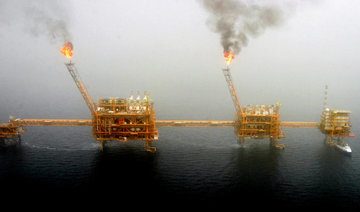
The Gina Krog field is situated in the North Sea and is controlled by Norwegian giant Statoil.



Saudi Arabia signs 90 deals as Global Labor Market Conference conference ends 

Updated 10 sec ago
Follow

Saudi Arabia signs 90 deals as Global Labor Market Conference conference ends 

RIYADH: Saudi Arabia signed 90 agreements and memorandums of understanding aimed at supporting global labor markets and benefiting more than 6 million people as the Kingdom wrapped up a two-day gathering in Riyadh.

The third Global Labor Market Conference saw deals struck between government entities and private-sector partners, spanning skills development, digital transformation, flexible employment and sustainable workforce partnerships. Officials said the initiatives will have an impact both inside and outside Saudi Arabia. 

The event attracted more than 10,000 participants from over 100 countries, including 40 labor ministers and more than 200 international experts. Organized by the Ministry of Human Resources and Social Development, the event was held under the theme “Future in Progress.” 

Saudi Minister of Human Resources and Social Development Ahmed Al-Rajhi stated in a post on X that the conference concluded after two days of discussions focused on practical solutions for current and future labor market challenges. 

“We discussed the future of skills, the impact of artificial intelligence, building resilient and inclusive labor markets, and empowering talent,” he said, adding that the conference is designed as a continuous platform for year-round cooperation, with partnerships and knowledge exchange extending beyond the event itself. 

Al-Rajhi also chaired a high-level ministerial meeting which was also attended by the director general of the International Labor Organization, during which participants agreed on six measures to help shape the future of work. 

The conference saw the release of several reports, including an international guide titled “What Works for Work: A Guidebook to Proven and Promising Employment Solutions,” produced in collaboration with the World Bank.

Another report, “A Decade of Progress,” reviewed the transformation of Saudi Arabia’s labor market over the past 10 years, documenting achievements since the launch of Vision 2030. 

Other outcomes included the graduation of the first cohort of the Labor Market Academy, comprising 36 graduates from 34 countries, and the launch of a second cohort. 

The event also featured a policy hackathon focused on securing first jobs for new labor market entrants, while side events highlighted milestones such as a decade of the Musaned platform for domestic workers. 

The conference concluded by reaffirming Saudi Arabia’s role in shaping the future of work globally through innovation, partnerships and workforce empowerment. 

Saudi Arabia’s economic transformation is being significantly accelerated by its booming events industry, which has evolved into a primary driver of growth alongside traditional infrastructure and giga-projects.