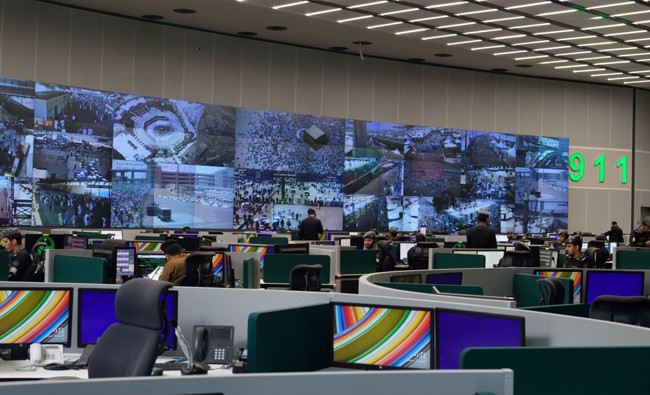
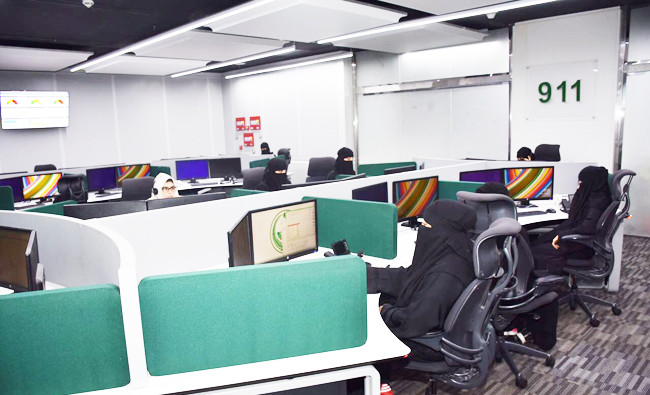
MINA: The 911 Unified Security Operations Center covering Makkah has been receiving more than 64,000 daily reports from the region and holy sites, mostly related to humanitarian services.
The center oversees more than 5,000 cameras to monitor the security situation in the region. Its staff of 720 people receive reports around the clock, and speak six languages: Arabic, English, French, Farsi, Indonesian and Urdu.
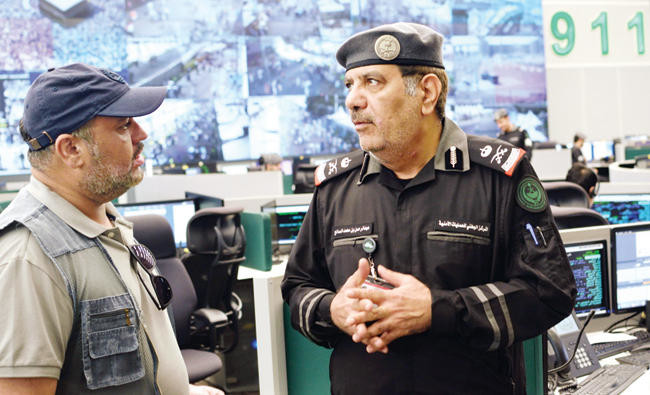
Security official Abdulrahman Al-Saleh confirmed that the center works with agencies concerned with emergency situations, including security patrols, traffic and road security departments and the Civil Defense.
The project involves “key partners such as the Saudi Red Crescent Authority (SRCA), ministries of health, environment, water, agriculture and transport, along with others, such as the secretariats,” Al-Saleh said.
Al-Saleh also announced that work is underway to implement such centers across all regions of Saudi Arabia.
The center in Makkah is divided into several sections, and includes a female-staffed group to receive reports from women.
It also includes support agencies for security work of the likes of the Ministry of Health and secretariats in Makkah, Jeddah and Taif, and the water and electricity companies.
“The mechanism of work of the center is based on receiving the reports and collecting all the information delivered by the reporter. The report is passed to all the concerned parties in 30 seconds,” Al-Saleh said.

Makkah security center receives 64,000 reports a day
Experimental farm in Al-Lith looks into future of Saudi Arabian agriculture
- Research initiative reflects strategic transformation
JEDDAH: An experimental farm in Saudi Arabia’s Al-Lith Governorate is one of the research initiatives reflecting the strategic transformation taking place in the Kingdom’s agricultural sector.
The farm uses highly efficient, sustainable production models that combine scientific research with commercial application, contributing to strengthening the country’s food security system and the sustainability of water resources.
Located in the Ghumaiqa Center on an area of about 10 hectares, the cutting-edge farm is a testing platform for modern agricultural technologies that tackle the challenge of water scarcity.
The farm includes developed open fields and modern greenhouses, supported by smart irrigation encompassing drip and sprinkler irrigation alongside surface and subsurface technologies.
All the systems operate via smart controls that enable the monitoring of water consumption and ensure improved efficiency, thereby achieving a balance between agricultural production and water conservation.
The farm also uses treated and diluted low-salinity seawater.
It aims to diversify agricultural water sources, reduce reliance on freshwater, and open new horizons for agriculture in coastal and semi-arid environments.
The project represents a promising investment opportunity in the field of smart agriculture, enabling the development of commercially scalable production models, particularly for high-value vegetables and fruits, while reducing operational costs associated with water and energy, enhancing the economic feasibility of future agricultural projects.
In addition, the project contributes to transferring and localizing agricultural expertise, supporting local food supply chains, and creating an attractive environment for agricultural investment.
This aligns with Sustainable Development Goals and enhances the efficiency of the private sector in adopting innovative agricultural solutions.
Yahya bin Abdulrahman Al-Mahabi, the director of the Ministry of Environment, Water and Agriculture office in Al-Lith Governorate, told the Saudi Press Agency that the project represented the future of agriculture in the Kingdom.
He explained that the vision was based on investing in technology, enhancing the return on water per unit, and integrating scientific research with investment opportunities.
Al-Mahabi spoke of the experimental farm as a modern, scalable and replicable model applicable in several regions of the Kingdom, particularly in coastal environments.
Al-Mahabi highlighted the Ministry of Environment, Water and Agriculture’s commitment to supporting distinctive projects that contributed to achieving food security while developing rural areas and enhancing agricultural production efficiency, in line with the objectives of the Kingdom’s Vision 2030.