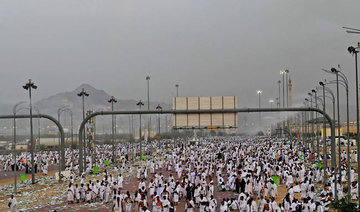
MINA: After a spiritually intense day on the plains of Arafat, Hajj pilgrims returned to Mina on Friday, the first day of Eid.
Making their way from Muzdalifa where they spent most of the night, 2 million pilgrims will undertake a number of rituals to complete their Hajj pilgrimage.
Walking on Mina’s winding streets, pilgrims headed to the Jamrat with the help of volunteers and security officials who provided directions to those who got lost in their way and cooling them with water to make their journey more comfortable to the vast multi-storied complex north of the tented city.
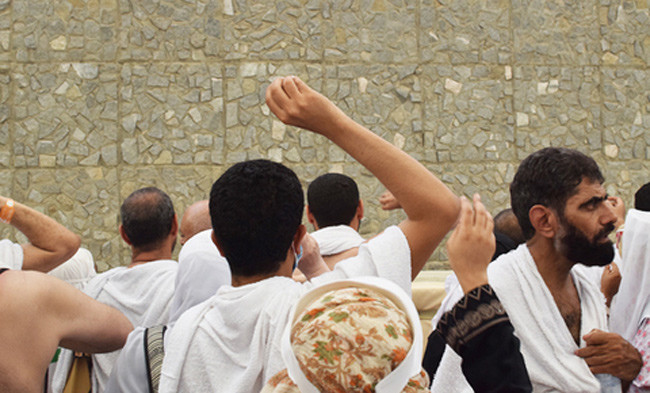
Inside the cooled and spacious Jamrat building, pilgrims took part in the ‘Stoning of Devil’ ritual, where they threw pebbles at the largest of three pillars called Aqaba, symbolizing the devil.
Pilgrims spread across the length of the elliptical-shaped pillar and hurled stones in an orderly manner.
Male pilgrims clad in Ihram, a two-piece seamless white garment, were also seen having their heads shaved, another important rite of the pilgrimage.
For the next three days pilgrims will be sleeping in Mina to complete their pilgrimage.
Saudi Arabia’s King Salman reviewed security arrangements from Mina on Thursday evening, while Makkah Governor Khalid Al-Faisal said the Arafat phase of the Hajj was a success.

Hajj pilgrims return to Mina for ‘Stoning of Devil’ ritual

Ramadan begins with celestial spectacle in Saudi Arabia's north
- Venus-crescent moon alignment visible over Northern Borders Region skies
- Meteorology Center completes operational plan for the holy month
ARAR/JEDDAH: The holy month of Ramadan has commenced in Saudi Arabia with a striking astronomical display in the Northern Borders Region, setting a serene tone for the month as meteorological authorities confirmed full readiness to support pilgrims in Makkah and Madinah, the Saudi Press Agency (SPA) reported.
On Tuesday evening, the skies over Arar witnessed a rare alignment as the planet Venus paired with the slender crescent moon marking the first day of Ramadan. Appearing shortly after sunset, the crescent shimmered low on the western horizon above Venus — one of the brightest celestial bodies — in a display enhanced by clear skies.
While the conjunction is a recurring astronomical phenomenon caused by the apparent proximity of the two bodies as viewed from Earth, its coincidence with the start of the holy month added a special aesthetic and spiritual dimension to the atmosphere in the north, SPA said.
Meteorological readiness
As the faithful began their fasting, the National Center for Meteorology (NCM) announced the completion of its operational and technical preparations for Ramadan 1447 AH.
NCM Chief Executive Dr. Ayman bin Salem Ghulam confirmed that the center has finalized a comprehensive plan to ensure round-the-clock weather monitoring for Makkah, Madinah, and the roads leading to the Two Holy Mosques. The initiative aims to provide accurate forecasting to enhance the safety and comfort of the influx of visitors and Umrah pilgrims.
The plan includes heightened performance levels at observatories in the Kingdom’s airports to manage increased flight traffic and aviation safety.
To ensure pilgrims have real-time access to information, the NCM has integrated its data with the "Nusuk" and "Tawakkalna" smart applications. Ten-day extended forecasts and real-time alerts will also be available via the "Anwaa" app and displayed on guidance boards along highways.
The center has mobilized 14 media platforms to deliver swift weather alerts, ensuring high standards of security and logistical support throughout the season.