ANKARA: Tuesday’s indictment of 19 people, including 15 Turkish security officials, by a US grand jury is likely to further complicate relations between Ankara and Washington.
The indictment relates to a clash in Washington between Turkish President Recep Tayyip Erdogan’s security detail and protesters on May 16.
Described by Washington’s police chief as a “brutal attack,” it happened outside the Turkish ambassador’s residence after a meeting between Erdogan and US President Donald Trump at the White House.
The US Attorney’s Office for the District of Columbia announced that 16 of the defendants had already been charged in June, while the indictment on Tuesday added three to the list.
All 19 defendants were indicted “on a charge of conspiracy to commit a crime of violence, with a bias crime enhancement,” the office said.
The charge is punishable by a maximum of 15 years in prison, and bias enhancement could lead to longer sentences, the statement said.
Only two of the 19 are currently in custody, and they are expected to have an initial court hearing on Sept. 7, it added.
The Turkish Embassy blamed the violence on demonstrators linked to the outlawed Kurdistan Workers’ Party (PKK), considered by the US and Turkey as a terrorist group. The PKK has been waging a bloody insurgency in Turkey for more than three decades.
Ankara criticized the US arrest warrants for Turkish citizens allegedly involved as “wrong” and “unacceptable.”
Ozgur Unluhisarcikli, Ankara director of the German Marshall Fund of the United States, told Arab News: “The culture and laws regarding peaceful protesters are different in Turkey and the US.”
He added: “In Washington there are several protests in front of the White House and embassies, usually attended by a handful, on any given day, and security forces don’t interfere. The physical intervention of Erdogan’s security detail against peaceful protestors was against US law, and legal consequences were expected from the very first day.”
Unluhisarcikli said it was a public diplomacy disaster for Turkey. “This incident could’ve been prevented if Erdogan’s security detail refused to be provoked by the protesters,” he said.
“The US police could’ve kept the protesters at a greater distance from the Turkish Embassy for Erdogan’s security at the very least.” Unluhisarcikli said the incident will add to the long list of problems between the two NATO allies.
They are at odds over the US decision to directly arm Kurdish militants in Syria, known as People’s Protection Units (YPG), which Turkey considers a terrorist group affiliated with the PKK.
Oubai Shahbandar, a fellow at New America’s International Security Program, expressed hope that both sides can move forward from the incident in Washington and focus on more important geopolitical issues.
“US policy in continuing to support the PKK terror group’s wing in Syria is ultimately not in the interests of American national security and certainly detrimental to Turkey’s security, and in the long term harmful to the Syrian people,” Shahbandar told Arab News.
He said Defense Secretary James Mattis’ visit to Turkey last week was viewed positively, but Ankara needs a US commitment to fight the PKK and prevent it from expanding its safe havens in Iraq and Syria, which will be used to attack civilians in Turkey.
“In Washington, there doesn’t seem to be a long-term plan to secure the gains made against Daesh in Syria,” Shahbandar said.
“The tactical partnership that the US has built with the PKK affiliate in Syria as part of the anti-Daesh fight will probably prove unsustainable in the long term.”


US indictment of Erdogan’s security detail sparks debate

US indictment of Erdogan’s security detail sparks debate
Sudan Quintet urges ‘those with influence’ to halt weapons flow, deescalate conflict ahead of Ramadan
- Group of 5 organizations condemns ‘increasingly destructive means of warfare’ in Sudan’s civil war, warns that civilians bear the brunt of fighting
- UN spokesperson describes ‘horrific’ situation on the ground, expresses ‘deep alarm’ at escalating attacks on civilian and humanitarian infrastructure
NEW YORK CITY: A group of five international and regional organizations on Wednesday called for an immediate end to flows of weapons and fighters into Sudan, and for coordinated action to deescalate the war in the country and protect civilians as the third anniversary of the start of the conflict approaches.
The so-called Sudan Quintet — comprising the African Union, the Intergovernmental Authority on Development, the League of Arab States, the EU and the UN — said those with influence over the warring factions must act to “halt the flow of weapons, fighters and other forms of support that sustain violence and contribute to the fragmentation of Sudan.”
In a joint statement, the Quintet expressed “grave concern at the continued escalation of the conflict” and called for “the immediate halting of any further military escalation, including the use of increasingly destructive means of warfare.” Civilians are bearing the brunt of the fighting, it warned.
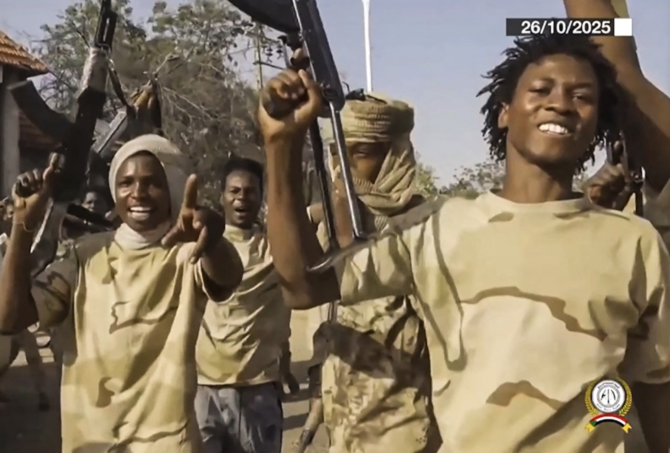
The conflict began in April 2023 when tensions between rival military factions the Sudanese Armed Forces and the paramilitary Rapid Support Forces escalated into full-scale war in the capital Khartoum and spread across the country.
The war has killed tens of thousands of people; US intelligence officials and independent analysts have suggested the true death toll could be in the hundreds of thousands.
The conflict has also triggered what the UN describes as one of the worst humanitarian crises in the world. More than 33 million people are in need of humanitarian assistance, and more than 13.6 million have been displaced by the fighting, 9.3 million of them within Sudan and about 4.3 million to neighboring countries.
The Quintet said the rapidly deteriorating situation in the Kordofan region and Blue Nile State was particularly alarming, citing reports of deadly drone strikes, the tightening grip of sieges around major population centers, and attacks on critical infrastructure such as hospitals, schools and humanitarian assets.
It also highlighted issues such as forced displacements, severe constraints on humanitarian access, and attacks on aid convoys. These developments “underscore the urgency of immediate action to prevent atrocities,” it said.
Recalling “the horrors witnessed in El-Fasher” and earlier warnings that went unheeded, the Quintet said civilians “must no longer bear the cost of ongoing hostilities.” The organizations stressed that the protection of civilians and critical infrastructure was a fundamental obligation under international law, and that the principles of international humanitarian law applies to all parties to the conflict.
“Civilians and civilian infrastructure must be protected, international humanitarian law must be respected, and safe, rapid and unhindered humanitarian access to all areas in need must be ensured,” they said.
“Serious violations of international humanitarian law cannot go unaddressed,” they added, and perpetrators must be held accountable.
With the start of the holy month of Ramadan only a week away, the Quintet urged all sides to embrace efforts to broker a humanitarian truce and “immediately deescalate hostilities” so as to prevent further loss of life and enable life-saving assistance to reach those in need.
The organizations reaffirmed their commitment to the sovereignty, unity and territorial integrity of Sudan, and said they remain committed to efforts to facilitate a Sudanese-owned, inclusive political dialogue with the aim of ending the war and paving the way for a peaceful political transition.
The situation on the ground in Sudan continues to be “horrific,” UN spokesperson Stephane Dujarric said on Wednesday as he expressed “deep alarm” at “the escalating attacks that we’re seeing in the country, where aerial strikes are placing civilians at grave risk and directly hitting humanitarian and public infrastructure.”
A drone strike on a mosque in the city of Al-Rahat in North Kordofan state at dawn on Wednesday killed two children and injured 13, all of them students attending a school at the mosque.
This followed drone strikes on a primary school in the town of Dilling in South Kordofan late on Tuesday, where injuries were also reported. The same night, a World Food Programme warehouse in Kadugli, the state capital of Kordofan, was struck by a suspected rocket attack that caused significant damage to buildings and mobile storage units.
In recent days drone strikes been reported in other parts of South Kordofan, North Kordofan and West Kordofan, Dujarric said, all of them close to key supply routes connecting the city of El-Obeid in North Kordofan with Dilling and Kadugli in South Kordofan.
“This is endangering civilians, including humanitarian workers,” Dujarric told reporters in New York. “The fact that we have to reiterate almost every day that civilians, civilian infrastructure, places of worship, schools and hospitals cannot and should not be targeted is a tragedy unto itself.
“Yet we have to keep reminding the parties of this almost every day, and that they need to respect international humanitarian law amid these deeply concerning developments.”


