MADINAH: Pilgrims and visitors to the Prophet’s Mosque are eager to communicate with relatives through social media during their presence in Madinah or Makkah, and social media is the easiest way to do so.
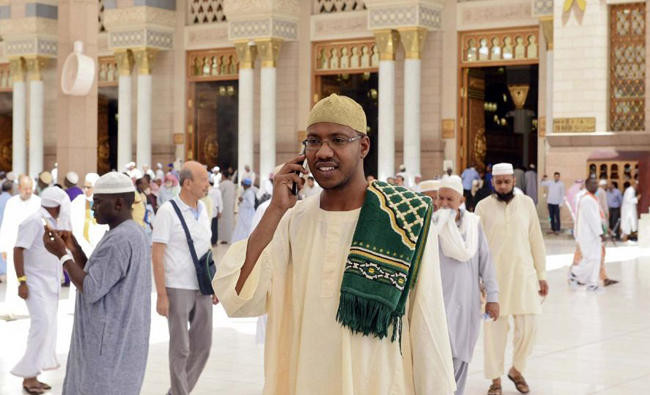
Many visitors to the Prophet’s Mosque were seen making calls from the yards of the mosque to relatives, and conveying the scenes of the great Islamic gathering. The calls carry deep emotional feelings where relatives ask Allah Almighty, to facilitate Hajj rituals for the pilgrims, accept their Hajj, and return them to their countries with their sins forgiven.
Rudwan Abdullah, a Sudanese pilgrim, said the call of a pilgrim to his family is an important matter. He was able to perform his rituals comfortably after calls to his mother, wife and children. He said he wanted to make calls to his family continuously throughout the day, adding that hearing his mother’s prayer by phone has a special impact on his heart.
Likewise, Mohammed Asad Al-Bakri, a Sudanese, said social media has provided easy and direct means of communication with relatives. On his arrival in Madinah, he was eager to get an Internet-access phone chip to communicate with his wife, children and brothers through voice and images via the Snap Chat application. In addition to normal phone calls, media applications document wonderful scenes from Madinah to become part of the memories in a pilgrim’s life, he said.
For his part, Mohammed Naim, an Indonesian pilgrim, said Hajj is a major step in the life of a Muslim, adding that it is a natural thing that a traveler, be it a pilgrim or visitor, wants to be in communication with his family, relatives or friends to let them know about his condition.
Murad Mahmoud, an Egyptian pilgrim who came with his wife to perform Hajj, said the phone has become a necessity for a pilgrim to keep in direct contact with relatives, and at the least cost, adding that he was in constant communication with his family via the WhatsApp application.

Social media communicates Hajj pilgrims’ feelings from holy sites to relatives around the world

Saudi Reef has played key role in empowering rural communities, says spokesperson
- Program has benefited more than 90,000 rural families, enabled productive projects
- Majed Al-Buraikan: The eight sectors supported by the Saudi Reef program help diversify agricultural production, support sustainable use of resources and improve supply chains
JEDDAH: The Saudi Reef program has played a key role in strengthening food security and empowering farmers and rural families across the Kingdom since its launch in 2019.
The program forms part of Saudi Arabia’s broader efforts under Vision 2030 to support sustainable agricultural development, diversify the economy, and enhance the contribution of rural communities to national growth.
Majed Al-Buraikan, the official spokesperson for Saudi Reef and its director of corporate communications and media, told Arab News that the program had made a positive impact in rural communities.
He said: “It has empowered small farmers and rural families to develop their agricultural projects and increase productivity.
“This support has helped strengthen food security, improve the use of resources, and support the long-term sustainability of the agricultural sector, in line with Vision 2030 goals to diversify the economy and develop rural areas.”
Through targeted support across eight priority agricultural sectors — including Saudi coffee, value-added development, livestock, rainfed crops, beekeeping and honey production, aromatic plants, fisheries, and fruit — the program focuses on enhancing the sustainability of these sectors to achieve empowerment and stability for rural families.
Al-Buraikan added: “The eight sectors supported by the Saudi Reef program help diversify agricultural production, support sustainable use of resources and improve supply chains.
“This diversity supports economic stability in rural areas, encourages balanced growth, and helps build a flexible rural production system that can expand over time.”
By benefiting more than 90,000 rural families and enabling productive projects rooted in local communities, the program has also opened up new economic opportunities for women and youngsters, supported entrepreneurship, and improved productivity across the rural sector.
Al-Buraikan said: “This shows the wide developmental impact of the Saudi Reef program and its strong geographic and social reach.
“It demonstrates the ability of rural areas to become productive economic spaces.
“This expansion has improved income levels, strengthened social stability in rural areas, and increased the contribution of agriculture to the national economy.”
The program has helped make rural work a competitive economic option by improving agricultural productivity, supporting a wide range of sectors, and enabling beneficiaries to access local and global markets.
The program announced in 2025 that the market value of production across its sectors had exceeded SR5.6 billion ($1.49 billion) since its launch.
Al-Buraikan said: “This reflects the strong economic potential of rural investment and its role in supporting the national economy, food security, and sustainability goals under Vision 2030.”
The Sustainable Reef initiative was launched in September 2025 to highlight the significant impact the program had made in supporting rural communities and enhancing agricultural and economic sustainability across various regions of the Kingdom.
Al-Buraikan said the initiative was a development-focused media extension of the Saudi Reef program.
“It highlights the real impact of government support through inspiring success stories that show how rural projects have become sustainable, productive businesses,” he said.
“What makes it different is that it goes beyond traditional support by building public awareness of the value of rural areas as promising economic and investment contributors.”
Saudi Reef has helped position rural work as a competitive and sustainable economic option, reinforcing its role in driving long-term development across the Kingdom.
The program has also empowered women in rural areas by opening new opportunities in agricultural activities while providing sustainable sources of income.
Al-Buraikan said: “It has also supported young people through an integrated entrepreneurship system that includes incubators, accelerators, and training programs, helping to turn rural ideas into productive projects led by and benefiting rural communities.”
In addition, the program supports Vision 2030 by empowering farmers, increasing local production, and building a sustainable agricultural sector that contributes to food security and economic development.
Demonstration farms serve as practical platforms where farmers can observe modern agricultural practices, learn improved production methods, and adopt modern technologies, thereby increasing efficiency and improving crop quality.
Al-Buraikan said: “The program balances agricultural production with environmental protection by promoting smart agriculture, improving resource use, and linking production to modern technologies. The program ensures agricultural growth while protecting the environment.”