Daesh fighters surrender Lebanon-Syria border enclave

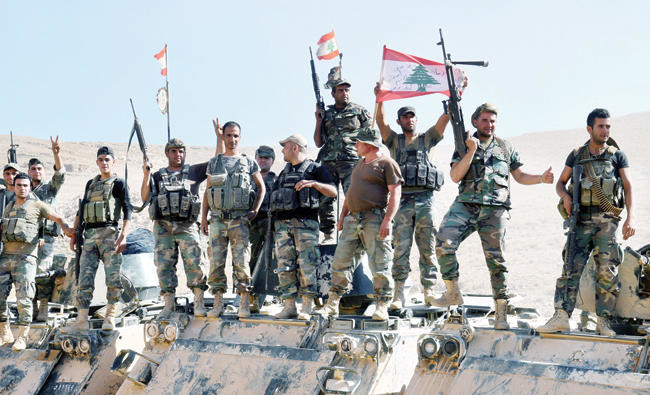
Lebanese soldiers flash the victory sign in Ras Baalbek, Lebanon. (Reuters)
Updated 29 August 2017
Follow

Daesh fighters surrender Lebanon-Syria border enclave

BEIRUT: A convoy of Daesh fighters and their families surrendered their enclave on the Lebanon-Syria border area on Monday and left for eastern Syria after a week-long battle.
Daesh had agreed a cease-fire on Sunday with the Lebanese army on one front and the Syrian army and Hezbollah on the other after losing much of its mountainous enclave straddling the border.
Lebanese officials said the evacuation was a surrender. “We do not bargain. We are in the position of the victor and are imposing conditions,” said security chief Gen. Abbas Ibrahim.
A total of 600 people, including both Daesh fighters and their family members, left in the convoy.
The militants will travel across Syria under heavy security escort to Daesh lines near Al-Bukamal in the east, a Lebanese security source said.
The Daesh fighters set fire to heavy equipment and weapons before they left their enclave.
A Lebanese military source said there had been no negotiation or coordination with Syrian forces or Hezbullah. “We heavily bombarded them and this is what accelerated the process of their surrender.”
The deal also involved Daesh handing over the bodies of eight Lebanese soldiers it captured and killed when it overran the town of Arsal in 2014. DNA tests are being conducted to reveal the identity of each body.
Some politicians asked why the terrorists were allowed to withdraw without being arrested. A military source told Arab News: “If the political decision had been in our hands, we would have waged this battle back in 2014, but they did not allow us to do so.”
Gen. Ibrahim said: “Lebanon is a country that doesn’t take revenge; it rather complies with the international law. Whoever falls into the hands of Daesh will certainly be killed, as they are criminals and murderers. This is what happened with our hero soldiers.”
Regarding the fate of photographer Samir Kassab and kidnapped bishops Boulos Yaziji and Youhana Ibrahim, Gen. Ibrahim said: “They were included in the recent negotiations but Daesh confirmed that it did not kidnap them and does not know anything about them.”
He said: “We are now reviewing their file from the beginning to determine the side that kidnapped them. I believe Daesh because it was collapsing and under pressure, therefore it cannot hide anything.”
Former Lebanese President Michel Sleiman said: “How can the Lebanese state stand still for the second time, after the withdrawal of terrorist Abu Malek Al-Tali and his group, allowing Daesh terrorists to leave Lebanon to where they choose without trials, especially after confirming the death of our soldiers.”
He claimed that their “withdrawal came implementing a bilateral agreement between Hezbollah and the Syrian regime,” which the Lebanese military denies.
Foreign Minister Gebran Bassil tweeted: “Our sorrow and mourning will not absolve us of the responsibility to reveal the truth and hold whoever killed our soldiers accountable. Only justice can bring comfort and peace to their souls.”
MP Mohammed Safadi asked for “an explanation regarding the departure of Daesh to Deir Ezzor and the agreement regarding their withdrawal.”


Israel’s ‘deliberate intention of preventing births among Palestinians’ meets ‘legal criteria of Genocide Convention’: Reports

Updated 10 sec ago
Follow

Israel’s ‘deliberate intention of preventing births among Palestinians’ meets ‘legal criteria of Genocide Convention’: Reports

  • Births in Gaza fell by 41% during conflict as maternal deaths, miscarriages surged
  • ‘The destruction of maternal care in Gaza reflects the deliberate infliction of conditions of life calculated to bring about the destruction of the Palestinian people, in whole or in part’

LONDON: Births in Gaza fell by 41 percent due to Israel’s war on the territory, with the conflict resulting in catastrophic numbers of maternal deaths, miscarriages and birth complications, two reports have found.

The data on pregnant women, babies and maternity care in the war-torn Palestinian enclave also revealed a surge in newborn mortality and premature births, The Guardian reported on Wednesday.

Dangerous wartime conditions and Israel’s systematic destruction of Gaza’s health systems were blamed for the alarming statistics.

The two reports were conducted by Physicians for Human Rights, in collaboration with the University of Chicago Law School’s Global Human Rights Clinic and Physicians for Human Rights — Israel.

Researchers highlighted Israel’s “deliberate intention of preventing births among Palestinians, meeting the legal criteria of the Genocide Convention.”

The reports build on earlier findings by PHR’s Israel branch. They place the testimonies of pregnant women and new mothers within the context of health data and field reports, which recorded “2,600 miscarriages, 220 pregnancy-related deaths, 1,460 premature births, over 1,700 underweight newborns, and over 2,500 infants requiring neonatal intensive care” between January and June 2025.

PHRI’s Lama Bakri, a psychologist and project manager, said: “These figures represent a shocking deterioration from pre-war ‘normalcy,’ and are the direct result of war trauma, starvation, displacement and the collapse of maternal healthcare.

“These conditions endanger both mothers and their unborn babies, newborns, and breastfed infants, and will have consequences for generations, permanently altering families.”

She added: “Beyond the numbers, what emerges in this report are the women themselves, their voices, choices and lived realities, confronting impossible dilemmas that statistics alone cannot fully capture.”

Maternal and newborn care in Gaza has been damaged by Israel’s destruction of health infrastructure, as well as fuel shortages, blocked medical supplies, mass displacement and relentless bombardment.

As a result, survival in Gaza’s overcrowded tent encampments has become the sole option for pregnant women and new mothers.

During the first six months of Israel’s war on the territory, more than 6,000 mothers were killed, at an average of two every hour, according to UN Women estimates.

It is also believed that about 150,000 pregnant women and new mothers have been forcibly displaced by the conflict.

In the first months of last year, just 17,000 births were recorded in Gaza, a 41 percent fall compared to the same period in 2022.

The researchers examined Israel’s apparent strategy to undermine Palestinian births, highlighting a targeted strike in December 2023 on the Al-Basma IVF clinic.

The attack on Gaza’s largest fertility center destroyed about 5,000 reproductive specimens and ended a pattern of 70-100 IVF procedures each month.

The strike was deliberately designed to target the reproductive potential of Palestinians, the Independent International Commission of Inquiry later found.

“Reproductive violence constitutes a violation under international law; when carried out systematically and with them intent to destroy, it falls within the definition of genocide of the Genocide Convention,” the reports said.

“The destruction of maternal care in Gaza reflects the deliberate infliction of conditions of life calculated to bring about the destruction of the Palestinian people, in whole or in part.”