Iranians up in arms as Apple removes top apps

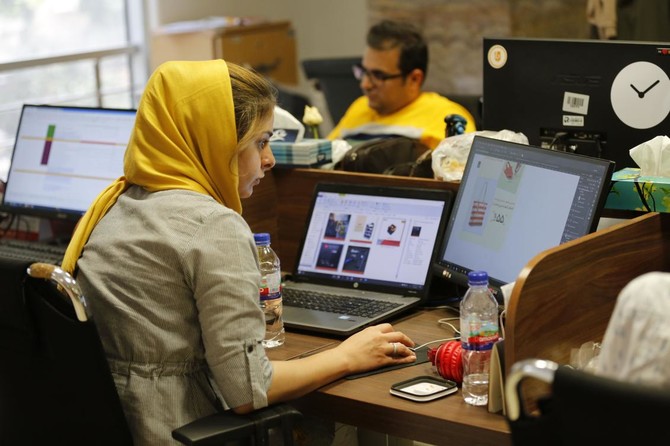
This file photo taken on July 09, 2017 shows Bamilo employees working at the e-commerce site's offices in the Iranian capital Tehran. Iranians have been joined by a minister in protest after Apple removed popular apps from its store, which the American company says has been done to comply with US sanctions. (AFP)
Updated 26 August 2017
Follow

Iranians up in arms as Apple removes top apps

TEHRAN: Iranians have been joined by a minister in protest after Apple removed popular apps from its store, which the American company says has been done to comply with US sanctions.
“Today, respecting consumers’ rights is a basic principle which Apple has not followed,” Information and Communication Technology Minister Mohammad Javad Azari Jahromi tweeted, promising to “legally pursue” the case.
“IT should be used for making human life better and comfortable not a tool for discrimination between countries,” he wrote.
The hashtag #StopRemovingIranianApps has been trending on Iranian social media in the past few days, after Apple removed at least 10 of the country’s most popular apps from its online store.
Those now missing include Amazon-style shopping apps Digikala and Bamilo, ride-hailing apps Snapp and Tap30, discount store Takhfifan and a brunch delivery service called Delion.
“We are unable to include your app on the App Store,” a message sent to some of those companies reportedly said.
“Under the US sanctions regulations, the App Store cannot host, distribute, or do business with apps or developers connected to certain US embargoed countries.”
The US lifted some sanctions on Iran, particularly in the aviation sector, under a 2015 nuclear deal that saw Tehran limit its atomic program.
But American individuals and companies are still barred from doing any business with Iranians because of much older and non-nuclear related sanctions on the Islamic republic.
“There are removed apps which did not have financial transactions, and due to sanctions, some of them were registered in countries other than Iran too,” the minister, Azari Jahromi, said on Twitter.
Some Iranian apps in the same category of the removed ones are still available on the app store.
Iran’s youthful and well-connected population own some 40 million smart phones, six million of them iPhones, the government-owned Iran Daily newspaper reported.
“Apple has not provided any clear answers to our messages,” the daily on Saturday quoted Mehdi Taghizadeh, vice chairman at Delion, as saying.
More than 4,500 Iranian netizens have signed an online petition urging Apple chief executive Tim Cook “to recognize our rights as Apple customers.”
“I’ve always been an Apple user, but despite preferring them... I’m now going to switch to Android,” a user going by the name Xerexes wrote on Twitter.
“Technology is best when it brings people together. We shouldn’t limit or keep others from using and developing it!” tweeted Ferial Govashiri, who used to work as a personal assistant to former US president Barack Obama but is now at Netflix.
Owners of devices that run on Android can still download Iranian apps from the online store for Google, also an American company, but they are still unable to use paid apps in the country.


Israeli police raid Christmas party in Haifa, arrest Palestinian man dressed as Santa

A person dressed as Santa Claus sells toys to people ahead of Christmas in Bethlehem, in the Israeli-occupied West Bank.
Updated 5 sec ago
Follow

Israeli police raid Christmas party in Haifa, arrest Palestinian man dressed as Santa

  • ‘Excessive force’ used in raid, says rights group for Palestinian citizens of Israel
  • Gaza marks first post-ceasefire Christmas as occupied West Bank faces holiday crackdown

LONDON: Police in Israel last week arrested a Palestinian man dressed as Santa Claus at a Christmas celebration in Haifa, The Guardian reported.

The Christmas event was closed on Sunday, after Israeli officers stormed the area and confiscated equipment, the Mossawa Center, a rights group for Palestinian citizens of Israel, said.

The Palestinian Santa Claus performer was arrested, as well as a DJ and street vendor.

In a video circulating on social media, police can be seen forcing the men to the ground and handcuffing them, as crowds of bystanders watch on.

The Palestinian man dressed as Santa Claus resisted arrest and assaulted an officer, Israeli police said in a statement.

But the police used excessive force during the raid, which was conducted without legal authority on the music hall venue, Mossawa said.

Palestinians across the occupied West Bank and Gaza are celebrating Christmas this week despite Israel’s imposition of restrictions on daily life there.

Celebrations for Dec. 25 were held in Bethlehem for the first time since the beginning of the war on Gaza.

Marching bands blew bagpipes in processions through the streets in the city of Jesus’ birth.

Churchgoers attended mass there at the Church of the Nativity and Palestinian children sang carols as the city hosted major celebrations.

Gaza’s small Christian community marked its first Christmas in the war-torn enclave since the signing of a fragile ceasefire between Israel and Hamas.

Amid the rubble strewn across Gaza, Christmas trees glitter brought sections of color to the territory, The Guardian reported.

Israel continued military operations and settler attacks took place despite the holiday.

In the town of Turmus Ayya outside Ramallah, Israeli settlers uprooted olive trees belonging to Palestinians, and near Hebron soldiers stormed the homes of residents and confiscated vehicles, according to the Palestinian news agency, WAFA.

Israel is carrying out mounting attacks against Christian sites in the occupied Palestinian territories.

A report in March documented 32 attacks on church properties and 45 assaults against Christians.

Pope Leo XIV, in his first Christmas address as pontiff, drew attention to the abysmal humanitarian situation in Gaza.

Hundreds of thousands of Palestinians there are living in tents amid fierce cold and rain, just as Jesus had been born in a stable, with God “pitching his fragile tent” among the peoples of the world, Leo said.

He added: “How, then, can we not think of the tents in Gaza, exposed for weeks to rain, wind and cold.”

The pope highlighted the plight of “the defenseless populations, tried by so many wars.”