JAKARTA: There is a huge demand from Indonesians to perform Hajj, since they form the largest Muslim population in the world, but to be able to go on one is not an easy matter. Most of those who want to go have to endure tedious years of waiting, and much also depends on where they live.
Residents in Bantaeng, a regency in Southeast Sulawesi, have to wait the longest — until 2050. Western Southeast Maluku regency has the shortest wait, with 57 people on the list to depart in 2020.
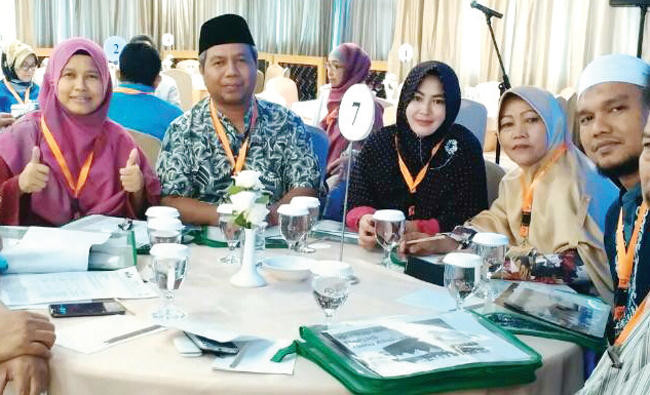
But some have been lucky enough to be able to go this year. Slamet Widodo, 54, a school principal from Semarang, Central Java, departed for Hajj on August 16 after he was selected as a member of the Semarang pilgrims’ regional observers’ team.
“I had to participate in a selection process from May to June, until it was confirmed that I was selected and would be able to go on Hajj,” he told Arab News.
Widodo applied as an observer last year and had already passed the selection process, but his place on the team was canceled at the last minute. “Maybe it was God’s way of showing that it was not yet my time to go on Hajj,” he said, and he found it a blessing in disguise because his school was selected to receive a government grant, and as the headmaster, he had to sign the agreement. “It happened during the Hajj season. If I had gone, my school would not have received the grant.”
Taufan Erikson Sjukri also found a blessing in the disguise of his delayed departure in 2015. Along with his siblings and sister-in-law, he registered to go on Hajj in 2012. He was told that he was on a three-year waiting list, and when the Hajj quota for Indonesia was reduced by 20 percent in 2013 from 211,000 to 168,800 because of renovations at the holy sites, he had to wait even longer.
Taufan found out that he was cleared to go this year; he also found that his older brother and sister-in-law, as well as an older sister, were all scheduled to go by the end of August.
“Maybe it was our luck to get postponed so that we could go together now. If it had been on schedule, we would have gone on Hajj separately,” Taufan told Arab News.
In January, President Joko Widodo announced that the government of Saudi Arabia has reinstated the quota back to normal for this year’s Hajj season.
“In addition to reinstating the quota back to 211,000, the government of Saudi Arabia has agreed to Indonesia’s request for additional quota and decided to add another 10,000. Therefore, the Hajj quota for Indonesia in 2017 increased from 168,800 to 221,000. That means Indonesia had a quota increase of 52,200,” the president said when he announced the news at the presidential palace on Jan. 11.
Despite the good news, it did not deter people from looking for shortcuts to go on Hajj sooner than if they were to wait by registering through the government.
On August 9, immigration officials at Sultan Hasanuddin Airport in Makassar, Southeast Sulawesi, stopped a group of 40 individuals aiming to go on Hajj using pilgrimage visas as they were embarking to Singapore but bound for Makkah.
“After questioning each one of them, it was confirmed that they were going to Saudi Arabia, but taking the unusual route via Singapore and Colombo, from where they would blend in as if they had departed for Makkah as part of the pilgrim group from Colombo,” immigration office spokesman Agung Sampurno told Arab News.
Sampurno said they were victims of a bogus travel agent who offered them an alternative way to reach Saudi Arabia so they could perform Hajj without having to queue in for decades in the country.
“We were suspicious because we know the Kingdom doesn’t issue any other type of visa except for the Hajj visa during the Hajj season. This is a common modus people would take during this season,” Sampurno said, and the government has established that there are at least 9,000 Indonesians who reached Saudi Arabia using similar means and will be deported after Eid.
Sampurno said the case was similar to last year when 177 Indonesians were detained by Philippines authorities for posing as Filipinos and using fake Philippine passports to go on Hajj using the Philippines’ unused quota.
“Except that this time they don’t use fake passports, they just tried to blend in as if they were part of the Colombo delegation,” Sampurno said.


![]()
Increased Hajj quota comes as relief for Indonesians despite mammoth waiting list
Increased Hajj quota comes as relief for Indonesians despite mammoth waiting list

Latest updates


© 2026 SAUDI RESEARCH & PUBLISHING COMPANY, All Rights Reserved And subject to Terms of Use Agreement.