Merkel attacks Turkey’s “misuse” of Interpol warrants

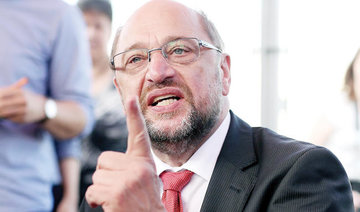
German Chancellor Angela Merkel addresses an election campaign rally of the Christian Democratic Union (CDU) in Steinhude, western Germany, in this August 18, 2017 photo. (AFP)
Updated 21 August 2017
Follow

Merkel attacks Turkey’s “misuse” of Interpol warrants

BERLIN: German Chancellor Angela Merkel criticized Turkey’s use of an Interpol arrest warrant to detain a German writer in Spain, telling an election town hall event on Sunday that this amounted to abuse of the international police agency.
Dogan Akhanli was stopped in Spain on Saturday after Ankara issued a “red notice.” The German-Turkish writer was released on Sunday but must remain in Madrid while Spain assesses Turkey’s extradition request.
“It is not right and I’m very glad that Spain has now released him,” Merkel said. “We must not misuse international organizations like Interpol for such purposes.”
Relations between Turkey and the European Union have been under growing strain since last year’s failed military coup in Turkey. European-Turkish nationals are among the 50,000 people detained since then in what critics condemn as an indiscriminate crackdown by President Recep Tayyip Erdogan.
Merkel has been more muted in her criticism of Erdogan than other German politicians, with critics charging her with being beholden to Erdogan because of Turkey’s role as a buffer against a renewed flood of Syrian war refugees arriving in Europe.
“(Dogan’s) is one of many cases, unfortunately,” Merkel said, in a sharpening of her tone toward Ankara. “That’s why we have massively changed our Turkish policy recently ... because it’s quite unacceptable that Erdogan does this.”
On Saturday Erdogan urged Turks in Germany to “teach a lesson” to Germany’s “anti-Turkish” mainstream parties in next month’s parliamentary election, despite German Foreign Minister Sigmar Gabriel’s warning he should keep out of German politics.
“Who are you to talk to the president of Turkey? Talk to Turkey’s foreign minister. Know your place,” Erdogan said at a rally for his AK Party in the southwestern province of Denizli.
European countries with large Turkish diasporas have grown increasingly uneasy at what they see as Ankara’s attempts to use ethnic Turkish populations to influence domestic politics.
“President Erdogan is trying to instrumentalize ethnic Turkish communities, especially in German and Austria,” Austrian Foreign Minister Sebastian Kurz told Die Welt newspaper. “He polarizes and brings Turkish conflicts into the EU.”
The final days before elections in the Netherlands this year were overshadowed by violent protests by local affiliates of Erdogan’s party. German security officials have expressed concern about a possible repetition in Germany.
Interpol did not immediately respond to a request for comment on Merkel’s remarks.


Four cops killed as separatist militants launch ‘coordinated’ attacks in Pakistan’s southwest — police

Updated 6 sec ago
Follow

Four cops killed as separatist militants launch ‘coordinated’ attacks in Pakistan’s southwest — police

  • The attacks began in Balochistan’s capital of Quetta at around 6am with a powerful explosion, followed by intense gunfire

QUETTA: Separatist militants, affiliated with the Balochistan Liberation Army (BLA), have launched “coordinated” attacks in several cities of Pakistan’s southwestern Balochistan province and killed at least four policemen, officials said early Saturday.

The attacks in the provincial capital of Quetta began at around 6am with a powerful explosion, followed by intense gunfire that lasted for two hours along with multiple explosions.

Residents of Dalbandin and Nuhski said they heard explosions and gunfire in the districts early Saturday morning, while there were reports of similar attacks in Mastung, Gwadar, Pasni and Turbat.

A senior police official, who requested anonymity, told Arab News that the militants attempted to enter the provincial capital of Quetta but police and other law enforcement agencies stopped them.

“The terrorists attacked a police mobile at Sariab road which resulted in the killing of two policemen,” he said. “Police and other law enforcement agencies denied space to the terrorists in Quetta city and a clearance operation is still going on.”

Balochistan, which borders Iran and Afghanistan, is the site of a decades-long insurgency waged by Baloch separatist groups who often attack security forces and foreigners, and kidnap government officials.

Shahid Rind, the Balochistan chief minister’s aide for media and political affairs, said police and paramilitary Frontier Corps (FC) had foiled the attacks and were chasing the assailants.

“After the killing of more than 70 terrorists at different places in Balochistan in the last two days, terrorists have attempted to attack at a few places in Balochistan, which have been foiled by timely action by the police and FC,” he said on X.

“At present, the pursuit of the fleeing terrorists is underway. More details will be revealed very soon.”

In a statement issued on Saturday, BLA said the group had launched ‘Operation Herof 2.0,’ which included a series of attacks in multiple cities of Balochistan.

Saturday’s attacks follow coordinated attacks carried out by the group in Aug. 2024 in various districts of Balochistan which killed dozens of people.

The separatists accuse the central government of stealing the region’s resources to fund development elsewhere in the country. The Pakistani government denies the allegations and says it is working for the uplift of local communities in Balochistan.

Pakistan Railways has suspended train service from Balochistan to other parts of the country for a day, following Saturday’s attacks.

“Quetta-Peshawar bound Jaffar Express, and Quetta-Chaman passenger trains have been canceled due to the prevailing security situation in Balochistan,” Muhammad Kashif, the railways controller in Quetta division, told Arab News.

At least four police officials in as many districts confirmed to AFP the situation was not completely under control yet.
“At least four policemen were killed in Quetta alone,” he added, speaking on condition of anonymity as he was not authorized to speak to the media.
A senior military official based in Islamabad confirmed the attacks, adding they were “coordinated but poorly executed.”