Trump special regulatory adviser resigned ahead of negative magazine story

1 / 2
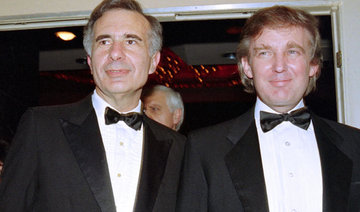
This file photo taken on March 13, 1990 shows investor Donald Trump (R) with Carl Icahn, chairman of Trans World Airlines, before presenting Icahn with the Starlight Foundation "Man of the Year" award in New York. Icahn has stepped down as special regulatory adviser to US President Donald Trump. (AFP / Maria R. Bastone)
2 / 2
Billionaire investor Carl Icahn. (AP Photo/Mark Lennihan, File)
Updated 20 August 2017
Follow

Trump special regulatory adviser resigned ahead of negative magazine story

WASHINGTON: Billionaire investor Carl Icahn, who resigned Friday from an unpaid post as President Donald Trump’s adviser on deregulation efforts, stepped down as The New Yorker was preparing to publish a lengthy article detailing Icahn’s potential conflicts of interest and questioning the legality of his actions.
Icahn said in a letter to Trump released Friday that he would resign to prevent “partisan bickering” about his role that Democrats suggested could benefit him financially.
The resignation came just three days before The New Yorker was scheduled to post its story online and begin selling printed magazines on newsstands. In the story, the magazine points out potential conflicts and even possible criminal law violations involving obscure rules that require oil refineries to blend ethanol into gasoline.
In his letter, Icahn wrote that he “never had access to nonpublic information or profited from my position, nor do I believe that my role presented conflicts of interest.”
But The New Yorker wrote that in 2012, Icahn, who made his name and fortune as a corporate raider, bought an 82 percent stake in CVR Energy, a Sugar Land, Texas, refinery. To comply with regulations designed to promote use of ethanol, refiners must blend the renewable fuel with their gasoline or buy credits from other refiners that are called “Renewable Identification Numbers.”
When Icahn bought his stake in CVR in 2012, the credits were cheap, about 5 cents each, so rather than equip refineries to add ethanol to its gas, the company just purchased credits. But by 2016 CVR was spending $200 million per year to buy them, and its stock value had dropped 70 percent from the prior year, the story said.
Icahn unsuccessfully tried to get the Obama administration’s Environmental Protection Agency to change the point at which the ethanol blending was required, making it closer to the gas pump so refiners weren’t responsible and CVR wouldn’t have to buy the credits, the magazine wrote.
Several weeks after Trump’s November victory, Icahn agreed to become special adviser to the president on regulatory reform, and CVR’s stock nearly doubled in value on the expectation that the renewable fuels rule would be changed, the magazine wrote.
On Dec. 22, the day after Icahn was formally declared a White House adviser, the price of the credits dropped. Then, on Feb. 27, news leaked that Icahn had struck a deal with the Renewable Fuels Association to change the ethanol blending requirement. That sent the price of credits down more, and it fell further when word leaked that an executive order on ethanol blending was imminent.
Previously the Renewable Fuels Association had opposed any changes, the magazine said. The association’s head later said he was told by Icahn that the blending point would be changed whether the association objected or not, so he agreed to take a deal to his board.
Early in the year, CVR actually was selling renewable fuel credits, the magazine wrote. It was able to buy them later at a discount to meet federal requirements, according to the story.
A day after news of the deal with the Renewable Fuels Association, the White House denied there was any plan to change the renewable fuel requirements, and no such change was made, according to the magazine.
Icahn’s attorney, Jesse Lynn, rejected allegations that Icahn exploited his relationship with Trump to make bets on the renewable fuel credits. He said the CVR board, which Icahn chairs, made decisions on when buy or sell credits. “Any suggestion that we had access to information that others didn’t is unequivocally false,” he told the magazine.
Richard Painter, a former chief White House ethics lawyer to President George W. Bush, told the magazine that a federal law makes it illegal for executive-branch employees to work on matters in which they have a financial interest. Lynn said the law doesn’t apply to Icahn because he had no official role or duty. But Painter said Icahn’s title was clearly an official one. He suggested the Justice Department should be investigating.
Painter, reached Saturday by The Associated Press, said Icahn faces potential legal exposure to insider trading laws as well as other fraud statutes “if he took information from the White House or government in violation of any relationship or trust.”
Despite being unpaid, his job title as adviser to the president exposes him to possible legal action, Painter said. “When you have a title like that, that’s ‘to the president,’ it’s very hard to argue that you’re not a government employee,” Painter said.
Efforts by The Associated Press to reach Icahn through a CVR spokeswoman Saturday were not successful.


Over 3k flights cancelled across the Middle East after attack on Iran by the US, Israel

Updated 01 March 2026
Follow

Over 3k flights cancelled across the Middle East after attack on Iran by the US, Israel

RIYADH: US and Israeli strikes on Iran led to widespread airspace shutdowns in the Middle East, canceling and rerouting thousands of flights and paralyzing key international travel corridors.

Flight cancellations affected seven airports across the Middle East, including Dubai and Abu Dhabi in the UAE, Doha in Qatar, and Manama in Bahrain.

Emirates Airlines said in a statement: “Due to multiple regional airspace closures, Emirates has temporarily suspended all operations to and from Dubai, up until 1500 hrs UAE time on Monday, 2 March.”

A flydubai spokesperson said the situation is evolving, and the airline is closely monitoring developments while coordinating with authorities to adjust its flight schedule.

“Our teams are working diligently to implement comprehensive welfare for all affected customers. The safety of our passengers and crew remains our highest priority,” the spokesperson said.

He added: “We are currently experiencing a high volume of calls and appreciate our customers’ patience while our teams work to assist everyone as quickly as possible.”

Qatar Airways announced that the airport will remain closed until at least the morning of March 2.

“Qatar Airways flights to, and from, Doha have been temporarily suspended due to the closure of Qatari airspace,” the airline said.

It added: “Qatar Airways will resume operations once the Qatar Civil Aviation Authority announces the safe reopening of Qatari airspace.”

Saudia also said in an official statement that it had canceled a number of flights due to developments in the region and the closure of airspace.

The organization said the decision was taken in line with aviation safety and security standards, noting that its Emergency Coordination Center is closely monitoring developments with relevant authorities.

Saudia urged passengers to verify the status of their flights before heading to the airport and said guests would be notified of updates through the contact details associated with their bookings.

The carrier added that further information would be announced in a subsequent statement if available.

Air Arabia also said its flights were experiencing cancellations, delays, or rerouting as a result of the evolving situation and airspace closures.

Airlines cited airspace closures and safety concerns as the main reasons for flight disruptions, urging passengers to check official channels for updates as the situation develops.

Israeli airspace also remained closed on March 1st. Israeli airline El Al said it was preparing a recovery effort to bring home Israelis stranded abroad once the airspace reopened.

Travelers were either stranded or diverted to other airports on Feb. 28 after Israel, Qatar, Syria, and Iran as well as Iraq, Kuwait and Bahrain, closed their airspace.

After the UAE announced a temporary partial airspace closure, FlightRadar24 recorded no flights over the country.

The closures affected key hub airports in Dubai, Abu Dhabi, and Doha. Emirates, Qatar Airways, and Etihad, airlines that operate from these hubs, normally handle around 90,000 passengers daily, with even more traveling to other Middle Eastern destinations, according to aviation analytics firm Cirium.

Airports hit by attacks

Two airports in the UAE reported incidents as the government there condemned what it called a “blatant attack involving Iranian ballistic missiles” on Feb.28.

Dubai International Airport, the UAE’s largest and one of the world’s busiest, reported four injuries, while Abu Dhabi’s Zayed International Airport said a drone attack killed one person and injured seven others. Strikes were also reported at Kuwait International Airport.

Though Iran did not publicly claim responsibility, the scope of retaliatory strikes that Gulf nations attributed to Iran extended beyond the US bases that it previously said it would target.

Flight delays, cancellations are likely to continue

“For travelers, there’s no way to sugarcoat this,” said Henry Harteveldt, an airline industry analyst and president of Atmosphere Research Group.

“You should prepare for delays or cancellations for the next few days as these attacks evolve and hopefully end,” he added.

To avoid conflict zones, airlines are rerouting Middle East flights over Saudi Arabia, adding hours and fuel costs, which could push ticket prices higher if the tensions persist.

The extra flights will strain air traffic controllers in the Kingdom, who may need to slow traffic for safety. Meanwhile, countries that closed their airspace will lose out on overflight fees from passing airlines.

Mike McCormick, former head of air traffic control at the FAA and now a professor at Embry-Riddle Aeronautical University, said some countries may reopen parts of their airspace in the coming days once US and Israeli officials provide airlines with details on military flight zones and Iran’s missile capabilities.

“Those countries then will be able to go through and say, ok, we can reopen this portion of our space but we’ll keep this portion of our airspace closed,” McCormick said.

“So, I think what we’ll see in the next 24 to 36 hours is how the use of airspace evolves as the kinetic activity gets more well-defined and as the capability of Iran to actually shoot missiles and create additional risk is diminished due to the attacks,” he added.

But it is unclear how long the disruption to flight operations could last. For comparison, the Israeli and US attack on Iran in June 2025 lasted 12 days.