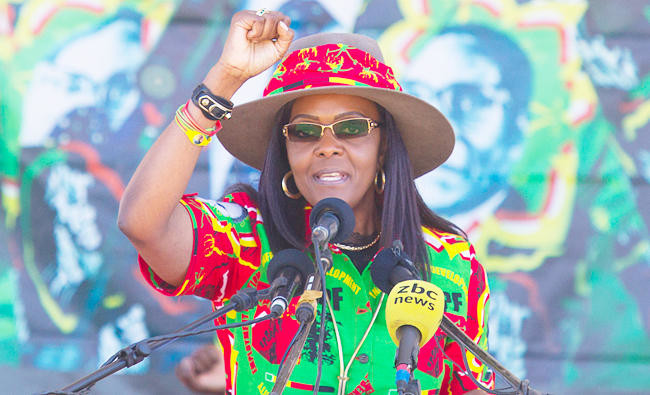
JOHANNESBURG: South Africa has granted diplomatic immunity to Zimbabwe’s first lady, Grace Mugabe, allowing her to return to Harare and avoid prosecution for the alleged assault of a 20-year-old model, a security source said on Friday.
South African police had put border posts on “red alert” to prevent Mugabe fleeing and indicated she would receive no special treatment in the case involving Gabriella Engels, who says Mugabe whipped her with an electric extension cable.
A security source, however, said immunity had been granted. The source also said Grace Mugabe had failed to turn up at a Johannesburg court hearing on Tuesday, as agreed with police, because of concerns she could be attacked.
The alleged assault — Engels said it occurred on Sunday evening as she waited with two friends in a luxury Johannesburg hotel suite to meet one of Mugabe’s adult sons — is a diplomatic nightmare for South Africa.
The country has a difficult relationship with its northern neighbor. It is home to an estimated three million Zimbabwean exiles who regard President Robert Mugabe as a dictator who has ruined what was once one of Africa’s most promising democracies.
But although he is also widely reviled in the West, Mugabe is still seen by many Africans as the continent’s elder statesman and a hero of its anti-colonial struggles.
A senior government source said on Friday there was “no way” Grace Mugabe, 52, would be arrested because of the diplomatic fallout that would ensue from Zimbabwe.
Indeed, the 93-year old president himself arrived two days early in Pretoria for a regional southern African summit this week to help resolve his wife’s legal problems.
The government source accepted the view widely held by legal experts that Grace Mugabe was not entitled to immunity because she was in South Africa for medical treatment, and said the government was expecting her immunity to be challenged in court.
However, the source said Pretoria justified its decision because of other countries in southern Africa that supported South Africa’s ruling ANC in the long struggle against apartheid would also see Grace Mugabe’s prosecution as a betrayal.
“There would obviously be implications for our relations with Zimbabwe. Sadly the other countries in the region are watching us and how we are going to act,” the source said, asking not to be named.
“What is likely to happen is that she will be allowed to go back home, and then we announce that we’ve granted diplomatic immunity and wait for somebody to challenge us.”
South Africa’s foreign ministry spokesman declined to comment when contacted by Reuters.
“DISGRACE“
Engels’ mother Debbie, who released photographs of her daughter with gashes to her head requiring 14 stitches, said it would be “very sad” if Grace Mugabe was allowed to leave.
However, her daughter’s legal team — which includes Gerrie Nel, the prosecutor who secured a murder conviction against Olympic and Paralympic track star Oscar Pistorius — would counter such a move, she said.
“Gerrie Nel and the team have contingency plans,” she told Reuters, without elaborating. “They will run with it.”
Afriforum, an Afrikaans rights group that Nel joined in January after quitting as a state prosecutor, said it would be illegal for Pretoria to give Mugabe immunity and branded the plans a “disgrace.”
“The government has two responsibilities: one, to protect its own citizens and two, to act according to the law. And the granting of diplomatic immunity would transgress the law,” chief executive Kallie Kriel said.
Harare has made no official comment on the saga and requests for comment from Zimbabwean government officials have gone unanswered. The South African government has restricted all official comment to the police ministry.
The Engels incident is not the first time Grace Mugabe — who is lauded in official Zimbabwean media as “Mother of the Nation” — has been in legal hot water.
In 2009, a newspaper photographer in Hong Kong said Grace and her bodyguard had assaulted him. Police said the incident was reported but no charges were brought.

South Africa has granted Grace Mugabe diplomatic immunity — source
Bangladesh police say student leader’s killers fled to India
DHAKA: Bangladesh police on Sunday said the alleged killers of popular student leader Sharif Osman Hadi had fled to India, in comments likely to further strain relations with its neighbor.
Hadi, a vocal India critic who took part in last year’s mass uprising, was shot by masked assailants in Dhaka earlier this month and later succumbed to his injuries at a hospital in Singapore.
His death set off violent protests with angry mobs torching several buildings, including two major newspapers deemed to favor India as well as a prominent cultural institution.
With protests being held across the country almost daily, pressure has been growing on Bangladesh’s interim government to arrest the killers of Hadi, who was set to contest general elections in February next year.
“The killing was premeditated. Those behind it have been identified,” SN Nazrul Islam, a senior Dhaka Metropolitan Police officer, said at a news conference.
Suspects Faisal Karim Masud and Alamgir Sheikh left Bangladesh through the Haluaghat border with India shortly after attacking Hadi on December 12, Islam said.
They were received at the border by two Indian citizens, who escorted them into the northeastern state of Meghalaya before handing them over to two accomplices.
Bangladeshi investigators were in contact with their Indian counterparts who had arrested the two suspected accomplices, Islam said.
“We are communicating with Meghalaya police, who have confirmed the arrest of two Indian nationals,” he added.
Two senior Meghalaya police officers however did not comment when contacted by AFP.
The Indian foreign ministry had earlier said it rejects “false narratives” about New Delhi’s involvement in Hadi’s killing.
Ties between the neighbors have deteriorated since ousted prime minister Sheikh Hasina fled the pro-democracy uprising and sought refuge in India.
India says it is still considering Dhaka’s requests to extradite Hasina, who was sentenced to death in absentia for orchestrating a deadly crackdown on the uprising.
The lynching of a Hindu garment worker by a mob on December 18 has also hit ties.
Amid the deteriorating security situation in the Muslim-majority country, Khuda Baksh Chowdhury, special assistant to interim leader Muhammad Yunus overseeing the home department, stepped down on Wednesday.
Hadi, a vocal India critic who took part in last year’s mass uprising, was shot by masked assailants in Dhaka earlier this month and later succumbed to his injuries at a hospital in Singapore.
His death set off violent protests with angry mobs torching several buildings, including two major newspapers deemed to favor India as well as a prominent cultural institution.
With protests being held across the country almost daily, pressure has been growing on Bangladesh’s interim government to arrest the killers of Hadi, who was set to contest general elections in February next year.
“The killing was premeditated. Those behind it have been identified,” SN Nazrul Islam, a senior Dhaka Metropolitan Police officer, said at a news conference.
Suspects Faisal Karim Masud and Alamgir Sheikh left Bangladesh through the Haluaghat border with India shortly after attacking Hadi on December 12, Islam said.
They were received at the border by two Indian citizens, who escorted them into the northeastern state of Meghalaya before handing them over to two accomplices.
Bangladeshi investigators were in contact with their Indian counterparts who had arrested the two suspected accomplices, Islam said.
“We are communicating with Meghalaya police, who have confirmed the arrest of two Indian nationals,” he added.
Two senior Meghalaya police officers however did not comment when contacted by AFP.
The Indian foreign ministry had earlier said it rejects “false narratives” about New Delhi’s involvement in Hadi’s killing.
Ties between the neighbors have deteriorated since ousted prime minister Sheikh Hasina fled the pro-democracy uprising and sought refuge in India.
India says it is still considering Dhaka’s requests to extradite Hasina, who was sentenced to death in absentia for orchestrating a deadly crackdown on the uprising.
The lynching of a Hindu garment worker by a mob on December 18 has also hit ties.
Amid the deteriorating security situation in the Muslim-majority country, Khuda Baksh Chowdhury, special assistant to interim leader Muhammad Yunus overseeing the home department, stepped down on Wednesday.
© 2025 SAUDI RESEARCH & PUBLISHING COMPANY, All Rights Reserved And subject to Terms of Use Agreement.